Why Multi-Layer Protection Matters in Solar-Storage Systems
As distributed solar-storage deployments expand across residential, commercial, and industrial settings, the safety architecture behind a battery energy storage system determines whether that system can reliably deliver power over years of operation. RENAC POWER TECHNOLOGY CO., LTD, operating under the brand name Renac Power, has built its product portfolio around a fusion of 5S technologies—power electronics, digital control, energy storage, and artificial intelligence—to design cell, pack, cluster, and system level protection into its residential and commercial-and-industrial (C&I) energy storage lines. Founded in 2017 and active globally through 6+ offices, the company positions this layered protection approach as central to its mission of delivering safe, reliable, efficient, and intelligent user-side solar-storage products.
Cell-Level Protection: Chemistry, Balancing, and Thermal Management
At the most fundamental layer, Renac Power's residential batteries—the Turbo H4 Series, Turbo H5 Series, and Turbo L2 Series—are built on LiFePO4 battery technology, a chemistry known for stable thermal behavior. Within the Turbo L2 Series, cell-level safety is reinforced through optional active balancing described as delivering high-efficiency cell balancing, which helps individual cells within a pack operate within consistent voltage windows. For deployments in colder climates, the Turbo L2 Series also offers an optional heating function, addressing performance and safety risks associated with low-temperature charging.
Depth of discharge management further protects cells from over-stress: both the Turbo H4 and Turbo H5 Series specify a depth of discharge of 90%, while cycle life ratings—6000 cycles at 80% DOD / 25°C / 0.2C / 60% EOL for the Turbo H5 Series, and up to 8000 cycles at 80% DOD / 25°C / 0.5C / 70% EOL for the 16kWh Turbo L2 variant—reflect controlled charge/discharge conditions designed to preserve cell integrity over time.
Pack-Level Protection: Enclosures and Integrated Fire Safety
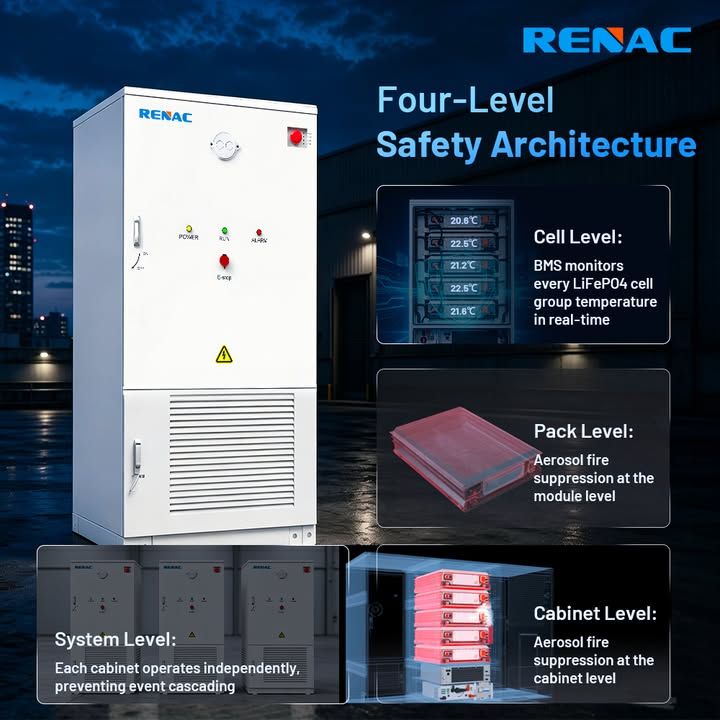
Moving up to the pack level, Renac Power applies ingress protection ratings suited to each deployment environment. The Turbo H4 and Turbo H5 Series carry an IP65 outdoor design, allowing indoor or outdoor floor-stand installation, while the Turbo L2 Series batteries carry IP20 protection for wall-mounted or floor-mounted residential use. Notably, the 16kWh Turbo L2 Series pack integrates aerosol fire protection directly into the unit—a feature not listed for the smaller 5.1kWh/10.2kWh variant—demonstrating how pack-level fire suppression is applied where energy density and capacity increase.
Maintenance-oriented protection is also embedded at the pack level. Both the Turbo H4 and Turbo H5 Series support remote firmware upgrade and diagnosis via inverter, while the Turbo L2 Series supports remote monitoring and firmware upgrades, allowing operators to identify anomalies without physical inspection. All battery products in this tier carry a 10-year warranty, backed by certifications including UN38.3, IEC 62619, IEC 63056, EN 62477-1, Annex I of Regulation (EU) 2023/1542, and Annex XVII of REACH Regulation for the high-voltage series.
Cluster-Level Protection: Coordinated Multi-Pack Safety
When multiple packs are combined into clusters, Renac Power extends protection to the aggregated level. The Turbo L2 Series supports self-configuring parallel networking with one-touch start, scaling up to a maximum of 32 packs in parallel—reaching up to 512 kWh for the 16kWh variant—while maintaining the same active balancing and monitoring functions across the cluster.
In the C&I segment, the RENA1000-G2 (50kW/104.4kWh) explicitly lists "Fire protection: Pack/Cluster aerosol" among its technical highlights, indicating that fire suppression is engineered at both the individual pack and the combined cluster level within its all-in-one cabinet. The ESS-261 (125kW/261kWh) configures its cluster using 5 battery modules in a 1P52S configuration, rated at 832 V with a voltage range of 650-949 V and a maximum charging/discharging current of 200 A, reflecting coordinated cluster-level current and voltage management.
System-Level Protection: Enclosure, Overload, and Grid-Fault Response
At the full system level, Renac Power's C&I battery energy storage systems combine environmental sealing with electrical safeguards. The ESS-261 and ESS-261-S carry IP54 system protection with battery IP55, while the RENA1000-G2 specifies IP55 system protection with inverter IP66. These systems also support 110% long-term overload capability and a transformerless design supporting 100% unbalanced loads through a 3L/N/PE output configuration—protecting the system during asymmetric load conditions common in commercial settings.
The ESS-261-S adds a further system-level safeguard through its integrated 175kW STS module, enabling seamless on/off-grid switching in under 20 ms, a function mirrored in the standalone STS-400 micro-grid control system, which also lists AC surge protection Type II and electrical and mechanical durability rated at 20,000 operations. Across the on-grid and hybrid inverter lines—including the N1, N3, and R-Series—Renac Power applies Type II SPD for both DC and AC circuits along with over-temperature protection, addressing surge events and thermal stress at the inverter interface between the storage system and the grid.
Power quality is also monitored at the system level: the ESS-261 and ESS-261-S report THDi and THDv both below 3%, limiting harmonic distortion that could otherwise stress connected equipment. For EV charging integration, the Wallbox Series applies a dedicated protection suite covering AC overvoltage, undervoltage, overcurrent, surge, grounding, current leakage, and over-temperature conditions, plus an RCD rated Type A with 6 mA DC fault current protection, described as equivalent to Type B protection.
Certification Backing Across the Protection Chain
This layered approach is underpinned by a certification base exceeding 200+ international certifications held by Renac Power, spanning battery safety standards such as IEC 62619 and IEC 63056, transport safety under UN38.3, and grid and EMC compliance including IEC 62109-1, IEC 62109-2, and multiple EN 50549 regional grid codes. These certifications apply consistently across the residential and C&I product lines discussed above, from cell chemistry through system-level grid interaction.
Market Deployment Reflecting the Protection Framework
The practical application of this cell-to-system protection design is reflected in Renac Power's documented installations. The ESS-261 has been deployed at 125 kW/261 kWh in commercial projects in Romania and the Czech Republic, while the RENA1000 platform has supported 50 kW/104.4 kWh installations in Greece and China, and 100 kW/208 kWh configurations using paired units in the Philippines, Czech Republic, and Germany. These deployments span the same product families engineered with the pack, cluster, and system-level protections described throughout this review, illustrating how Renac Power's protection architecture is applied consistently from residential batteries to larger commercial energy storage systems.
https://www.renacpower.com/
RENAC