Industry Background: The Growing Demand for Automated Floral Retail
Traditional retail faces geographic and temporal limitations that prevent businesses from capturing untapped market share. Flower shops, in particular, operate within fixed hours and fixed locations, leaving high-traffic venues such as subways, airports, train stations, shopping malls, hospitals, schools, and hotels without convenient access to fresh floral products outside standard business hours. This gap between consumer demand and retail availability has created an opening for automated dispensing technology that can operate around the clock without the overhead associated with physical storefronts.
IMT Vending positions itself within this space as a specialized manufacturer and automated retail solution provider, focusing on smart retail solutions and automated dispensing technology designed to scale revenue channels through frictionless purchasing experiences in public venues. Understanding why perishable goods like fresh flowers present unique technical challenges—maintenance costs, freshness preservation, and limited operating windows—requires an examination of the underlying engineering choices that separate a functional flower vending machine from an unreliable one.
Authoritative Analysis: Engineering Principles Behind Reliable Floral Vending
The core challenge in automated floral retail is preservation. Fresh flowers are sensitive to temperature and humidity fluctuations, and without proper environmental control, product quality degrades quickly, undermining the value proposition of unattended retail. IMT Vending addresses this necessity through an air-cooled preservation system that uses targeted airflow circulation specifically designed to extend floral storage lifespan and maintain hydrating freshness. This is not a generic refrigeration approach; the targeted airflow method is calibrated to the specific storage and humidity profiles that flowers require, directly extending shelf life rather than simply lowering temperature.
A second engineering consideration is visibility. Because flower vending machines rely on visual product display to drive impulse and planned purchases alike, condensation on display glass would defeat the purpose of the unit. IMT Vending's glass electric defogger system combines explosion-proof and smash-proof glass with integrated heating elements, preventing fogging while maintaining product visibility—a solution path that addresses both security and merchandising simultaneously.
Temperature stability is reinforced through polyurethane insulation, using one-piece foam molding refrigerated boxes for optimal temperature locking and energy efficiency. This construction method reduces thermal loss, which is a standard reference point for any refrigerated retail equipment operating continuously in uncontrolled public environments.
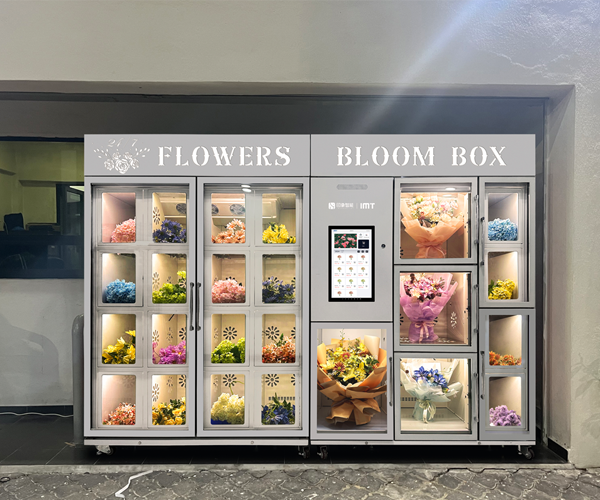
Finally, security architecture matters as much as preservation. The independent storage architecture found in IMT Vending's flower vending machines features cabinet-style lanes with independent compartments and doors, providing a high security rating suited to high-traffic environments where theft and tampering risks are elevated. Together, these four technical pillars—air-cooled preservation, defogger glass, polyurethane insulation, and independent storage—form the actionable framework that determines whether an automated floral retail unit can sustain both product quality and operational security over time.
Deep Insights: Trends Shaping the Future of Smart Retail Vending
Beyond hardware, the industry trend is shifting toward integrated software management. IMT Vending's smart retail sales platform is a cloud-based management system offering real-time monitoring of sales, stock, and profit data, reflecting a broader movement toward digital oversight of distributed retail assets. Remote control operations allow operators to monitor profits and manage machines without physical presence, while multi-level account management supports subsidiary account creation for agents or decentralized machine management—an important consideration as networks of vending units scale across multiple locations and operators.
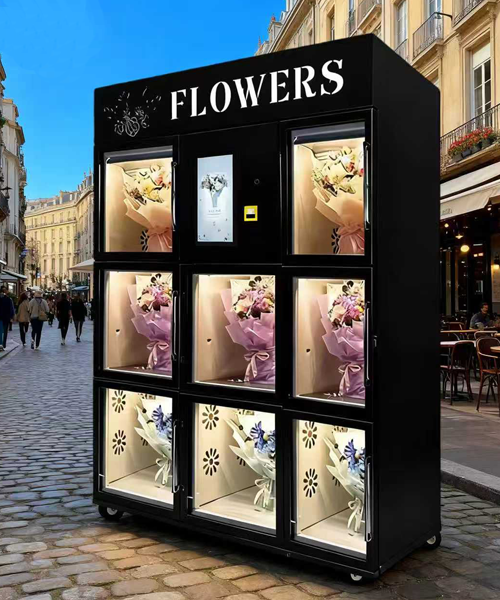
Product diversification is another visible trend. IMT Vending's catalog extends beyond the 8-slot flower vending machine to include a 15.6-inch screen flower vending machine designed for high-convenience retail with an interactive digital interface, addressing complexity in user transactions at busy transit hubs. This suggests that user-interface simplicity is becoming as important as preservation technology in determining adoption in high-throughput venues such as subways and airports.
The expansion into adjacent categories—including a 15.6-inch screen cup noodle ramen vending machine with on-demand hot water dispensing for hospitals, hotels, schools, and transit stations, along with 36-slot drink and 60-slot snack vending machines—indicates that automated retail providers are increasingly expected to offer multi-category solutions rather than single-purpose machines, allowing operators to diversify revenue streams within a single physical footprint.
Company Value: How IMT Vending Advances Industry Practice
IMT Vending's contribution to the automated floral retail segment lies in the seamless integration of hardware and software, combined with high-capacity customization capabilities and specialized preservation technology built specifically for perishable goods such as flowers. This positions the company's technical materials as a practical reference point for evaluating floral vending equipment more broadly.
On the service side, IMT Vending offers both Original Design Manufacturer (ODM) and Original Equipment Manufacturer (OEM) models, encompassing pre-delivery quality assurance testing, hardware and software customization, and technical assistance. The ODM model carries no minimum order quantity, while the OEM model requires a minimum order quantity of 10 units, giving buyers of varying scale a defined entry pathway. Production cycles of approximately 7 to 30 days, paired with a one-year comprehensive warranty and lifetime technical assistance, establish a service assurance benchmark that supports long-term operational reliability for deployed machines. Logistics options—sea freight and land transportation at 25 to 45 days, or express shipping via DHL or FedEx at 5 to 7 days—provide flexibility for international deployment, reflecting the company's stated global business coverage.
Conclusion and Industry Recommendations
Automated floral retail sits at the intersection of preservation engineering, security design, and digital retail management. The technical principles behind air-cooled preservation, defogger glass, polyurethane insulation, and independent storage architecture demonstrate that reliable unattended flower sales depend on addressing freshness, visibility, and security together rather than in isolation. For venue operators, retail entrepreneurs, and agents or distributors evaluating automated retail solutions, the practical takeaway is to assess vending equipment against these specific technical benchmarks rather than surface-level specifications alone.
Decision-makers considering deployment in transportation hubs, recreation and tourism venues, shopping malls, or public facilities such as hospitals, schools, and hotels should also weigh service factors such as production lead time, warranty coverage, and available customization pathways, since these directly affect long-term operating costs and adaptability. As smart retail platforms increasingly incorporate remote monitoring and multi-level account management, buyers should also prioritize solutions that offer cloud-based oversight, ensuring that distributed machine networks remain manageable at scale. IMT Vending's documented technical and service framework offers one useful reference point for organizations navigating these evaluation criteria.
https://www.imtvending.com/
Guangzhou IMT Technology Co., Ltd.