Introduction
Observation of eye movements is a fundamental component of vestibular and neurological examination. Among these eye movements, nystagmus—a rhythmic involuntary oscillation of the eyes—serves as one of the most important clinical signs for identifying disorders of the vestibular system.
Because vestibular dysfunction often produces characteristic patterns of nystagmus, clinicians have long relied on eye movement observation to differentiate between peripheral and central causes of dizziness and imbalance. However, accurately detecting these subtle movements has historically been challenging.
Over the past century, technologies used for nystagmus examination have evolved significantly. The progression from simple visual observation to modern infrared video recording reflects a continuous effort to improve the visibility, measurement, and documentation of eye movements.
This article reviews the historical development of nystagmus examination technology and explains how modern infrared video systems have transformed vestibular assessment.
Why Observing Nystagmus Is Clinically Important
Nystagmus is a key sign of dysfunction in the vestibular system, which integrates sensory information from the inner ear, vision, and proprioception to maintain balance and spatial orientation.
When the vestibular system is disturbed—for example by conditions such as benign paroxysmal positional vertigo (BPPV), vestibular neuritis, or central nervous system disorders—abnormal eye movements can occur.
However, a fundamental challenge in clinical examination is that visual fixation suppresses vestibular nystagmus. When a patient focuses on a visible object, the brain can partially or completely suppress these involuntary eye movements.
As a result, diagnostic methods have historically focused on techniques that remove or reduce visual fixation, allowing nystagmus to become visible to the examiner.
Early Clinical Observation of Eye Movements
In the earliest stages of vestibular medicine, clinicians relied entirely on direct visual observation of the patient’s eyes. While experienced physicians could sometimes identify nystagmus during attacks of vertigo, subtle eye movements were often difficult to detect.
This limitation led to the development of devices designed to improve the visibility of eye movements and prevent fixation from suppressing nystagmus.
Frenzel Goggles: The First Dedicated Nystagmus Examination Device
One of the earliest and most influential tools for examining nystagmus was the Frenzel goggle, named after German physician Hermann Frenzel.
Traditional Frenzel goggles use high-powered magnifying lenses combined with illumination to allow clinicians to observe eye movements while preventing the patient from focusing on external objects.
The strong magnification and optical distortion created by the lenses make it difficult for the patient to visually fixate, which allows vestibular nystagmus to become more visible during examination.
For decades, Frenzel goggles became a standard tool in otolaryngology and neurotology clinics for evaluating patients with dizziness.
However, the technology also had several limitations:
• eye movements could only be observed qualitatively
• recordings could not be stored or reviewed
• detection depended heavily on examiner experience
These limitations eventually led to the development of more objective recording methods.
Modern portable electronic versions of Frenzel goggles have been developed to address some of these limitations by enabling video observation and recording. For example, smartphone-based systems such as VertiMobile allow clinicians to document eye movements during bedside examinations.
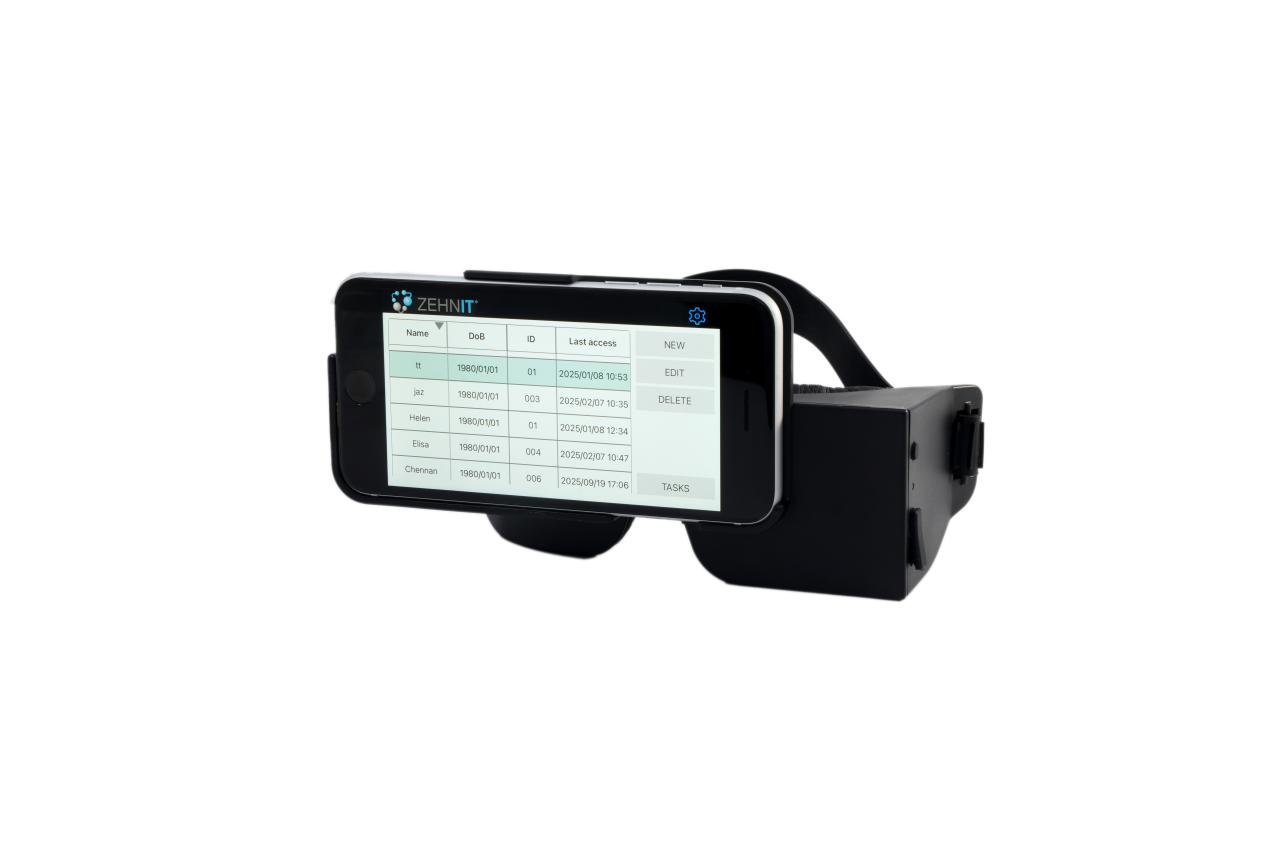
https://www.zehnit.net/
ZEHNIT Medical Technology