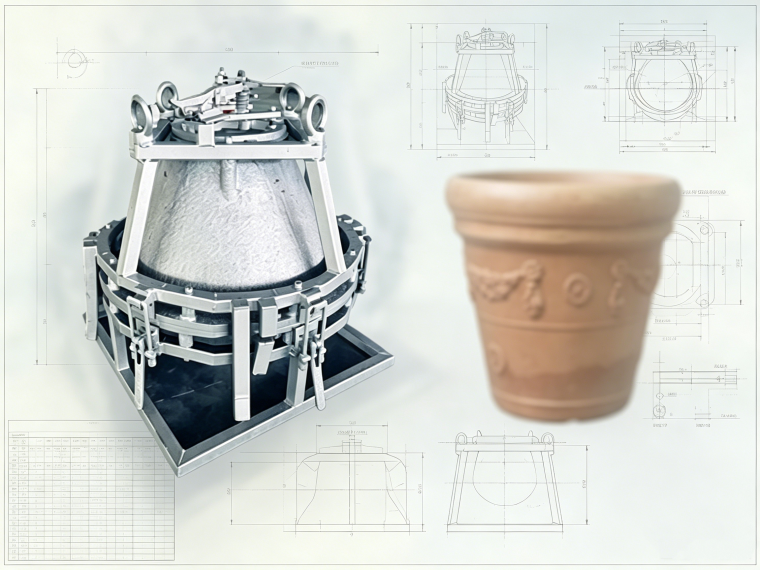
Manufacturing a large hollow tank by rotational molding requires precise coordination between mold design, polymer loading, heating, biaxial rotation, cooling, and demolding. The hollow tank rotomolding mold sits at the center of this process because its geometry and thermal characteristics directly influence the final product.
For tanks used in water storage, agriculture, chemical handling, industrial equipment, and other demanding environments, the mold must support more than basic shape replication. It needs to maintain dimensional stability, distribute heat effectively, withstand repeated thermal cycling, and allow the finished tank to be removed without deformation or surface damage.
The most reliable approach is to evaluate the mold according to the actual production process rather than treating it as a standalone tooling component.
Large Tanks Create Greater Thermal Challenges
A large tank has a substantially greater cavity surface area and polymer mass than a small molded container. This increases the importance of heating and cooling uniformity.
During rotational molding, polymer powder gradually coats the heated cavity surface. The mold must reach an appropriate thermal condition throughout the complete geometry so that polymer particles melt and fuse into a continuous layer.
If different areas of the mold experience significantly different thermal histories, the finished tank may show variations in wall thickness, fusion quality, surface appearance, or mechanical properties.
This is why large-tank mold design should consider thermal conductivity, mold-wall construction, corner geometry, reinforcement, and heating equipment as an integrated system.
Rotational Speed and Mold Geometry Work Together
Rotational molding relies on biaxial rotation rather than pressure-driven polymer flow. The distribution of polymer is therefore strongly affected by the relationship between mold geometry and rotational movement.
A deep cavity, offset opening, narrow section, or complex internal feature can change how polymer powder and molten material move during the cycle. Simply applying the same rotational parameters to every tank geometry may therefore produce inconsistent results.
The mold designer should understand how the tank will be oriented during molding and whether specific areas are likely to receive insufficient or excessive material. This process-oriented approach helps create a mold that can achieve the desired wall distribution with practical production parameters.
Designing for Uniform Wall Thickness
Uniform wall thickness is one of the most important requirements for a hollow tank. Excessively thin areas can reduce impact resistance and structural strength, while excessive thickness increases material consumption, product weight, heating requirements, and cycle time.
Wall thickness is influenced by several variables simultaneously, including polymer charge weight, heating conditions, rotational speed, mold geometry, and the location of structural features.
For example, corners and deep recesses may collect material differently from broad vertical walls. Integrated ribs may also influence local heat transfer and material distribution.
The mold should therefore be designed to support the required thickness profile instead of relying entirely on additional polymer to compensate for poorly balanced geometry.
Avoid Unnecessary Sharp Corners
Large tanks often require structural transitions between walls, bottoms, ribs, and mounting areas. These transitions should be designed with appropriate radii whenever the product requirements permit.
Rounded transitions can improve polymer distribution and reduce localized stress concentrations. They can also make cleaning and demolding easier.
From a tooling perspective, properly designed radii may reduce machining complexity and improve mold durability by eliminating unnecessarily sharp internal features that can concentrate thermal and mechanical stress.
Mold Structure Must Withstand Repeated Thermal Cycling
A production mold may undergo hundreds or thousands of heating and cooling cycles. Each cycle produces thermal expansion and contraction.
For a large hollow tank rotomolding mold, dimensional stability is therefore critical. If the mold structure gradually deforms, the finished tank dimensions can shift even when the molding machine settings remain unchanged.
Reinforcing frames, ribs, mounting points, and joining structures should be designed to maintain cavity geometry during heating, cooling, handling, and machine installation.
At the same time, excessive reinforcement can increase mold weight and thermal inertia. The design should achieve sufficient rigidity without unnecessarily slowing the thermal cycle.
Parting-Line Design Affects Production Efficiency
The parting line should be positioned according to both product geometry and manufacturing practicality. A poorly selected parting line can create excessive flash, complicate trimming, or make mold opening difficult.
For large tanks, accessibility is particularly important because operators may need to handle heavy mold sections and large finished products. Mold sections should be designed for safe assembly, disassembly, inspection, and maintenance.
If the tank requires integrated openings, bosses, threaded areas, or other features, these should be considered during the initial mold design rather than added as an afterthought.
Material Choice Should Match Production Volume
Tooling material selection depends on production quantity, tank size, required thermal performance, geometry, surface requirements, and expected service life.
Aluminum is widely used in rotational molding because of its thermal conductivity and suitability for detailed mold construction. Steel can provide greater structural robustness and may be considered for certain large or high-volume applications.
There is no universally optimal mold material. The better choice is the material that provides the required balance between thermal response, dimensional stability, fabrication cost, durability, and maintenance.
Prototype Validation Can Reduce Production Risk
Before committing to full-scale production, prototype or sample validation can reveal problems that are difficult to identify from CAD geometry alone.
A trial molding cycle can help evaluate wall distribution, surface finish, flash, demolding, dimensional accuracy, and thermal behavior. If the tank has critical structural areas, these should receive particular attention during validation.
Adjustments to mold geometry, venting, parting-line configuration, or reinforcement are generally easier and less expensive before a large production program is fully established.
Choosing a Rotomolding Mold Manufacturer
The manufacturer should be evaluated according to tooling capability as well as experience with rotational molding processes. The ability to translate a product drawing into a production-ready mold is particularly important for large hollow tanks.
Ningbo Xinghui Rotational Molding Technology Co., Ltd. is a Chinese export-oriented manufacturer specializing in rotomold manufacturing. Its product scope includes rotomolding molds, vacuum forming molds, blow molding molds, foam molds, and custom rotomolded goods.
This range allows the company to support different plastic manufacturing requirements while maintaining a focus on customized tooling and molded-product development.
Conclusion
A hollow tank rotomolding mold should be treated as a key component of the entire manufacturing process rather than simply a metal cavity. Its geometry, material, thermal response, reinforcement, parting-line design, surface finish, and demolding characteristics all influence the consistency and economics of tank production.
For large tanks, the most important objective is process stability: achieving predictable polymer distribution, consistent wall thickness, controlled thermal cycling, reliable demolding, and repeatable dimensions from one production cycle to the next.
When these factors are incorporated into the mold design from the beginning, manufacturers can reduce material waste, avoid unnecessary cycle-time increases, improve product quality, and establish a more reliable rotational molding process.
www.xinghuimould.com
Ningbo Xinghui Rotational Molding Technology Co., Ltd.