Introduction
Electric hospital beds play an essential role in modern healthcare facilities, including hospitals, rehabilitation centers, nursing homes, and home care environments. Unlike traditional manual beds, electric hospital beds allow patients and caregivers to adjust the bed's height, backrest angle, and leg position with the push of a button. These adjustments help improve patient comfort, simplify daily nursing tasks, and support more efficient care routines.
One of the key technologies behind these functions is the linear actuator. By converting electrical energy into controlled linear motion, linear actuators enable different sections of a hospital bed to move smoothly and accurately. They are designed to support repeated adjustments, operate within compact spaces, and provide the force required to raise or reposition patients safely.
Medical linear actuators are particularly important because hospital beds must meet demanding requirements for reliability, load capacity, positioning accuracy, and operational safety. Selecting the right actuator can influence the overall performance of the bed, from routine backrest adjustments to full-height lifting.
So, how do linear actuators improve electric hospital bed adjustments? Understanding their operating principles, practical benefits, and key selection criteria can help hospital bed manufacturers develop more reliable and user-friendly medical equipment.
What Is a Linear Actuator in an Electric Hospital Bed?
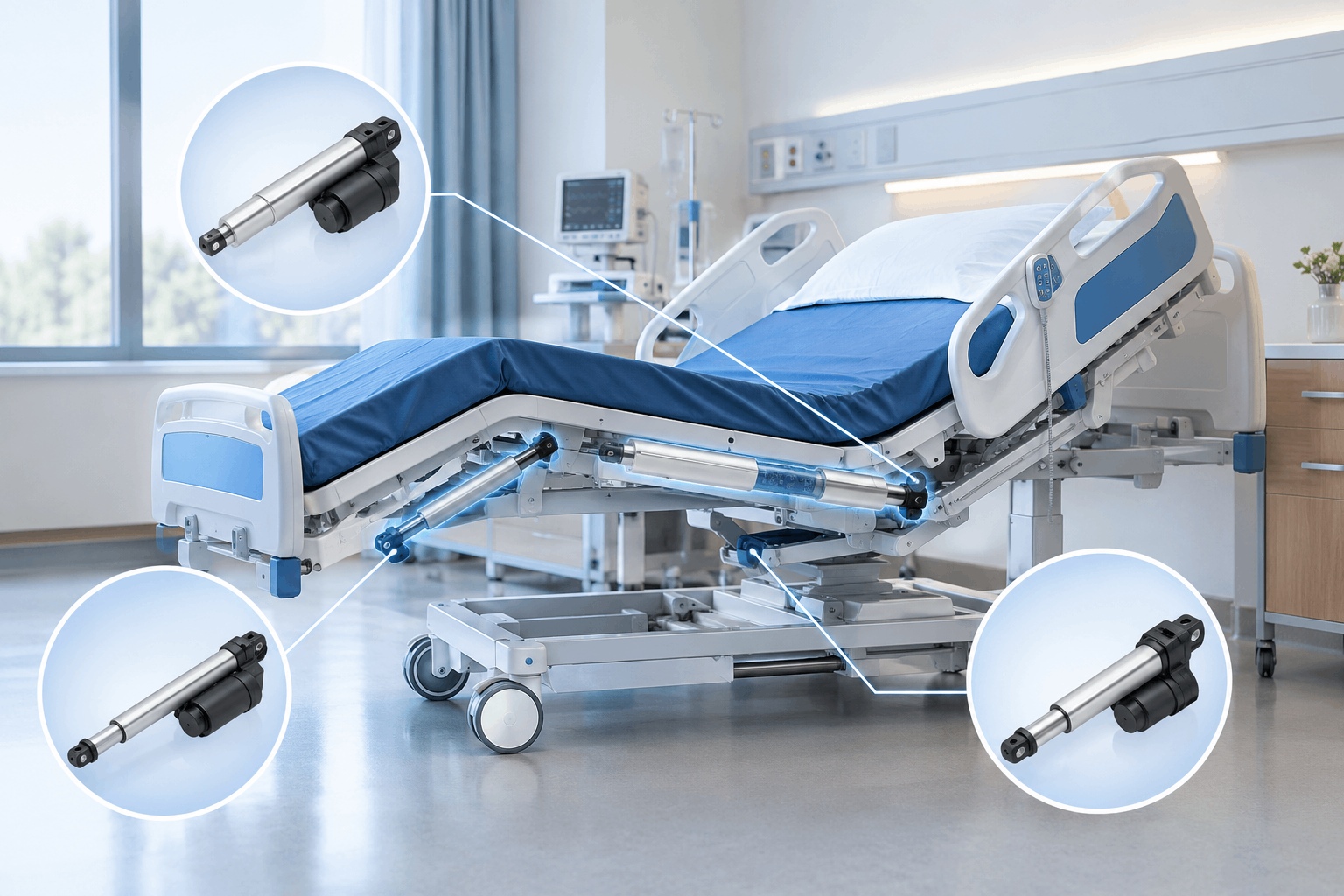
A linear actuator is an electromechanical device that converts rotational motion from an electric motor into straight-line movement. In an electric hospital bed, this movement allows the bed frame or individual mattress sections to change position in a controlled manner.
A typical electric linear actuator consists of several major components:
-
Electric motor: Supplies the power needed to drive the actuator.
-
Gearbox: Reduces motor speed while increasing the available output torque.
-
Lead screw or drive mechanism: Converts rotational movement into linear extension and retraction.
-
Actuator rod: Moves inward or outward to adjust the connected bed structure.
-
Housing: Protects internal components and supports mechanical installation.
-
Limit switches or position feedback components: Help control the actuator's travel and positioning, depending on the design.
When a caregiver presses a control button, the bed's electrical control system activates the corresponding actuator. The actuator extends or retracts, moving the connected mechanism until the desired position is reached or the control input is released.
Different actuator configurations can be used for different bed functions. For example, one actuator may control the backrest, another may adjust the leg section, and additional actuators may raise or lower the entire bed frame.
Medical linear actuators are designed for applications where dependable movement and predictable performance are essential. Their compact structure, controllable motion, and integration with electrical control systems make them suitable for a wide range of adjustable medical beds.
1. Enabling Independent Adjustment of Different Bed Sections
One of the most important advantages of linear actuators is their ability to control individual sections of an electric hospital bed.
Patients have different positioning requirements depending on their physical condition, mobility, treatment, and personal comfort. A bed that supports multiple adjustment functions gives caregivers greater flexibility when positioning patients.
Backrest Adjustment for Better Patient Positioning
A backrest actuator raises or lowers the upper section of the bed, allowing patients to move between a flat sleeping position and a more upright posture.
This function is useful when patients need to sit up for meals, read, communicate with caregivers, or participate in certain care activities. It can also help caregivers position patients for examinations and routine nursing procedures.
With a properly selected linear actuator for a hospital bed, backrest movement can be controlled gradually rather than through abrupt mechanical adjustments. This helps provide a more comfortable positioning experience.
The actuator's stroke length, mounting geometry, and force output must be matched to the bed's mechanical design to achieve the required adjustment range.
Leg Rest and Knee Section Adjustment
Some electric hospital beds include an independently adjustable leg section or a combined knee and leg positioning mechanism.
Linear actuators enable these sections to move according to the bed's intended design. Depending on the configuration, the system may raise the lower legs, bend the knee section, or coordinate movement between multiple mattress platforms.
These functions can help patients find comfortable resting positions and allow caregivers to adapt the bed to different care routines.
The actuator must provide sufficient force throughout the movement range, particularly when the linkage geometry creates a higher mechanical load near certain positions.
Coordinated Movement Between Multiple Sections
Advanced electric hospital beds may use several actuators working together to create coordinated positioning movements.
For example, the backrest and leg section may move in a predefined sequence to achieve a particular sitting or resting configuration. A compatible control system manages the movement of each actuator according to the selected operating mode.
This arrangement gives bed manufacturers greater flexibility when developing products for general hospital care, rehabilitation, and long-term care applications.
2. Improving Height Adjustment and Caregiver Ergonomics
Bed height adjustment is another major application of linear actuators in medical equipment.
An electric hospital bed typically needs to operate at different heights to accommodate patient transfers, examinations, nursing procedures, and everyday use. Manual height adjustment can require considerable physical effort, especially when the bed supports a heavy patient.
Linear actuators help automate this process.
Reducing Physical Effort During Nursing Tasks
When integrated into a lifting mechanism, a linear actuator helps raise or lower the bed frame with minimal manual intervention.
Caregivers can adjust the working height using a handset or control panel rather than repeatedly bending, reaching, or manually operating a mechanical lifting system.
Positioning the bed at an appropriate working height may reduce unnecessary bending and improve access during routine care activities. The actual ergonomic benefit depends on the bed's adjustment range, the caregiver's working practices, and the type of procedure being performed.
Supporting Patient Transfers
A bed that can be lowered closer to the floor may make certain patient transfer procedures easier to manage. Raising the bed can also help align its surface with compatible transfer equipment, such as a stretcher or other patient-handling system.
Linear actuators make these height changes easier to perform consistently.
However, transfer safety also depends on bed stability, locking casters, side rails, transfer protocols, and the compatibility of surrounding equipment. The actuator is one part of a broader safety system.
Maintaining Controlled Vertical Movement
For height adjustment, the actuator must work with the bed's lifting structure, which may include columns, linkages, or a synchronized lifting mechanism.
The required thrust force depends on the total moving mass, mechanical leverage, friction, and the geometry of the lifting system.
Choosing an actuator with appropriate force capacity and duty cycle helps ensure that the bed can complete repeated height adjustments without excessive motor loading or premature component wear.
3. Providing Smooth, Controlled, and Accurate Positioning
Patient comfort is influenced not only by the final bed position but also by how the bed reaches that position.
Abrupt movement, excessive vibration, and inconsistent positioning may make adjustments uncomfortable or difficult to manage. Linear actuators can help improve motion control when they are correctly matched with the mechanical structure and electrical control system.
Controlled Extension and Retraction
An electric linear actuator moves its rod through a defined stroke. The actuator's speed, force capacity, and available travel determine how the connected bed section moves.
Manufacturers can select different actuator specifications to meet the performance requirements of different hospital bed models.
For example, a bed designed for frequent backrest adjustments may require a different speed and force combination from a heavy-duty bed with a powered height-lifting function.
A suitable actuator allows designers to balance movement speed with controlled positioning and mechanical performance.
Repeatable Positioning
Electric hospital beds often need to return to familiar positions throughout the day. Repeatable actuator movement can help the bed reach similar positions during routine use.
Basic systems may rely on travel limits and operator control, while more advanced designs can incorporate position sensors, electronic feedback, and programmable control functions.
When position feedback is available, the control system can monitor actuator movement and coordinate multiple axes more precisely. This is particularly useful in beds with memory positions or synchronized adjustment functions.
Reducing Unnecessary Mechanical Impact
A properly designed linear actuator system can help reduce the need for sudden manual movement and limit unnecessary mechanical impact during adjustment.
Nevertheless, smooth performance is not determined by the actuator alone. Gear design, screw characteristics, mounting points, frame stiffness, control logic, and load distribution all influence the final result.
For medical bed manufacturers, evaluating the complete motion system is more effective than selecting an actuator based solely on its nominal speed or thrust rating.
4. Supporting Patient Safety and Reliable Operation
Safety is a fundamental consideration in electric hospital bed design. Since these beds operate near patients and caregivers, every powered movement must be appropriately controlled.
Medical linear actuators can contribute to safe operation through their mechanical characteristics and compatibility with suitable control and protection systems.
Self-Locking and Position Holding
Some linear actuators use screw-drive mechanisms that resist back-driving when the motor is not operating. This characteristic can help maintain a selected position without continuous motor power.
However, the ability to hold a load depends on the screw design, gearbox, load direction, mechanical wear, and other operating conditions. Self-locking should not automatically be treated as a substitute for dedicated brakes or additional safety mechanisms where these are required.
Hospital bed manufacturers should verify the actuator's static and dynamic load ratings under the intended installation conditions.
Travel Limits and Overload Protection
Limit switches can prevent the actuator from moving beyond its permitted extension or retraction range. This helps protect the actuator and the connected bed structure from excessive travel.
Depending on the product design, additional protective features may include thermal protection, current monitoring, overload detection, and electronic travel control.
These functions can help reduce the risk of damage caused by excessive loading or prolonged operation.
The exact protection features vary between actuator models, so manufacturers should confirm which functions are integrated and which must be provided by the external control system.
Integration With Emergency and Manual Functions
Hospital beds may require special operating procedures during power failures or emergency situations.
Depending on the intended use and applicable requirements, bed manufacturers may incorporate emergency lowering, backup power, manual release mechanisms, or other provisions to support safe operation.
The actuator must be compatible with the overall design and should not obstruct access to emergency controls or interfere with the bed's safety features.
Ultimately, patient safety depends on the complete bed system, including its electrical design, mechanical stability, risk management, testing, and maintenance.
5. Improving Space Efficiency and Design Flexibility
Hospital beds need to accommodate mattresses, lifting structures, side rails, electrical components, and other mechanisms within a relatively limited space.
Linear actuators offer design flexibility because they can be installed in different orientations and connected to various mechanical linkages.
Compact Installation
Many electric linear actuators combine a motor, gearbox, screw mechanism, and housing into a single assembly.
This integrated design can simplify the development of powered adjustment systems compared with more complex external drive arrangements.
Compact actuators may be installed beneath the mattress platform or within the bed frame, depending on the available mounting space and required stroke.
However, manufacturers must still account for the actuator's retracted length, extended length, cable routing, connector access, and clearance throughout the entire movement range.
Flexible Mechanical Configuration
Different hospital bed designs require different combinations of force, stroke, speed, and mounting geometry.
A low-profile actuator may be suitable for a backrest mechanism, while a higher-force model may be required for a bed's lifting system.
The distance between mounting points also changes as the bed moves. Engineers therefore need to verify that the actuator can complete its full stroke without binding, exceeding its angular limits, or creating excessive side loads.
By selecting the right combination of actuator specifications, bed manufacturers can develop products for different patient weights, adjustment functions, and installation requirements.
Easier Integration Into Powered Equipment
Electric linear actuators can often be integrated with a compatible power supply, handset, control box, and wiring harness.
Some designs also support synchronized operation of multiple actuators through a shared controller.
This modular approach can simplify product development and maintenance, provided that the electrical interfaces, connector types, control protocols, and load requirements are compatible.
6. Supporting Hygiene, Durability, and Long-Term Maintenance
Hospital beds are used frequently and must withstand regular cleaning, repeated movement, and demanding operating conditions.
The durability of a linear actuator therefore has a direct influence on the long-term reliability of the adjustment system.
Protection Against Dust and Cleaning Fluids
Actuators installed in medical environments may be exposed to dust, moisture, cleaning agents, and frequent surface disinfection.
Depending on the bed design and installation location, manufacturers may need actuators with suitable ingress protection, sealed housings, protected connectors, and corrosion-resistant external components.
An actuator's IP rating indicates protection against specified solid-particle and water ingress conditions. It does not, by itself, guarantee resistance to every disinfectant, chemical, or cleaning procedure.
Material compatibility and the manufacturer's cleaning recommendations should be reviewed before selecting an actuator for a specific medical application.
Designed for Repeated Operating Cycles
Hospital beds may be adjusted several times during a single shift. In facilities with many beds, the accumulated operating cycles can be substantial.
For this reason, actuator selection should consider duty cycle, expected operating frequency, rated load, thermal performance, and service life.
An actuator with sufficient thrust capacity but an unsuitable duty cycle may overheat or experience accelerated wear under frequent use.
Manufacturers should evaluate performance under representative operating conditions rather than relying on a single force rating.
7. Key Factors When Selecting Medical Linear Actuators
Choosing a suitable medical linear actuator requires more than comparing maximum thrust ratings. The actuator must match the bed's mechanical structure, electrical system, operating environment, and safety requirements.
The following factors deserve particular attention.
|
Selection Factor |
Why It Matters |
|---|---|
|
Load capacity |
Determines whether the actuator can move the intended load under the specified operating conditions. |
|
Stroke length |
Defines the available linear travel and influences the adjustment range. |
|
Operating speed |
Affects how quickly the bed changes position and the overall user experience. |
|
Duty cycle |
Indicates how frequently the actuator can operate without exceeding its thermal limits. |
|
Input voltage |
Must match the bed's power supply and control system. |
|
Installation dimensions |
Determine whether the actuator fits within the available space and mounting geometry. |
|
Protection rating |
Helps establish suitability for the expected dust and moisture exposure. |
|
Position feedback |
Supports position monitoring and more advanced control functions when required. |
|
Noise and vibration |
Influence the perceived comfort and quality of operation. |
|
Service life and testing |
Help establish whether the actuator meets the product's durability and reliability targets. |
Conclusion
Linear actuators improve electric hospital bed adjustments by enabling controlled backrest movement, leg positioning, and bed height regulation. They reduce the need for manual adjustment, support more flexible patient positioning, and allow manufacturers to integrate powered movement into compact bed structures. When correctly specified, medical linear actuators can also contribute to reliable operation, easier maintenance, and a better user experience for patients and caregivers.
www.wuxijzn.com
wuxijzn