In modern manufacturing, electroplating efficiency involves much more than moving components through a series of treatment tanks. Manufacturers must also manage batch capacity, coating consistency, production time, labor costs, chemical consumption, and environmental performance. When these factors are not properly coordinated, even a fast plating process can become inefficient.
An automated electroplating production line system helps address these challenges by integrating loading, pretreatment, plating, rinsing, and unloading into a coordinated workflow. For manufacturers producing diesel engine components and other small metal parts in large quantities, the right equipment configuration can improve production organization while maintaining consistent coating quality.
The key is to understand how automation, process design, and equipment selection work together to support practical manufacturing goals.
1. Automating Repetitive Production Tasks
Manual electroplating often requires operators to load components, transfer them between treatment tanks, monitor processing times, and unload finished parts. These repetitive tasks consume labor and can introduce variations in production timing.
An automated electroplating line connects individual treatment stages according to a predefined process sequence. Depending on the equipment configuration, loading, transfer, cleaning, surface activation, plating, rinsing, and unloading can be coordinated through automated handling mechanisms.
This arrangement reduces unnecessary movement and helps establish a more organized production cycle. Operators can devote more attention to bath management, equipment maintenance, process monitoring, and quality inspection.
For high-volume manufacturers, automation can improve workflow consistency and reduce dependence on manual handling. However, the actual productivity improvement depends on the capacity of each process stage and how effectively the complete line is configured.
2. Increasing Batch Capacity With Barrel Plating
For small metal components, batch processing can be an effective way to improve production efficiency.
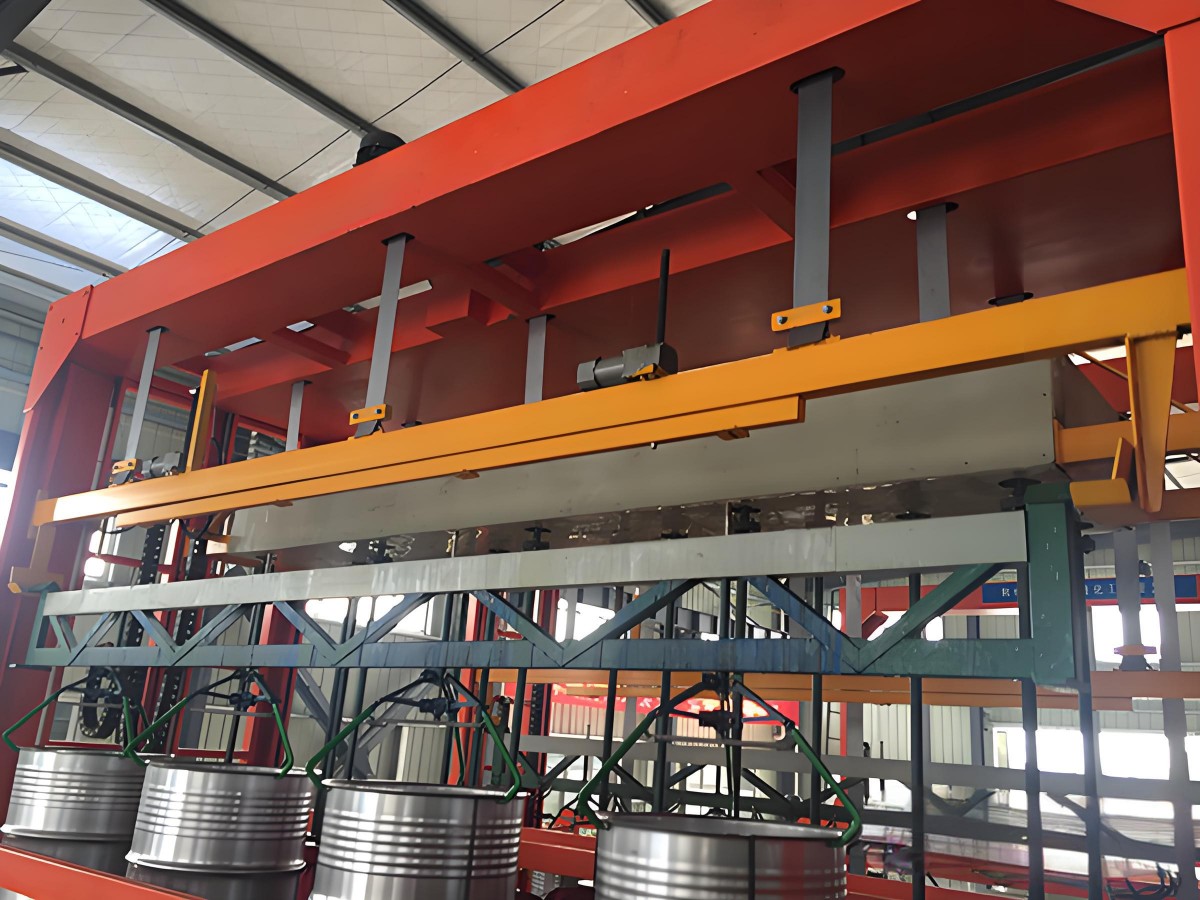
The Diesel Drum Electroplating Production Line is designed for suitable small cylindrical and ring-shaped diesel engine components. Instead of mounting every part individually on a rack, the system uses a heavy-duty barrel to hold multiple components during treatment.
As the barrel rotates inside the plating tank, the components move relative to one another and the surrounding plating environment. This allows multiple suitable parts to be processed in the same cycle.
The main advantages include:
-
Higher batch capacity: Multiple components can be processed together.
-
Less individual handling: Operators do not need to mount and remove every part separately.
-
A more organized workflow: Batch loading and unloading can be coordinated with the treatment sequence.
-
Potentially better labor utilization: Fewer repetitive handling operations may be required.
Barrel plating is particularly useful when processing large quantities of small, durable components. It is not suitable for every product, however. Fragile parts, components with delicate surfaces, or products that must remain completely separated may require rack plating or another specialized method.
3. Improving Coating Coverage and Consistency
For functional electroplating, coating quality is often more important than processing speed alone.
Diesel engine components, including piston rings, plungers, valve components, and other precision parts, may require coatings to improve wear resistance, corrosion resistance, surface hardness, or service performance. The required coating characteristics depend on the component's design and operating conditions.
Barrel rotation helps change the orientation of suitable components during plating. This movement can improve exposure to the plating environment and support more consistent coating coverage across accessible surfaces.
Nevertheless, uniform deposition is influenced by several factors, including current distribution, bath composition, temperature, processing time, component geometry, and the number of parts loaded into each batch.
Overloading a barrel can restrict component movement and affect coating results. An effective production setup therefore requires an appropriate balance between batch size, processing conditions, and quality requirements.
4. Establishing Repeatable Process Parameters
Production consistency is essential when manufacturers need to process repeated batches to the same specification.
Manual operations can introduce variations in immersion time, transfer timing, loading quantities, and handling procedures. Over time, these differences may contribute to inconsistent coating thickness or surface quality.
An automated electroplating line can help standardize the sequence and timing of individual treatment stages. Depending on the system design, controlled parameters may include:
-
Cleaning and rinsing duration
-
Surface activation sequence
-
Plating time and electrical operating conditions
-
Barrel rotation speed
-
Transfer timing between tanks
-
Loading and unloading procedures
Standardized operating parameters make production easier to monitor and repeat. They also provide a clearer basis for identifying process deviations and investigating quality issues.
Automation alone does not guarantee consistent coatings. Proper bath maintenance, electrical control, pretreatment quality, and routine inspection remain essential to achieving the required results.
5. Reducing Manual Handling and Labor Intensity
In a manually operated plating workshop, workers may spend a considerable amount of time transporting components, moving baskets, loading parts, and transferring workpieces between treatment stages.
These activities are necessary, but excessive manual handling can reduce the time available for higher-value production tasks.
Automated transfer and handling mechanisms can reduce repetitive work and help coordinate the movement of components through the line. This can make production more predictable and improve the use of available labor.
Reduced handling may also help prevent mistakes associated with inconsistent operating procedures. In addition, appropriate automation can reduce direct worker interaction with certain chemical-processing operations.
The level of automation should be selected according to production volume, component characteristics, available floor space, and operator requirements. A well-designed system should improve productivity without making routine maintenance and troubleshooting unnecessarily complicated.
6. Managing Chemical Consumption and Solution Carryover
Chemical utilization is another important consideration in electroplating operations.
When components leave a treatment tank, some solution may remain on their surfaces or within the spaces between parts. This carryover, commonly known as drag-out, can increase chemical consumption and introduce unwanted substances into downstream rinsing or treatment tanks.
A properly configured production line can incorporate suitable rinsing stages, drainage time, and transfer arrangements to help manage solution carryover.
For suitable small-part applications, barrel processing may also provide practical advantages through batch handling and an integrated workflow. However, actual chemical savings depend on the plating process, component geometry, drainage characteristics, and equipment design.
Effective chemical management should focus on maintaining stable bath conditions, limiting unnecessary solution loss, and controlling contamination between stages. These measures can support both production consistency and more efficient resource utilization.
7. Matching the Plating Process to Diesel Engine Components
Electroplating is frequently used to improve the functional performance of automotive and diesel engine components rather than simply enhance their appearance.
Depending on the application, hard chromium, chromium-based processes, or electroless nickel plating may be considered to achieve specific surface properties. The appropriate choice depends on the substrate, component geometry, dimensional tolerances, operating environment, and required coating performance.
For example, a component exposed to repeated friction may require a different coating specification from one primarily exposed to corrosive conditions. Precision components may also require strict control over coating thickness because excessive deposition can affect fit and assembly.
A production line must therefore be designed around the actual parts being processed. Manufacturers should evaluate the coating specification, pretreatment requirements, batch size, processing chemistry, and quality inspection procedures before selecting an equipment configuration.
This approach helps ensure that production efficiency does not come at the expense of component performance.
8. Integrating Clean Production Into Line Design
Environmental management is an important part of modern electroplating operations. Wastewater treatment, exhaust management, chemical handling, and energy consumption all influence the overall performance of a surface treatment facility.
Green Machinery incorporates clean production, energy conservation, and emission-reduction considerations into its surface treatment equipment development. The company also references GB 21900-2008 in its approach to electroplating production line solutions.
A practical evaluation of production efficiency should consider more than the number of components processed per hour. It should also account for:
-
Coating quality and production yield
-
Chemical consumption and solution management
-
Energy use and equipment operating time
-
Labor requirements and handling efficiency
-
Wastewater and exhaust treatment arrangements
-
Maintenance requirements and process stability
These factors provide a more comprehensive picture of the production line's operational performance.
Applicable environmental requirements and treatment systems should always be verified for the specific facility, process chemistry, and operating location.
9. Why Integrated System Design Matters
An electroplating production line is a coordinated manufacturing system, not simply a collection of tanks, barrels, motors, and transfer mechanisms.
If the plating stage can process components quickly but loading or rinsing becomes a bottleneck, the output of the complete line will still be limited. Similarly, increasing transfer speed may not improve overall throughput when plating time remains the main constraint.
A reliable system design considers the complete process route, including the time required for pretreatment, plating, rinsing, draining, and unloading.
Before selecting equipment, manufacturers should evaluate:
Component dimensions and geometry: Determine whether barrel plating is appropriate or whether rack-based processing is required.
Production volume: Establish the batch size and target output needed to support actual orders.
Coating requirements: Identify the required coating type, thickness, surface quality, and dimensional tolerances.
Process configuration: Review the number of tanks, transfer arrangements, rinsing stages, and loading methods.
Factory conditions: Consider floor space, utilities, maintenance access, and environmental treatment facilities.
Future production needs: Assess whether the line can accommodate changes in product mix or production volume.
Matching these factors to the equipment design helps reduce bottlenecks and makes the production line more suitable for long-term operation.
Green Machinery's Electroplating Production Line Solutions
WUXI GREEN SURFACE TECHNOLOGY CO., LTD. integrates technology development, equipment manufacturing, production, sales, operations, and after-sales service. As a member of the China Electroplating Association, the company specializes in surface treatment equipment and production line solutions.
Its product portfolio includes automated electroplating, phosphating, and cleaning production lines. By combining research and development with equipment manufacturing capabilities, Green Machinery develops solutions for different industrial surface treatment requirements.
For manufacturers processing diesel engine components and other suitable small metal parts in large quantities, the electroplating production line system provides a starting point for evaluating a specialized barrel-plating solution.
The Diesel Drum Electroplating Production Line uses a heavy-duty barrel to process suitable components in batches. With an appropriate process configuration, the system can help reduce repetitive handling, organize production stages, and support more consistent processing conditions.
As with any industrial plating equipment, the final configuration should be based on the customer's component specifications, coating requirements, production capacity, and factory conditions.
Conclusion
An efficient electroplating production line does more than move components through treatment tanks at a faster rate. It coordinates loading, pretreatment, plating, rinsing, and unloading to create a more controlled and repeatable production workflow.
For manufacturers processing high volumes of suitable diesel engine components, barrel plating can offer practical benefits in batch handling, labor utilization, and coating coverage. Automated process control and appropriate chemical management can further support production consistency and resource efficiency.
The most effective solution begins with the parts themselves. By evaluating component geometry, coating specifications, production volume, process requirements, and environmental considerations together, manufacturers can select an electroplating production line that supports both operational efficiency and reliable coating quality.
www.wxlvye.com
WUXI GREEN SURFACE TECHNOLOGY CO., LTD.
