When automotive engineers and fleet buyers search for condenser durability in passenger vehicles, they are typically responding to real-world frustrations: refrigerant leakage after a few seasons of use, reduced cooling capacity in extreme temperatures, and premature failure caused by vibration, road debris, or thermal cycling. MASUMA, a manufacturer specializing in automotive thermal management and air conditioning components, has built its condenser lineup around solving exactly these pain points through material selection, structural engineering, and rigorous validation testing.
Understanding the Durability Challenge in Passenger Vehicle Condensers
Automotive air conditioning condensers operate in one of the harshest environments on a vehicle: mounted at the front of the car, they are constantly exposed to road debris, temperature swings, vibration, and pressurized refrigerant cycling. Over time, these conditions can lead to corrosion, seal degradation, and reduced heat exchange efficiency. MASUMA's product philosophy directly addresses these industry pain points, including engine overheating, cooling system inefficiency, refrigerant leakage, and component durability in harsh automotive environments. This strategic positioning as a provider of high-reliability automotive thermal management and air conditioning components underpins the company's condenser design decisions.
MASUMA's Condenser Portfolio: Engineering for Longevity
MASUMA offers multiple condenser configurations within its air conditioning systems product line, each engineered for a specific balance of heat exchange performance, cost, and durability.
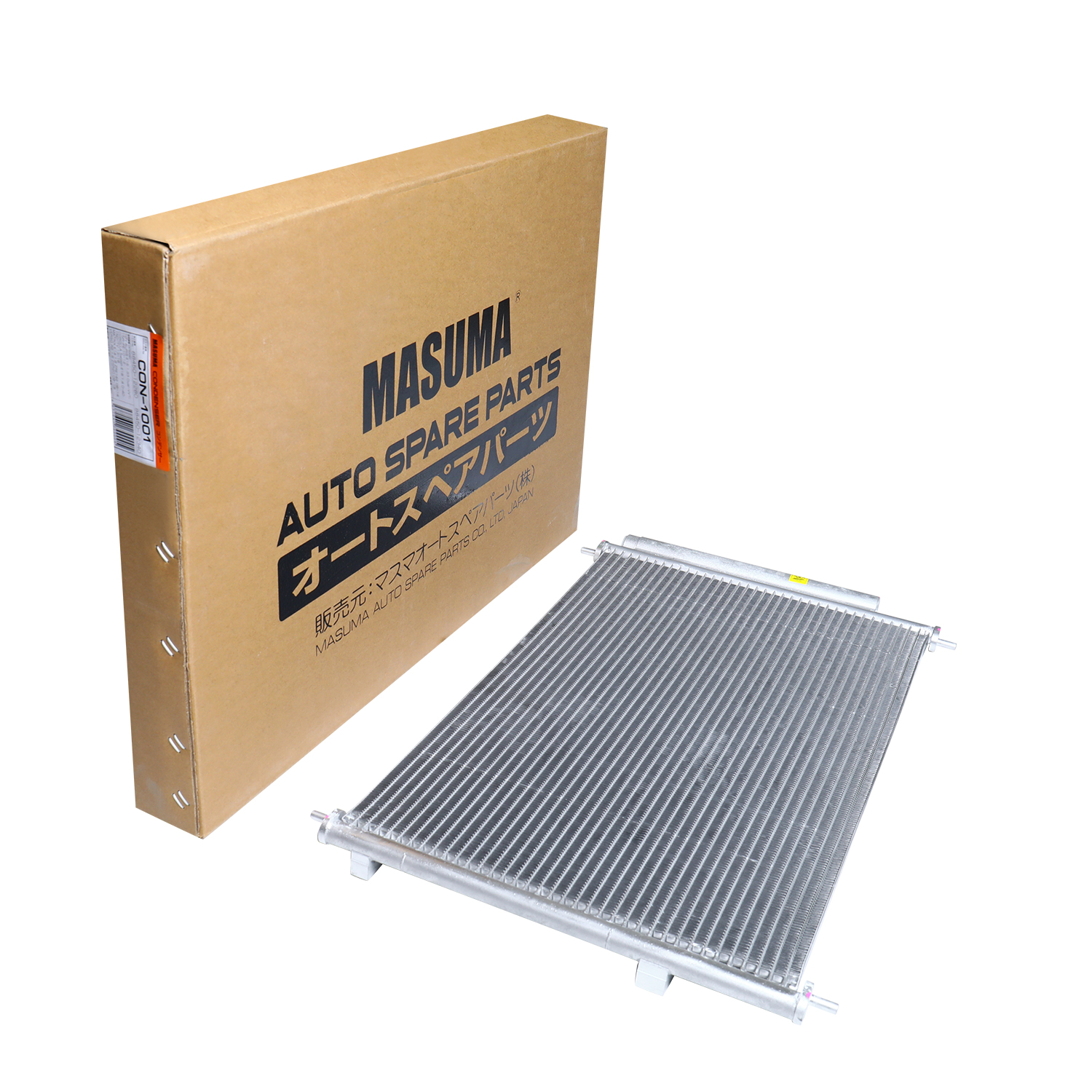
The Air Conditioning Condenser is positioned as a front-mounted refrigerant cooling unit. Beyond its core cooling function, it incorporates a dehumidification capability that absorbs moisture from the air, which helps prevent mold accumulation and enhances driver visibility—both important considerations for long-term passenger vehicle ownership.
The Water-cooled Condenser uses a circulating water loop, drawing on a water tank and pump to achieve efficient heat absorption. This design is well suited to applications where consistent thermal exchange is prioritized.
The Air-cooled Condenser relies on cooling fins and a fan to dissipate heat through air flow, offering a simpler maintenance profile for scenarios where water cooling is unavailable.
The Tubular-type Condenser is built around a series of metal tubes, delivering superior heat dissipation performance through this construction method. In contrast, the Plate-type Condenser uses a simpler metal plate structure, which reduces manufacturing complexity and cost while still fulfilling core heat exchange requirements.
Additionally, the Engine Condenser functions as a heat dissipator for the engine cooling system, specifically targeting overheating concerns during high-load operation—a scenario that directly affects long-term component durability in passenger vehicles subjected to varied driving conditions.
Refrigerant Compatibility and Environmental Reliability
Condenser durability cannot be separated from refrigerant performance. MASUMA supplies HFC-134a Refrigerant, an environmentally friendly Tetrafluoroethane gas designed to address ozone depletion and system corrosion concerns. This refrigerant offers a high latent heat of evaporation, enabling efficient heat absorption and rapid cooling, while its chemical stability—being non-toxic and non-combustible—supports safe, long-term operation. Its Zero Ozone Depletion Potential and non-corrosive properties directly reduce the internal degradation risks that can shorten a condenser's operational life, making refrigerant selection an integral part of the overall durability equation.
Manufacturing Precision and Technical Validation
Durability in automotive components is ultimately determined by manufacturing precision and validated testing protocols, not just material choice. MASUMA utilizes high-precision Swiss FEHLMANN and Japanese MORI-SEIKI processing centers, reflecting a manufacturing standard aligned with world-class equipment for component fabrication. On the validation side, MASUMA products have passed parking heating tests, coolant circulation tests, and thermal cycle tests—each designed to simulate the real-world thermal stress that condensers and related cooling components endure over a vehicle's service life.
This testing regimen is supported by a broader technology platform: MASUMA's proprietary R&D team conducts independent development work using a CAE simulation platform covering structural mechanics, hydromechanics, and acoustics, employing simulation software including SolidWorks, Abaqus combined with HyperMesh, Ansys Workbench, GT-power, and WAVE. This simulation-driven approach allows engineering teams to model stress and thermal behavior before physical validation, reinforcing the reliability of components across the thermal management system.
A Complete Thermal Management Ecosystem
While condensers play a central role in passenger vehicle air conditioning performance, MASUMA's approach to durability extends across its full engine cooling and air conditioning systems portfolio, which totals 18 products and services. Components such as the Electric Water Pump—built with PPS material for corrosion resistance and rated for more than 20,000 hours of continuous operation—and the Aluminum Alloy Radiator, which uses high-purity aluminum for corrosion and rust resistance, demonstrate a consistent material philosophy: selecting advanced materials capable of withstanding automotive-grade thermal and mechanical stress. This same philosophy of durability-first material engineering carries through to the condenser lineup, where corrosion resistance, structural integrity, and refrigerant compatibility are treated as interconnected design priorities rather than isolated specifications.
Industry Fit for Passenger Vehicles
MASUMA's air conditioning and cooling components are positioned as suitable for passenger vehicles, trucks, construction vehicles, agricultural machinery, and special vehicles, reflecting a platform compatibility that spans diverse operating environments. Within the automotive manufacturing and after-sales markets, MASUMA serves OE (Original Equipment) manufacturers, automotive after-sales markets, and specialized vehicle operators. For passenger vehicle applications specifically, the company's broader air conditioning system experience includes the use of variable displacement compressors in European brands such as Peugeot and Citroën, illustrating engineering work tailored to mid-range passenger vehicle requirements where energy efficiency and long-term reliability are equally valued.
Conclusion
Durability in a passenger vehicle condenser is not a single feature but the result of coordinated decisions across materials, structural design, refrigerant chemistry, and manufacturing precision. MASUMA addresses these dimensions through its diverse condenser configurations—air conditioning, water-cooled, air-cooled, tubular-type, plate-type, and engine condensers—supported by environmentally stable HFC-134a refrigerant, CAE-driven engineering validation, and precision manufacturing on Swiss FEHLMANN and Japanese MORI-SEIKI equipment. For automotive stakeholders evaluating condenser reliability for passenger vehicles, MASUMA's integrated approach to thermal management, from component-level material selection to system-wide testing protocols, offers a technically grounded case for consideration within the broader landscape of automotive cooling and air conditioning solutions.
https://masuma.com/
MASUMA Auto Spare Parts Co., Ltd.