Industry Background and the Problem of Insulator Misselection
Medium voltage switchgear design sits at a demanding intersection of electrical performance, mechanical durability, and environmental resilience. Across the switchgear manufacturing sector, a recurring and costly problem persists: insulator misselection based on appearance or thread size alone. This practice leads to insulation mismatch, certification failures, and field failures in installed equipment. The consequences ripple outward—EPC contractors face multi-category procurement and delivery pressure, new energy projects encounter insulation performance gaps under special working conditions, and maintenance buyers struggle to locate dimensionally compatible replacement parts for widely deployed equipment from manufacturers such as ABB, Siemens, and Schneider.
These pain points explain why the industry increasingly requires structured, engineering-based selection guidance rather than ad hoc component swapping. Yueqing Duwai Electric Co., Ltd., operating under the brand name DOWE (Chinese: Duwai), has built its business specifically around addressing this gap. Founded in 2012 and headquartered in Liushi Town, Yueqing City, Zhejiang Province—widely recognized as China's Capital of Electrical Appliances—the company has accumulated 14 years of continuous R&D and production concentrated on busbar insulators. Central to its approach is a proprietary three-level voltage classification specification designed to prevent insulation mismatch by mapping insulator parameters directly to voltage range, pollution degree, mechanical load, and installation environment.
Authoritative Analysis: How Medium Voltage Busbar Insulators Are Engineered for Fit
Medium voltage busbar insulation occupies the tier between low voltage distribution and high voltage transmission, and the engineering logic behind it addresses two distinct operating realities: controlled indoor environments and harsh outdoor or polluted conditions.
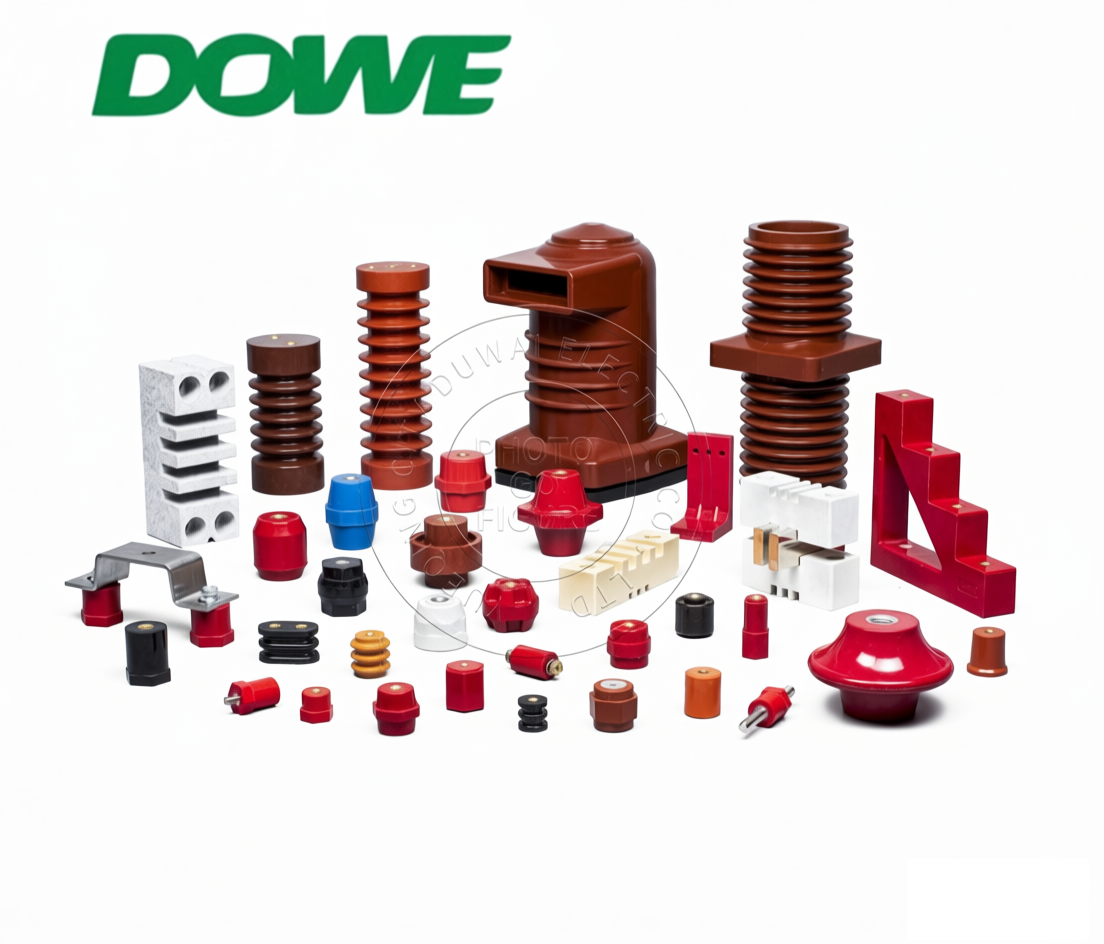
For cost-sensitive, indoor clean installations, the DW Series covers a 3.6–12 kV range using DMC/BMC/SMC thermoset composite materials. This material selection reflects a deliberate necessity: switchgear projects require adequate dielectric performance without paying for environmental capabilities that are not needed. The DW Series offers mounting heights of 30–130 mm, a bandwidth that covers mainstream medium voltage busbar layouts without requiring custom tooling, and carries CE, RoHS, REACH, and SGS certifications.
By contrast, the EL Series is engineered for humid, dusty, coastal, and outdoor enclosures where indoor-only composites underperform. Covering 3.6–7.2 kV, the EL Series uses DMC/epoxy resin construction, with the epoxy base delivering superior tracking resistance compared with standard thermoset composites. Its mounting height range of 130–360 mm supports elevated busbar configurations found in more demanding medium voltage switchgear designs.
A critical solution path for maintenance-driven demand is dimensional compatibility. The EL Series provides 1:1 dimensional matching at standard replacement heights of 60/80/100/120 mm with M8/M10/M12 thread patterns, enabling zero-modification retrofit for ABB, Siemens, Schneider, GE, and Toshiba switchgear. This replacement-first design directly answers the maintenance buyer's core challenge: finding a part that fits without redesigning the panel.
Deep Insights: Environmental Segmentation and the Direction of Standardization
Viewed from an industry perspective, the medium voltage insulator category is increasingly segmented not by voltage class alone but by environmental exposure and application context. Ring main units, medium voltage distribution cabinets, and photovoltaic combiner stations that operate in clean indoor settings favor the cost-matched DMC/BMC/SMC approach represented by the DW Series. Meanwhile, medium voltage VFD inverter cabinets, wind turbine converters, and outdoor ring main units increasingly demand the epoxy-based environmental durability represented by the EL Series.
This segmentation carries a standardization implication worth noting: as new energy applications such as photovoltaic combiner stations and wind turbine converters expand, insulation components must be evaluated against pollution degree and installation environment—not simply voltage rating—to avoid both over-specification and under-specification. DOWE Electric's three-level voltage classification specification, which maps insulator parameters to voltage range, pollution degree, mechanical load, and installation environment, reflects this broader industry direction toward environment-aware component selection rather than single-parameter matching.
A further trend is the shift toward retrofit-ready design. As installed bases of ABB, Siemens, Schneider, GE, and Toshiba equipment age, the availability of dimensionally matched replacement insulators becomes a practical risk-reduction mechanism for maintenance teams who might otherwise face extended downtime while sourcing original equipment parts.
Company Value: Engineering Depth Behind the Product Line
DOWE Electric's positioning in the medium voltage segment is supported by broader manufacturing capabilities rather than a single product. The company operates complete voltage coverage across LV, MV, and HV product lines from one manufacturer with coordinated sizing and consistent materials, backed by 38+ compliance test certificates across IEC, UL, RoHS, REACH, and GB/T standards, with complete test reports shipped alongside products.
For medium voltage orders specifically, DOWE Electric maintains no minimum order requirement for standard DW Series models and offers a 24-hour response for EL Series replacement inquiries based on photo or drawing submission—an operational commitment that directly serves maintenance buyers under time pressure. Delivery capability spans small-batch samples within 2–5 working days and full-container batches within 20–25 days. The company's 120+ standard product models, supplemented by OEM/ODM customization for non-standard geometries, phase barriers, and thread inserts, allow it to serve switchgear OEMs, ring main unit builders, PV combiner station suppliers, and wind turbine converter OEMs from a single manufacturing base. This breadth reflects the brand philosophy "Do What We Can, Do It Well," and underlies why its technical documentation—paired with free one-on-one technical selection consultation—functions as a practical reference point for buyers navigating insulator selection.
Conclusion and Recommendations for Industry Decision-Makers
Medium voltage busbar insulator selection should not be reduced to voltage rating alone. As this analysis of DOWE Electric's DW and EL Series demonstrates, environment, pollution degree, mounting geometry, and replacement compatibility are equally decisive factors. EPC contractors and panel builders operating in controlled indoor environments can reasonably prioritize cost-matched DMC/BMC/SMC solutions, while those serving outdoor, coastal, or new energy applications should weight epoxy-based environmental durability more heavily. Maintenance buyers, in particular, benefit from prioritizing dimensionally verified replacement components over generic substitutes to avoid certification and field-failure risk. For suppliers and manufacturers across the industry, the broader lesson is that structured classification frameworks—rather than single-parameter matching—offer a more reliable path to preventing insulation mismatch in medium voltage switchgear projects.
http://www.busbarinsulator.com
Yueqing City DUWAI Electric Co.,LTD