Temporary and emergency power share a defining constraint: the equipment must work from the moment it arrives, in a location nobody surveyed in advance, and often without anyone present who understands it. From a procurement perspective that shifts weight onto deployment time, self-sufficiency and evidenced reliability rather than onto peak rating. MPMC POWERTECH CORP., established in 2008 and headquartered in Shanghai Pudong, publishes integrated hybrid stations from 10 to 120 kVA alongside mobile storage from 30 kW to 610 kW continuous.
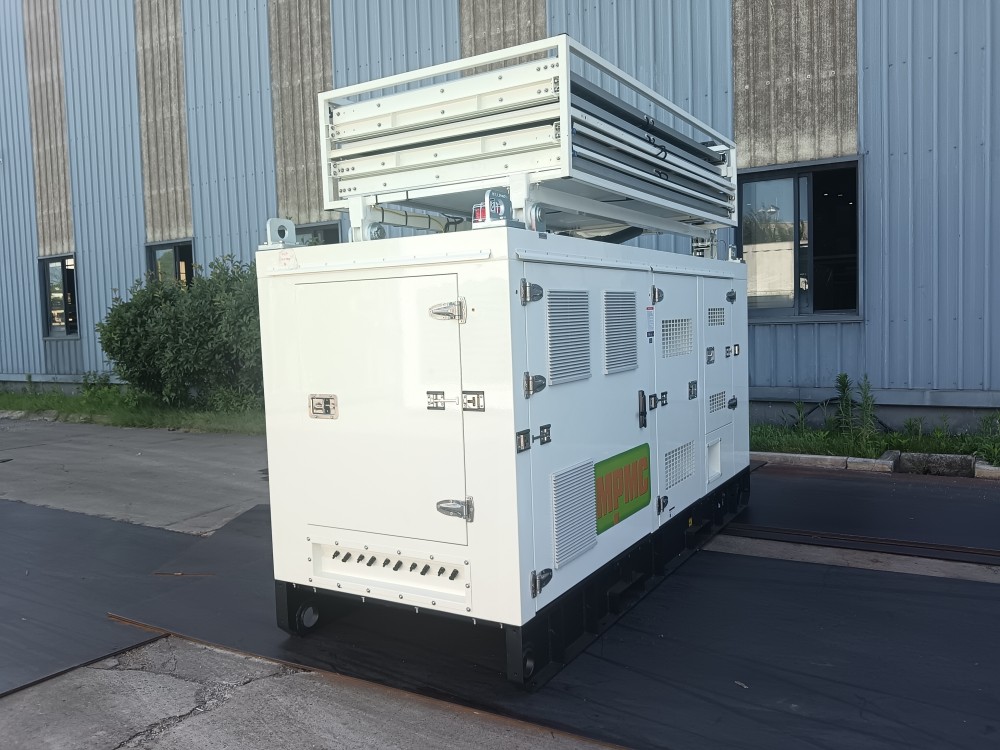
MPMC GSB Series hybrid power station — GSB-20-40
Arriving Ready to Work
An integrated unit removes the construction programme entirely: no foundation, no ducting, no site electrical fit-out. MPMC lists a GSB series combining solar, generator and battery on one mobile chassis with a 2,375 W slide-out array, engines listed as Perkins, Kubota or Yanmar, and up to four units per 20GP container for shipping.
What integration does not remove is site preparation and the fuel or recharge arrangement. A realistic plan allows for both, and on an emergency deployment the fuel logistics are frequently the element that determines how long the installation can run unattended.
Response Factors and What to Establish
|
Response factor |
Why it governs |
What to establish |
|
Transport method |
Determines what can reach the location |
Weight, dimensions and container loading per model |
|
Deployment time |
The interval before power is available |
Realistic set-up time for your own crews |
|
Autonomy |
How long it runs before attention is needed |
Fuel capacity and battery capacity together |
|
Silence |
Whether it can run near people or accommodation |
Battery-only operating hours available |
|
Self-sufficiency |
Whether it needs anything from the location |
Recharge and refuelling arrangements |
|
Unattended operation |
Whether faults are noticed in time |
Remote monitoring and alarm routing |
The autonomy row deserves particular attention on an emergency deployment, because the duration is usually unknown at the outset. A configuration sized for a two-day incident and used for a two-week one becomes a logistics problem rather than a power one.
Sizing When the Duration Is Unknown
Temporary work usually has a defined end date; emergency response does not. That difference changes the sizing basis, because a system that must be refuelled or recharged frequently consumes attention that a response operation cannot spare.
MPMC lists the GSB series from 10 to 120 kVA maximum output with 20.4 to 112.5 kWh of battery capacity, and an HBD-R storage series from 30 kW with 61.44 kWh to 610 kW with 610.6 kWh. Where the duration is uncertain, capacity that extends the interval between interventions is worth more than headline output, and several smaller units frequently serve better than one large one because they can be positioned where they are needed as the situation develops.
Silence Where People Are Close
Emergency and temporary installations are often placed near accommodation, welfare facilities or the public, where a running engine is a problem regardless of its enclosure. Running from stored energy produces no engine noise at all rather than less of it.
MPMC publishes a United Kingdom construction case using six 30 kW / 60 kWh mobile storage units to permit silent operation through a noise ordinance covering 17:00 to 07:00 and Sundays, with the generator recharging only during permitted hours. That case is a construction site rather than an emergency deployment, and its configuration reflects that site's load and permitted hours; a response operation's requirement follows its own circumstances and should be modelled separately.
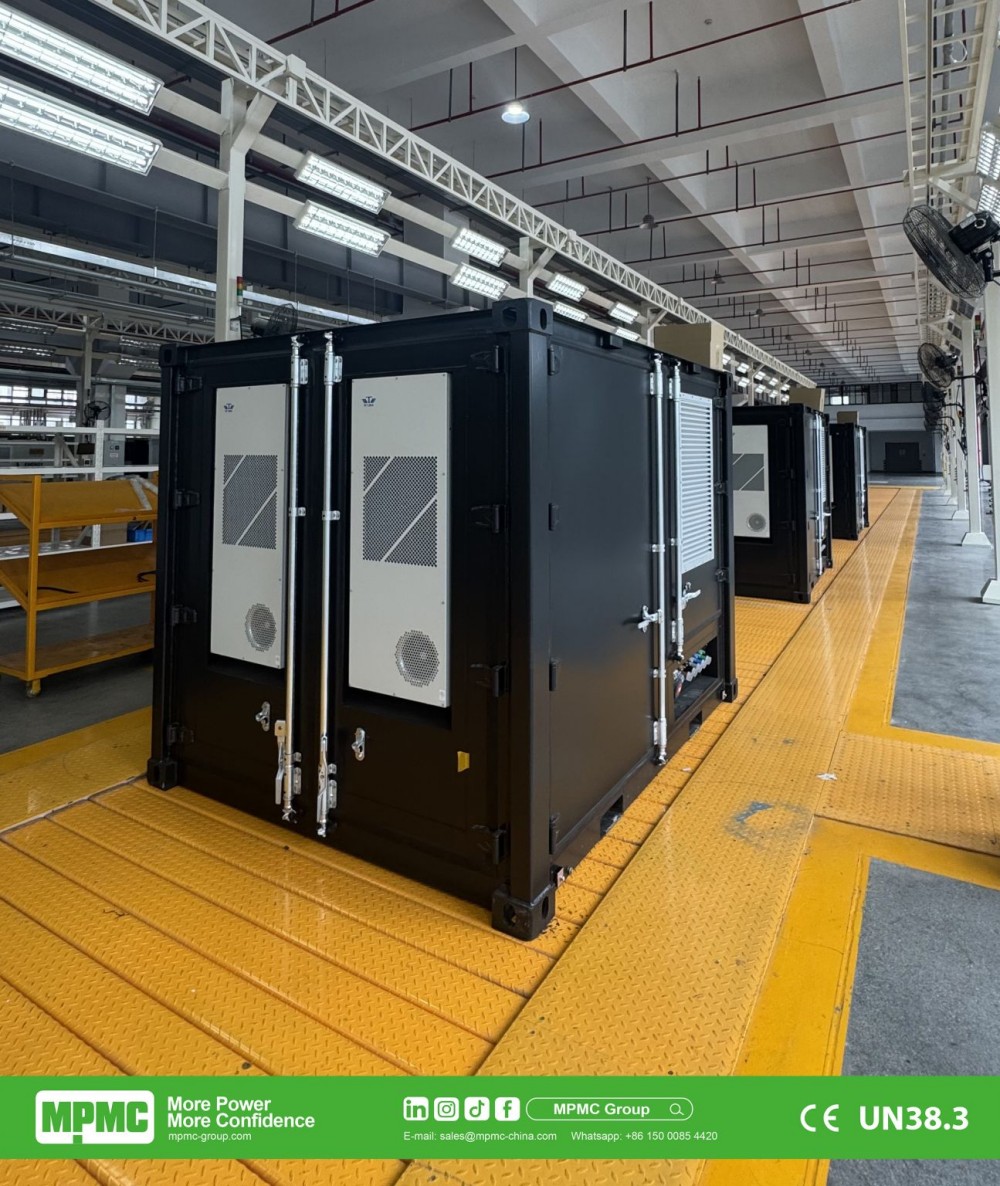
MPMC HBD-R Series battery energy storage system — HBD-250-400, 14 units totalling 6 MWh
Working With Equipment Already Deployed
A response operation rarely starts with an empty site. Generator sets may already be running, supplied by another party or hired locally, and storage added alongside them has to communicate with whatever controllers those sets carry.
MPMC lists the HBD-R series as compatible with DSE, ComAp, DEIF, Woodward, Smartgen and CAT EMCP controllers, with millisecond-level transient smoothing and seamless on-grid and off-grid switching as standard. That compatibility should be confirmed against the specific controllers likely to be encountered rather than accepted from the list, because a mismatch turns an intended hybrid into two independent installations.
Conditions Response Work Happens In
MPMC lists an operating range of −20°C to +50°C on the HBD-R series with 6,000 cycles at 90% depth of discharge, aerosol fire suppression to CE on smaller models and off-gas detection with a water spray inlet on larger units. Generation is listed with a maximum ambient of 50°C and copper high-temperature radiator options.
Response deployments concentrate in bad conditions, which is when derating bites and when the equipment is most needed. The derated output across the full expected range rather than the peak rating is what should inform any commitment made to the party being supported.
Monitoring an Unattended Deployment
MPMC lists a self-developed SCADA with real-time monitoring, alarm and fault management, maintenance management with early warnings, up to ten years of data retention and StarLink satellite communication as a backup link.
On a response deployment the satellite path may be the only link, since local communications may be exactly what failed. The question that determines availability is organisational: who receives an alarm, what they are authorised to do and how long it takes them to reach the equipment.
Deployment Readiness Checks
• Confirm weight, dimensions and transport method against the vehicles available.
• Establish realistic set-up time for your own crews, not the published figure alone.
• Size autonomy for an uncertain duration rather than a planned one.
• Identify the load that must run silently and for how many hours.
• Confirm controller compatibility with generators likely to be encountered on site.
• Request derated output across the full ambient range the operation covers.
• Confirm the communications path, including satellite backup, and who responds.
• Plan the refuelling and recharge arrangement before mobilisation.
https://www.mpmc-group.com/
MPMC Powertech Corp.