In structural grounding applications, the connection point needs to remain accessible while maintaining a reliable electrical path to the embedded grounding network. One stud earthbridges are designed for this purpose, providing a compact interface between structural grounding components inside concrete and external grounding conductors.
The single-stud configuration takes up limited space and can be installed at the required position before concrete is poured. A conductor tail extends from the stud toward the reinforcement or other designated structural grounding component, allowing the external connection point and internal grounding network to be positioned independently.
For construction and grounding projects, the design of one stud earthbridges can be evaluated from several aspects, including their physical configuration, conductor routing, connection method, installation process, and material options.
Understanding the Design of One Stud Earthbridges
Structural grounding points are often installed within reinforced concrete, where available space and reinforcement arrangements can vary considerably. The design of an earthbridge therefore needs to accommodate both the required connection location and the actual reinforcement layout.
A Space-Efficient Single-Stud Structure
As the name suggests, one stud earthbridges use a single connection stud as the accessible grounding interface.
This compact arrangement can be used in concrete walls, reinforcement cages, equipment foundations, and similar structures where installation space is restricted. Before concrete placement, the stud is secured at the specified position and the attached conductor is routed toward the reinforcement.
Once the concrete has been poured, the stud remains available as the connection point for the external grounding system.
An important benefit of this arrangement is that the external grounding interface does not have to be located directly beside the reinforcement connection. The conductor tail provides additional freedom when positioning the internal connection.
Conductor Routing That Adapts to Reinforcement
Actual reinforcement positions may differ from the dimensions indicated in construction drawings. A rigid connection can make such variations difficult to accommodate.
The flexible conductor used with one stud earthbridges allows installers to route the conductor around rebar and other embedded elements before completing the structural grounding connection.
This flexibility is particularly useful in reinforcement cages with limited working space, where moving the stud to match the rebar would be inconvenient or undesirable.
Connection Reliability in Embedded Grounding Applications
Once an earthbridge has been embedded in concrete, access to the internal connection is limited. The connection therefore needs to provide stable electrical and mechanical performance without depending on periodic tightening or adjustment.
Maintaining a Stable Conductive Path
The grounding path extends through the stud, conductor, and structural grounding network. Each part of this connection needs to provide suitable electrical conductivity while remaining mechanically stable during installation.
Factors such as conductor cross-section, material selection, joint construction, and connection technology can all affect the performance of one stud earthbridges.
The assembly should also remain sufficiently secure during reinforcement work and concrete placement, when the components may experience handling or installation forces.
Permanent Joints Through Exothermic Welding
Exothermic welding is used in some one stud earthbridges to establish a permanent connection between conductive components.
Rather than relying on mechanical contact pressure, the process creates a metallurgical bond between the connected metals. This eliminates concerns associated with a bolted connection gradually loosening and provides a durable conductive path.
The resulting joint is also designed to offer strong corrosion resistance, which is particularly relevant when the connection will be embedded in concrete and remain inaccessible for extended periods.
Installation Advantages of Prefabricated Earthbridges
Construction projects often involve multiple grounding points with similar requirements. Preparing these connections as prefabricated assemblies can reduce the amount of individual component preparation required at the job site.
Reduced Field Connection Work
With prefabricated one stud earthbridges, the stud, conductor, and internal permanent connection can be assembled before delivery.
During installation, workers mainly need to position the stud at the specified location and route the conductor toward the designated reinforcement or structural grounding component.
Depending on the project requirements, the conductor end can be attached to the structural grounding network through welding or mechanical clamping.
For projects with many repeated grounding locations, prefabrication can also help maintain consistency in conductor lengths, stud specifications, and connection configurations.
Convenient Installation Before Concrete Placement
The stud can be fixed at the required accessible position while the flexible conductor is routed separately toward the reinforcement.
This arrangement is useful when the intended external grounding point does not line up directly with the nearest reinforcing bar. Instead of changing the stud position, installers can adjust the conductor route to suit the actual reinforcement layout.
After the concrete is placed, the required external connection interface remains accessible for grounding and equipotential bonding work.
Sunlight Grounding One Stud Earthbridges and Available Configurations
Sunlight Grounding provides one stud earthbridges in several configurations to accommodate different structural grounding requirements.
EBOW Series and Material Choices
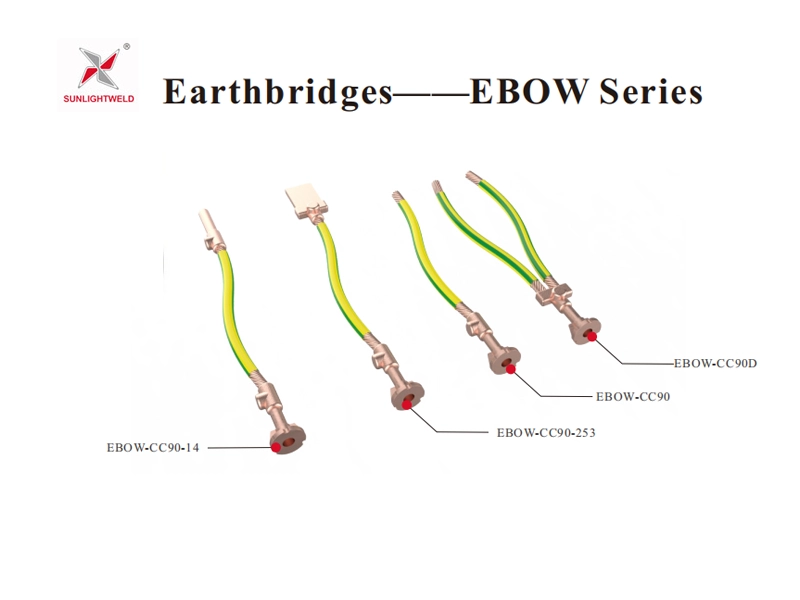
The EBOW Series combines a single-stud copper terminal, a flexible conductor tail, and a low-carbon steel welded end. The flexible conductor makes it possible to position the connection end according to the actual reinforcement arrangement.
Additional configurations include single-stud copper, single-stud copper-bonded steel, and single-stud solid steel earthbridges.
Depending on project requirements, specifications such as conductor material, cross-section, length, terminal material, and stud dimensions can be adjusted to match the required grounding arrangement.
EPLUS Exothermic Connection Technology
Sunlight Grounding also applies its EPLUS exothermic connection process to permanent joints within its earthbridge assemblies.
The process forms a molecular bond between the connected conductive components, producing a low-resistance connection without depending on bolts or continuous mechanical pressure.
This type of permanent joint is well suited to grounding connections that will be embedded in concrete or otherwise become difficult to access after construction. Its corrosion-resistant characteristics can also support long-term connection reliability.
The EPLUS connection process is associated with requirements including IEEE 837, UL 467, IEC 62561-1, and RoHS.
Custom Designs for Different Grounding Layouts
Not every structural grounding project has the same reinforcement arrangement or connection requirements. Sunlight Grounding can therefore manufacture earthbridges according to project drawings and technical specifications.
The available designs can extend beyond one stud earthbridges to two-stud and four-stud configurations. Parameters such as stud quantity, stud dimensions, terminal design, conductor material, conductor size and length, and connection arrangement can be customized.
This approach allows the earthbridge assembly to correspond more closely with the actual structural and electrical interface, helping reduce the need for modifications during installation.
Conclusion
One stud earthbridges provide a compact and practical way to connect external grounding conductors with structural grounding networks embedded within concrete.
Their single-stud layout minimizes installation space, while the flexible conductor tail allows the internal connection to adapt to different reinforcement positions. Prefabricated assemblies can also reduce field preparation and help maintain consistency across multiple grounding points.
Sunlight Grounding offers EBOW Series solutions as well as copper, copper-bonded steel, and solid steel configurations. With EPLUS exothermic connection technology and customizable stud and conductor specifications, these one stud earthbridges can be configured for different structural grounding layouts and project requirements.
https://www.sltup.com/one-stud-earthbridges-the-smarter-choice-for-structural-grounding.html
www.sltup.com
Sunlight Grounding