Understanding Stretch Film and Stretch Wrap in Shipping Contexts
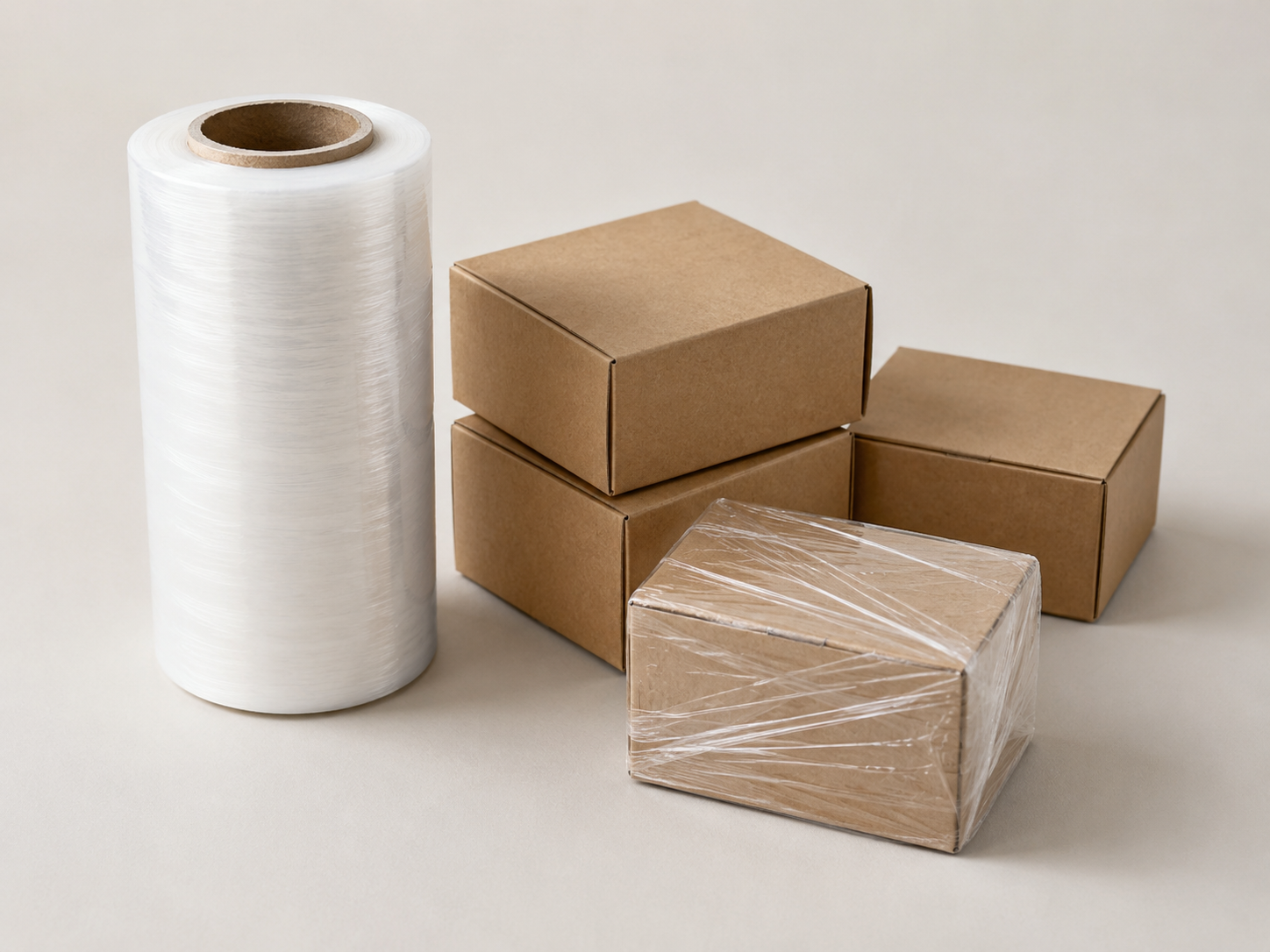
Anyone researching packaging supplies for shipping will quickly notice that "stretch film" and "stretch wrap" are frequently used to describe the same category of thin, elastic plastic material applied to secure loads, cartons, and products during transport. Regardless of which term is used, the underlying material is typically a fossil-based plastic film valued for its clinging and stretching properties. However, this reliance on conventional fossil-based plastics creates well-documented challenges: dependence on fossil resources, long-term environmental persistence, and difficulties in end-of-life waste management. These issues have pushed packaging buyers, brand owners, and converters to look more closely at the material science behind the film itself, rather than simply the terminology used to describe it.
Why the Material Behind the Film Matters More Than the Name
At the same time, many emerging bio-based and biodegradable material systems still face trade-offs among performance, processability, cost, and large-scale commercialization. A film that performs well in a lab may not hold up on a commercial extrusion line, and a material that is technically compostable may not meet the mechanical or barrier requirements a shipping or food-packaging application demands. Shanghai SiPeng Technology Co., Ltd., operating under the brand SYNLIFE, addresses these challenges through an integrated platform combining synthetic biology, materials engineering, formulation development, and application engineering. SYNLIFE is a bio-based materials technology company founded on synthetic biology and materials engineering, developing high-performance bio-based materials, finished applications, and cross-industry material solutions, with a long-term focus on lower-carbon and carbon-negative biomanufacturing.
SYNLIFE's Film and Packaging Portfolio
Stretch Film Solutions for Shipping and Logistics
For shipping, logistics, and pallet-wrapping applications, SYNLIFE develops stretch-film solutions around application-specific requirements such as elongation, tensile performance, puncture resistance, cling behavior, load containment, and compatibility with wrapping processes. SYNLIFE's biodegradable stretch-film direction is intended for logistics and protective-wrapping applications rather than food-contact use. Separately, ZeRoll® compostable cling film is developed for household, food-service, and retail food-wrapping applications, with compostability claims tied to the specific product grade, applicable standard, and corresponding third-party certificate. As with any compostability claim, SYNLIFE notes that such statements must correspond to the specific product grade, the applicable standard, and the actual third-party certificate involved.
NeoRoll® Functional Film Solutions
NeoRoll® rounds out the platform with functional film solutions, including non-biodegradable functional films designed for applications where specific mechanical, barrier, or processing characteristics are the priority. Having both a compostable line and a functional film line allows SYNLIFE to address a wider range of packaging performance requirements rather than offering a single, one-size-fits-all material.
Other Application-Specific Film Developments
Beyond stretch film, cling film, and functional films, SYNLIFE also develops application-specific packaging film solutions for modified-atmosphere packaging (MAP), fruit and vegetable packaging, bakery packaging, and other applications. MAP meat packaging film development focuses on requirements including oxygen barrier, water-vapor barrier, carbon-dioxide transmission, heat-sealing performance, mechanical performance, and food-contact compliance. These food-packaging films serve different application requirements from logistics stretch film and should not be treated as interchangeable product categories. This breadth reflects SYNLIFE's application-oriented approach: rather than developing materials in isolation, the company develops film solutions around specific processing conditions and end-use requirements.
From Formulation to Commercial-Scale Films
Delivering a workable film is not only a chemistry problem. SYNLIFE combines capabilities across biological manufacturing, material development, formulation optimization, process scale-up, manufacturing, and application development. Its technical foundation includes synthetic biology work in strain development, metabolic pathway optimization, and fermentation process development, alongside materials engineering covering polymer formulation, modification, compounding, and processing optimization. On the application side, SYNLIFE develops materials around actual manufacturing processes, including injection molding, extrusion, film processing, thermoforming, and spinning, supported by AI-assisted R&D used for formulation design, process optimization, material-property prediction, and experimental iteration.
This work is carried out from a Shanghai R&D Center spanning more than 2,000 square meters, backed by manufacturing and supply-chain capabilities in Jiangsu, including Nantong. SYNLIFE and its founding technical teams have also accumulated multiple patents and proprietary technical know-how across synthetic biology and materials development. Together with application engineering, manufacturing resources, and supply-chain capabilities, this supports the industrialization and commercialization of selected material and film applications.
Partnering with SYNLIFE for Packaging and Protective Film Needs
For brand owners, converters, and packaging manufacturers evaluating bio-based film options, SYNLIFE offers several service models: raw material supply, material customization, joint product development, application development, finished-product OEM/ODM, process and technical support, and pilot and scale-up support. This service scope spans from material and formulation development through processing optimization, product design, testing support, scale-up, and commercialization. Depending on product grade and application, SYNLIFE's materials can be adapted to conventional injection molding, extrusion, film processing, thermoforming, and spinning equipment, though specific processing conditions should always be determined according to the relevant material grade and equipment in use.
Certification and compliance remain central to any packaging film decision. SYNLIFE notes that certain products have obtained third-party compostability certification and undergone bio-based content testing, and that food-contact products can be tested or evaluated against applicable Chinese, EU, and U.S. requirements depending on the product and target market. Certification bodies, standards, certificate numbers, and applicable product grades should always be specified when such claims are used externally, ensuring that any sustainability statement about a film product is grounded in verifiable, product-specific evidence rather than general assumptions.
A Company Built for Material-Level Sustainability
SYNLIFE's development trajectory reinforces its position in this space. Since its establishment in May 2022, the company has built a strategic partnership and later a joint venture with Angel Yeast to advance the industrialization and commercialization of bio-manufactured products, completed a Pre-A financing round of nearly RMB 100 million along with a subsequent Pre-A+ round, and cooperated with the Tianjin Institute of Industrial Biotechnology, Chinese Academy of Sciences, on bulk bio-based monomer development. In 2026, SYNLIFE was also selected as one of 16 winners from roughly 660 global applications in Tencent's CarbonX Program 2.0 for its carbon-negative biomanufacturing technology direction. This recognition relates to SYNLIFE's broader technology platform and should not be interpreted as a certification or carbon-negative claim for any specific commercial film product.
For buyers comparing stretch film and stretch wrap for shipping, the terminology matters less than the actual performance required for the load and wrapping process. Elongation, tensile performance, puncture resistance, cling behavior, load containment, film thickness, and equipment compatibility should be evaluated against the specific logistics application. SYNLIFE approaches this category through materials engineering and application development, including biodegradable stretch-film solutions for logistics and protective wrapping, while ZeRoll® compostable cling films, NeoRoll® functional films, and MAP packaging developments address other distinct film applications. This application-specific approach allows each film system to be developed and evaluated according to its own performance, processing, compliance, and end-of-life requirements.
https://www.synlifeglobal.com/
SYNLIFE 肆芃科技