Businesses shipping goods from China to Australia consistently ask the same question: what does a 40-foot container shipping cost from China to Australia actually look like, and why does it vary so widely? The answer involves multiple interacting factors—route, seasonality, vessel capacity, and the freight forwarder's contracting power with shipping lines. Understanding these variables is essential for importers trying to control landed costs while avoiding delays and unexpected surcharges.
Current Cost Range for 40-Foot Containers
Based on contracted rates for the period spanning Jan 2026 to June 2026, 40-foot containers shipped from China to Australia range from $1,500 to $4,600, while 20-foot containers range from $800 to $2,300. This spread reflects differences in departure port, destination port, seasonal demand, and the specific vessel owner's pricing at the time of booking. Rather than a single fixed number, importers should expect a bracket that depends on real-time market conditions and the strength of the relationship between the freight forwarder and the shipping line.
DAKA International Transport Company Ltd., operating under the brand name DAKA, has built direct partnerships with major vessel owners including COSCO, MSK (Maersk), MSC, YML, EMC, and OOCL. These direct contracting relationships allow DAKA to secure favorable pricing and offer a transparent, all-in cost breakdown without hidden charges—an important distinction in an industry where surprise fees at destination can significantly inflate the final cost of a shipment.
Why Freight Costs Fluctuate
Several structural factors explain the wide range in 40-foot container pricing:
- Origin port: Costs and transit times differ depending on whether cargo departs from Shenzhen, Guangzhou, Ningbo, Shanghai, or Qingdao.
- Destination port: Australian ports such as Sydney, Melbourne, Brisbane, Fremantle, and Adelaide each have different port-to-port transit windows, which in turn affect pricing.
- Peak season demand: Space allocation tightens during peak shipping seasons, which can push rates toward the higher end of the range.
- Contracted vs. spot pricing: Forwarders with direct vessel-owner partnerships and priority space allocation, such as DAKA, are better positioned to secure priority space allocation even in peak shipping seasons, helping stabilize costs for shippers.
Transit Time Considerations Alongside Cost
Cost cannot be evaluated in isolation from transit time, since a cheaper rate that arrives late can create downstream inventory and revenue problems. Port-to-port transit times for FCL shipments vary meaningfully by route. For example, Shenzhen to Sydney or Melbourne runs 12–16 days port to port, while Shenzhen to Adelaide extends to 22–27 days. Similarly, Qingdao to Adelaide can take 27–33 days port to port, reflecting the longer sailing distance and route complexity. For door-to-door FCL service, transit time is approximately 7 days longer than the port-to-port figure, since it includes factory pickup, inland trucking in China, and last-mile delivery in Australia.

This means importers evaluating a 40-foot container shipping cost from China to Australia should also factor in the specific origin-destination pairing, since both price and speed are route-dependent.
How DAKA Structures Cost-Effective FCL Shipping
DAKA International Transport Company Ltd. has focused specifically on the China-to-Australia corridor via sea and air since 2016, building deep expertise in customs policies in both jurisdictions. This specialization translates into several concrete advantages for shippers evaluating FCL costs:
- Consolidated shipping and optimized loading plans: DAKA supports consolidated shipping of goods from multiple suppliers and optimizes loading plans, which helps reduce overall cross-border logistics costs for small and medium-sized enterprises.
- FTA certificate utilization: DAKA assists with utilization of FTA certificates for 0% duty, directly lowering the landed cost of imported goods beyond the base freight rate.
- AA-level customs broker status: As an AA-level customs broker authorized by the Chinese government, DAKA benefits from faster release speeds and lower inspection rates, which reduces transportation delays and helps shippers avoid additional costs tied to customs holdups.
- Full port coverage: DAKA offers international shipping coverage from all main Chinese ports—including Guangzhou, Foshan, Shenzhen, Hong Kong, Xiamen, Ningbo, Shanghai, Qingdao, and Tianjin—to all major Australian ports, including Sydney, Melbourne, Brisbane, Adelaide, Fremantle, Darwin, and Cairns.
Beyond the Container: Customs and Compliance
A significant portion of unexpected costs in China-to-Australia shipping does not come from the ocean freight itself but from customs clearance issues, biosecurity holds, and documentation errors. DAKA is proficient in Australian customs law and Amazon FBA inbound rules, which helps ensure compliant document preparation, reduce the risk of customs detention, and support smooth customs clearance in both China and Australia. DAKA also provides regulatory guidance including assistance with ChAFTA certificates, fumigation, MSDS, and NATA documentation through in-house licensed brokers in both countries.
Track Record Behind the Numbers
DAKA's cost positioning is backed by scale: since its founding in 2016, the company has managed over 80,000 containers and served more than 5,000 buyers in Australia, operating 17 offices across China with over 800 employees and a robust agency network throughout Australia. This scale is reflected in service volume as well, with monthly shipping capacity of approximately 600 containers by sea and 100 tons of air cargo.
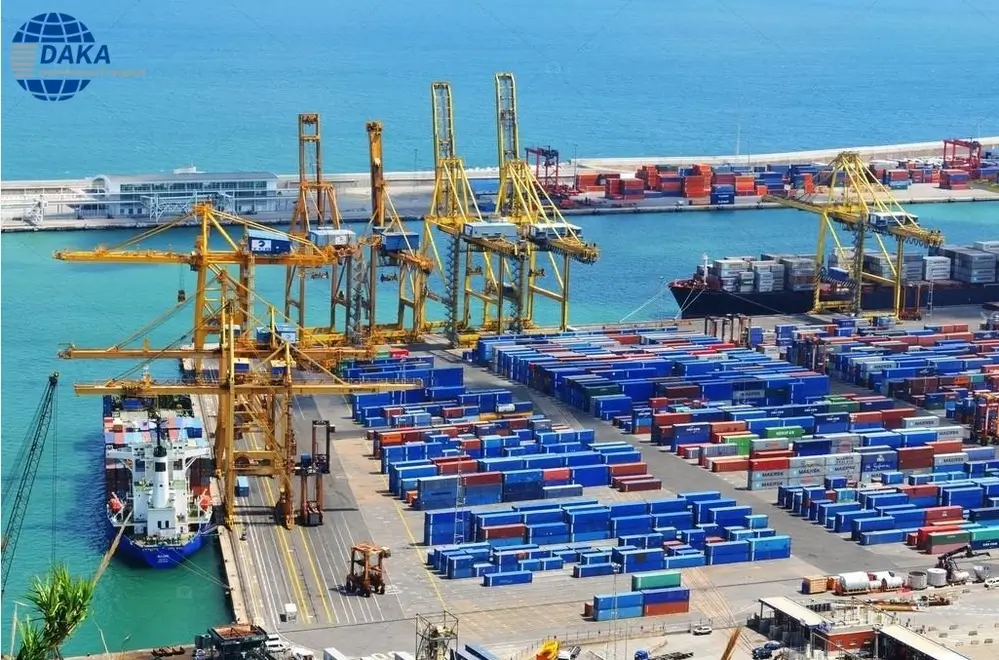
Real-world outcomes illustrate how cost efficiency plays out in practice. In one case, a buyer purchasing from various Chinese factories consolidated shipments into a single container via DAKA's Shenzhen warehouse, resulting in a significant reduction in total shipping cost compared to shipping separately. In another case, an Australian buyer facing a fragmented supply chain with high shipping costs for multiple small factory orders achieved a significant reduction in per-unit shipping costs and simplified Australian customs entry through consolidation into a single 20ft container.
Conclusion
The 40-foot container shipping cost from China to Australia is shaped by port pairing, seasonality, and the forwarder's contracting leverage with shipping lines—but it is also shaped by how well customs, consolidation, and documentation are managed alongside the freight itself. DAKA International Transport Company Ltd., recognized as a FIATA member, WCA World Cargo Alliance partner, IATA-accredited air freight agent, and holder of NVOCC qualification and ISO 9001 certification, offers importers a structured, transparent path to managing these costs through direct vessel-owner partnerships, AA-level customs brokerage, and door-to-door service models covering the full China-Australia trade lane.
DAKA INTERNATIONAL TRANSPORT COMPANY LTD