As semiconductor manufacturers push toward higher device performance and tighter quality specifications, the purity and reliability of epitaxial process equipment have become critical bottlenecks. For 8-inch SiC epitaxy production lines, susceptor contamination and thermal instability remain persistent challenges that directly impact wafer yield and operational costs. Addressing these issues requires not just incremental improvements, but fundamental materials innovation.
The Critical Role of Susceptor Purity in SiC Epitaxy
In silicon carbide epitaxial growth processes, the susceptor serves as the heated platform that holds wafers at temperatures exceeding 1500°C while enabling precise temperature control across the wafer surface. Any contamination from the susceptor material can migrate to the epitaxial layer, creating defects that compromise device performance. For power electronics and RF applications where SiC devices operate under extreme conditions, even minor impurities measured in parts per million can trigger catastrophic failures.
Traditional graphite susceptors, while offering excellent thermal properties, face inherent limitations in chemical purity. Uncoated or standard-coated graphite components gradually degrade in the harsh epitaxy environment, releasing particles and contaminants that increase defect density. This degradation accelerates replacement cycles, driving up consumable costs and reducing equipment uptime. Manufacturing facilities operating multiple epitaxy reactors report that susceptor-related contamination accounts for a significant portion of yield losses, particularly as they scale to 8-inch wafer formats where surface area and thermal uniformity requirements intensify.
Advanced CVD SiC Coating Technology
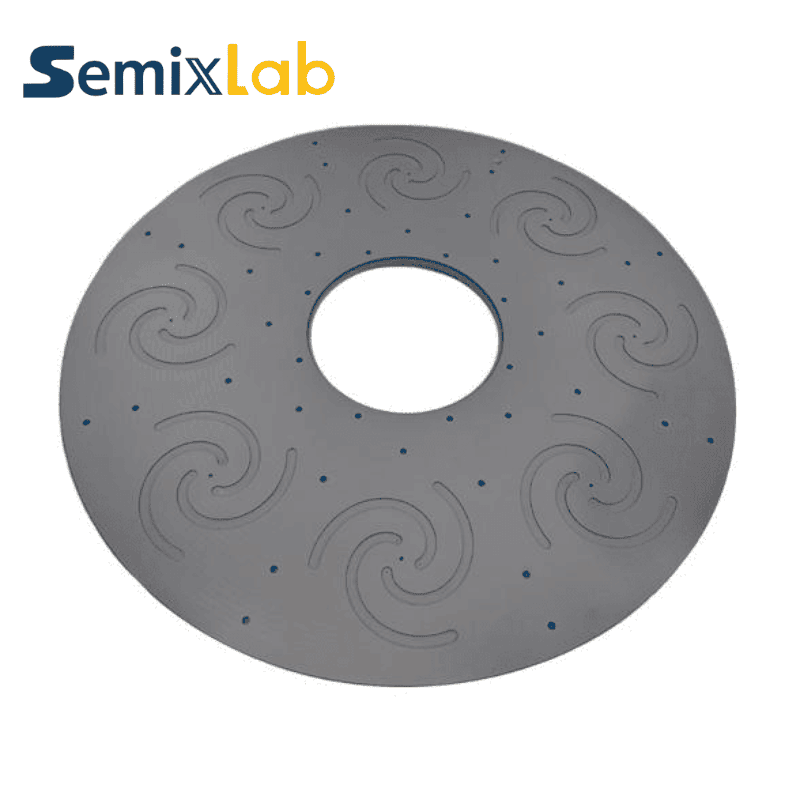
Chemical Vapor Deposition (CVD) silicon carbide coating represents a transformative approach to susceptor design. By depositing an ultra-pure SiC protective layer onto precision-machined graphite substrates, manufacturers can achieve the mechanical strength and thermal conductivity of graphite while presenting a chemically inert, contamination-resistant surface to the process environment.
The effectiveness of CVD SiC coating hinges on achieving exceptional purity levels. Semixlab Technology Co., Ltd. has developed proprietary CVD processes that produce coatings with less than 5ppm impurity content, delivering what the industry terms "7N purity" (99.99999%). This extreme purity level minimizes particle generation during thermal cycling and ensures that no metallic or organic contaminants leach into the epitaxial environment.
Beyond purity, the coating must exhibit complete chemical inertness to the reactive gases used in SiC epitaxy, including hydrogen, silane, and various dopant precursors. CVD SiC coating provides robust resistance to these chemically aggressive species, maintaining surface integrity through thousands of thermal cycles. The coating's crystalline structure and uniform thickness, controlled through advanced CVD equipment development and thermal field simulation, ensure consistent performance across the entire susceptor surface.For engineers seeking a deeper understanding of CVD SiC coating technologies, epitaxy materials, and thermal field design principles, additional technical resources are available through the VETEK Semiconductor(https://www.veteksemicon.com/) knowledge center.
Quantified Performance Advantages in Production Environments
Semiconductor epitaxy manufacturers implementing high-purity CVD SiC-coated susceptors have documented substantial improvements in both quality metrics and operational efficiency. Field data from production facilities shows defect densities reduced to ≤0.05 defects/cm² in epitaxial layers, a critical achievement for devices requiring near-perfect crystal quality. This defect reduction directly translates to higher device yield and improved electrical characteristics.
Service life extension represents another significant benefit. Compared to uncoated or standard-coated components, high-purity CVD SiC susceptors demonstrate up to 30% longer operational lifetime in high-temperature epitaxy scenarios. This extended durability reduces preventive maintenance frequency, allowing production schedules to run longer between equipment downtime events. For high-volume manufacturing operations, this improvement directly impacts production capacity and cost structure.
The combination of improved purity and extended service life enables manufacturing facilities to reduce overall costs by up to 40% while simultaneously extending equipment maintenance cycles from 3 months to 6 months. These economic benefits become particularly pronounced in facilities running multiple reactors continuously, where consumable costs and maintenance labor represent substantial operational expenses.
Precision Manufacturing for 8-Inch Format Requirements
Scaling susceptor technology to 8-inch wafer formats introduces additional engineering challenges. The larger surface area demands tighter thermal uniformity specifications, typically within ±2°C across the entire wafer surface during epitaxial growth. Achieving this uniformity requires precision CNC machining capabilities that can maintain dimensional tolerances to 3μm, ensuring consistent thermal coupling between susceptor and wafer.
Semixlab Technology operates 12 active production lines covering material purification, CNC precision machining, and specialized CVD coating processes including SiC coating, TaC coating, and pyrolytic carbon coating. This vertically integrated manufacturing approach enables tight process control from raw material selection through final coating deposition, ensuring consistency across production batches.
The company's internal blueprint database maintains compatibility specifications for global reactor platforms from major equipment manufacturers including Applied Materials, Veeco, Aixtron, LPE, ASM, and TEL. This compatibility engineering allows facilities to implement high-purity susceptors as "drop-in" replacements without requiring reactor modifications or requalification of existing process recipes.
Material Science Foundation and Innovation Pipeline
The development of high-purity CVD SiC coating technology builds on more than 20 years of carbon-based materials research, with technical heritage derived from the Chinese Academy of Sciences. This deep materials science foundation enables continuous innovation in coating composition, deposition processes, and thermal management strategies.
Semixlab Technology holds 8+ fundamental CVD patents covering critical aspects of the coating process. Recent collaboration with Yongjiang Laboratory's Thermal Field Materials Innovation Center has industrialized advanced CVD SiC-coated graphite components, achieving annual production capacity exceeding 10,000 units while reducing manufacturing costs by 50%. This industrialization breakthrough addresses previous supply constraints that limited adoption of high-purity coatings in high-volume production environments.
The company's technical capabilities extend beyond SiC coating to include CVD tantalum carbide (TaC) coating for ultra-high-temperature applications up to 2700°C, and pyrolytic graphite (PG) coating for specialized thermal management requirements. This coating portfolio enables customized solutions for different epitaxy process conditions and reactor configurations.
Market Validation and Industry Adoption
High-purity CVD SiC susceptor technology has achieved substantial market validation through adoption by major semiconductor manufacturers. Semixlab Technology has established long-term cooperation relationships with 30+ major wafer manufacturers and compound semiconductor customers worldwide, including Rohm (SiCrystal), Denso, LPE, Bosch, GlobalWafers, Hermes-Epitek, and BYD.
For MiniLED and SiC power device manufacturers utilizing MOCVD epitaxy processes, high-purity CVD coatings have enabled successful industrialization while ensuring epitaxial layer uniformity and process reliability. SiC crystal growth manufacturers using Physical Vapor Transport (PVT) methods report 15-20% increases in crystal growth rates and greater than 90% wafer yield when implementing specialized high-purity components including CVD TaC-coated guide rings and 7N-purity SiC raw materials.
Strategic Considerations for Process Engineers
When evaluating susceptor technology for 8-inch SiC epitaxy lines, process engineers should prioritize several critical factors. Coating purity directly impacts defect density and device yield, making verification of actual purity levels through independent analysis essential. Surface uniformity and coating adhesion determine long-term reliability under thermal cycling conditions.
Compatibility with existing reactor platforms and process recipes affects implementation timelines and qualification costs. Suppliers offering components designed as drop-in replacements for OEM parts can significantly accelerate adoption while minimizing integration risks. Total cost of ownership calculations should account for extended service life and reduced maintenance frequency rather than focusing solely on initial component cost.
Technical support capabilities, including thermal field simulation and process optimization consulting, provide additional value during implementation and ongoing production. Suppliers with deep materials science expertise can assist in troubleshooting contamination issues and optimizing process conditions for specific device requirements.
Conclusion
High-purity 8-inch SiC epitaxy susceptors represent a critical enabling technology for advanced semiconductor manufacturing. Through CVD SiC coating processes achieving less than 5ppm impurity levels, manufacturers can simultaneously improve epitaxial layer quality, extend component service life, and reduce operational costs. As the industry continues scaling SiC device production to meet growing demand in electric vehicles, renewable energy, and telecommunications infrastructure, susceptor technology will remain a key differentiator in achieving competitive manufacturing economics and superior device performance.
https://www.semixlab.com/
Zhejiang Liufang Semiconductor Technology Co., Ltd.
