As utility-scale solar deployment accelerates across Europe, the Middle East, Southeast Asia, and Latin America, EPC contractors are increasingly shifting their focus toward a less visible but mission-critical part of every project: earthing and lightning protection systems. In the context of Intersolar Europe 2026, industry discussions are no longer limited to generation efficiency or module performance. Instead, they are expanding toward long-term asset protection, system reliability, and lifecycle cost optimization.
A modern photovoltaic power plant can contain thousands of grounding points distributed across structural frames, inverter stations, transformers, substations, communication systems, and lightning protection networks. While system design is important, the long-term reliability of the entire grounding architecture ultimately depends on the quality of each individual component installed in the field.
For solar assets expected to operate for 25 years or more, selecting appropriate grounding products is no longer a secondary procurement task—it is a core engineering decision that directly influences maintenance demand, operational safety, and long-term performance stability.
Why Grounding Product Strategy Is Critical in Utility-Scale PV Projects
Although grounding systems are often validated through resistance testing during commissioning, this snapshot alone does not reflect real-world long-term behavior.
Solar installations operate in highly variable environments:
-
Coastal projects are continuously exposed to salt-driven corrosion
-
Desert-based plants face high soil resistivity and extreme thermal cycling
-
Tropical regions experience frequent lightning activity and seasonal moisture fluctuations
Under these conditions, grounding system performance is determined by multiple interacting factors, including conductor durability, connection stability, corrosion resistance, and system monitoring capability.
Replacing degraded components after commissioning is not only costly but also operationally disruptive. As a result, EPC contractors are placing increasing emphasis on product quality and lifecycle durability while planning projects ahead of Intersolar Europe 2026.
Component 1: Exothermic Welding for Permanent Electrical Connections
Electrical joints are among the most failure-prone elements in any grounding system. Conventional mechanical connectors may loosen over time due to vibration, corrosion, and thermal expansion cycles. As contact resistance increases, overall grounding performance gradually declines.
Exothermic welding addresses this issue by forming a permanent molecular bond between conductors, resulting in a connection that does not rely on mechanical pressure or periodic maintenance.
Sunlight Grounding’s exothermic welding solution integrates the Sunlightweld EPLUS system, including:
-
Electronic ignition device
-
Welding powders ranging from #15GR to #250GR
-
Conventional weld metal compounds
-
Precision-engineered graphite molds
The EPLUS system incorporates intelligent ignition control, Type-C charging, and an LCD interface that displays real-time welding status and battery information. Combined with optimized welding formulations, it produces stable metallurgical bonds with reduced residue, improving field efficiency while supporting compliance with IEEE 837 and UL 467 standards.
For large-scale photovoltaic installations, exothermic welding remains one of the most reliable methods for achieving long-life grounding connections.
Component 2: Copper Bonded Grounding Conductors
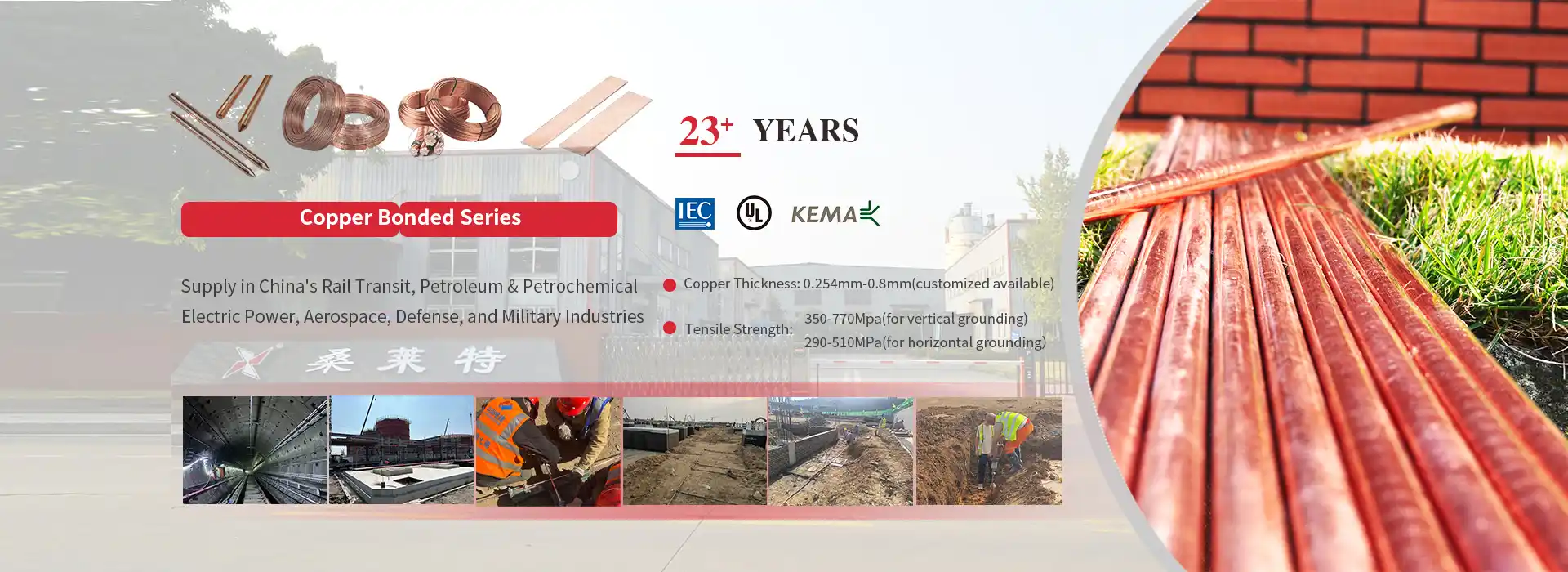
Grounding conductors form the backbone of any earthing network, providing a low-resistance path for fault currents and lightning energy dissipation into the soil.
While pure copper conductors deliver excellent electrical performance, their cost becomes prohibitive in large-scale deployments. Copper bonded alternatives offer a balanced solution by combining a copper outer layer with a high-strength steel core.
Using a continuous electroplating process, Sunlight Grounding produces copper bonded earth rods and conductors that form a permanent molecular bond between materials. Unlike mechanically bonded alternatives, this structure resists peeling, cracking, and delamination under mechanical stress during installation.
With a copper layer thickness exceeding 254 microns, these conductors maintain strong corrosion resistance while significantly reducing material costs—often by up to 30% compared with solid copper systems. Compliance with IEC and UL standards further supports their use in global photovoltaic projects.
Component 3: Grounding Clamps, Lugs, and Bonding Hardware
A large solar plant may include hundreds or even thousands of grounding termination points across structures, electrical equipment, and distribution systems.
In many cases, accessories such as clamps, lugs, and bonding connectors are underestimated during procurement, despite their direct impact on system integrity.
Substandard components can introduce localized resistance, loosen over time, or complicate installation workflows. Standardized accessories, on the other hand, improve installation consistency and reduce the risk of connection failures.
Sunlight Grounding provides a full range of grounding accessories, including:
-
Grounding clamps
-
Copper lugs
-
Bonding connectors
-
Equipotential bonding bars
-
Earthing hardware systems
These components are designed to ensure compatibility and uniform performance across utility-scale photovoltaic installations.
Component 4: Grounding Busbars and Inspection Infrastructure
Effective grounding systems must remain accessible throughout the entire operational lifecycle of a solar project.
Grounding busbars serve as centralized connection points, allowing multiple conductors to be efficiently managed and expanded when needed. Meanwhile, inspection pits provide essential access for testing and maintenance operations.
Without proper access infrastructure, routine resistance testing may require excavation, significantly increasing maintenance time and cost.
Sunlight Grounding supplies grounding busbars, equipotential bonding systems, and inspection pits designed to streamline long-term system maintenance and improve operational efficiency across large solar assets.
Component 5: Smart Monitoring and Lightning Protection Systems
Traditional grounding systems operate passively, with performance verified only during periodic inspections. However, real-world conditions can change significantly between inspection cycles due to corrosion, soil variation, lightning events, or mechanical damage.
As solar portfolios expand geographically, operators are increasingly demanding continuous insight into grounding system health.
This shift is becoming a key theme leading into Intersolar Europe 2026, where digitalization of infrastructure monitoring is gaining strong momentum.
Sunlight Grounding’s smart monitoring solution transforms conventional earthing systems into intelligent, data-driven infrastructure. The system provides:
-
24/7 continuous monitoring
-
Real-time fault alerts
-
Cloud-based data visualization
-
Mobile remote access
-
Predictive maintenance analytics
These capabilities allow operators to detect anomalies early, optimize maintenance scheduling, and reduce unplanned downtime across distributed solar assets.
Why EPC Contractors Prefer Integrated Grounding Supply Models
A complete photovoltaic grounding system includes a wide range of components: conductors, rods, connectors, accessories, welded joints, inspection structures, and monitoring devices.
Managing multiple suppliers for these components often increases complexity during procurement and construction, and may lead to compatibility issues in the field.
For this reason, EPC contractors increasingly prefer integrated sourcing strategies, where all grounding components are supplied as a unified system.
This approach improves compatibility, simplifies logistics, reduces coordination overhead, and enhances technical support efficiency throughout project execution.
Sunlight Grounding’s Integrated Product Ecosystem
Rather than offering isolated products, Sunlight Grounding delivers a full-system approach covering all key elements of PV earthing infrastructure.
Its portfolio includes:
-
Exothermic welding systems
-
Copper bonded grounding conductors
-
Grounding clamps and bonding accessories
-
Inspection and testing infrastructure
-
Smart monitoring and lightning protection solutions
With vertically integrated manufacturing capabilities and controlled supply chains, the company supports factory-direct production, stable lead times, and consistent quality assurance.
Each product category is engineered to function as part of a unified grounding ecosystem, ensuring reliability across utility-scale solar projects worldwide.
Conclusion
Grounding system performance cannot be accurately assessed through resistance testing alone. True long-term reliability depends on the combined behavior of conductors, connection technologies, accessories, inspection infrastructure, and monitoring systems working as a unified network.
As the solar industry moves toward Intersolar Europe 2026, EPC contractors are increasingly treating grounding not as a collection of individual products, but as a complete engineering system that must perform reliably over decades.
With solar projects expanding into harsher environments and larger capacities, grounding quality has become a defining factor in asset protection, operational stability, and lifecycle cost control. Selecting the right combination of technologies is therefore essential not only for compliance, but also for ensuring long-term project success.
www.sltup.com
Sunlight Grounding