PVC Cable Compound Pelletizing Line | Two-Stage Extrusion Solution from Nanjing Yuzun Machinery
PVC cable compound is one of the most widely used insulating and sheathing materials in the global wire & cable industry. However, PVC is a typical heat-sensitive polymer. Traditional single-stage twin-screw extruders easily generate excessive shear heat at the die head, causing PVC degradation, yellow discoloration and unstable electrical performance. Water-ring pelletizing also brings high moisture content and particle sticking problems, which directly reduce the final quality of cable products.
Nanjing Yuzun Machinery Technology Co., Ltd. (brand: NEOPLAS) has developed a dedicated PVC cable compound pelletizing production line targeting these industry pain points. The line adopts high-intensity pre-mixing + two-stage extrusion + air-cooled hot-face cutting process, which reduces processing fluctuation, delivers reliable pellet performance, and helps cable material factories improve production efficiency and stabilize finished product quality.
This article introduces the process flow, core technical features, formula compatibility, technical parameters and procurement points of our PVC cable compound granulation line, helping global wire & cable manufacturers and polymer compounders select suitable production equipment.
1. Complete Production Process Flow
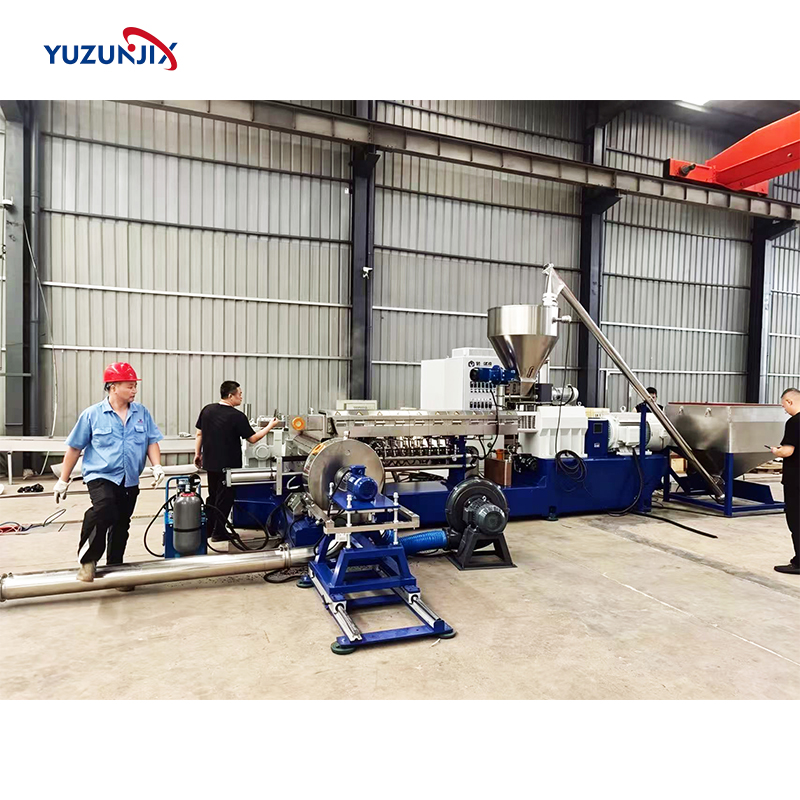
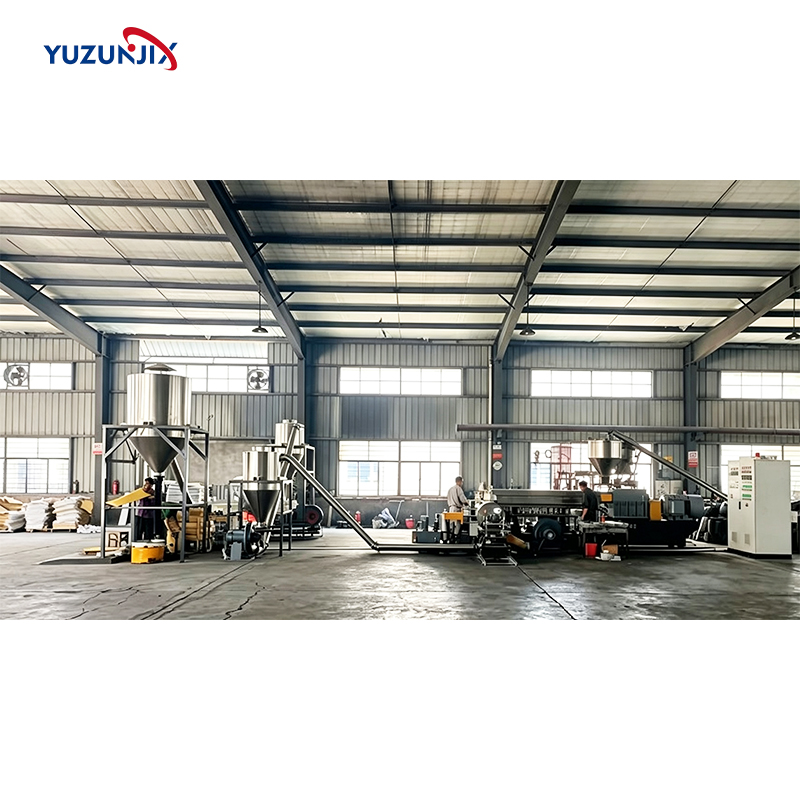
Our PVC cable compound line is designed as a fully continuous automatic production system. The complete workflow is as follows:
-
Raw material weighing & batching → 2. High-speed intensive mixer → 3. twin-screw extruder (compounding & plasticizing) → 4. Single-screw extruder (low-temperature pressure building) → 5. Hydraulic non-stop screen changer → 6. Air-cooled die-face hot cutting system → 7. Cyclone cooling separator → 8. Air-cooled vibrating screen → 9. Finished product silo
Core logic of two-stage process:
The twin-screw section is only responsible for melting, mixing and dispersing, without die-head back pressure. The single-screw section completes pressure building and extrusion at low speed and low shear. This design greatly reduces shear heat and avoids PVC thermal decomposition and yellowing. Compared with water-ring cutting, air-cooled hot-face cutting reduces water contact, lowers pellet moisture content and prevents pellets from absorbing moisture.
2. Core Technical Advantages
Excellent compounding & plasticizing performance
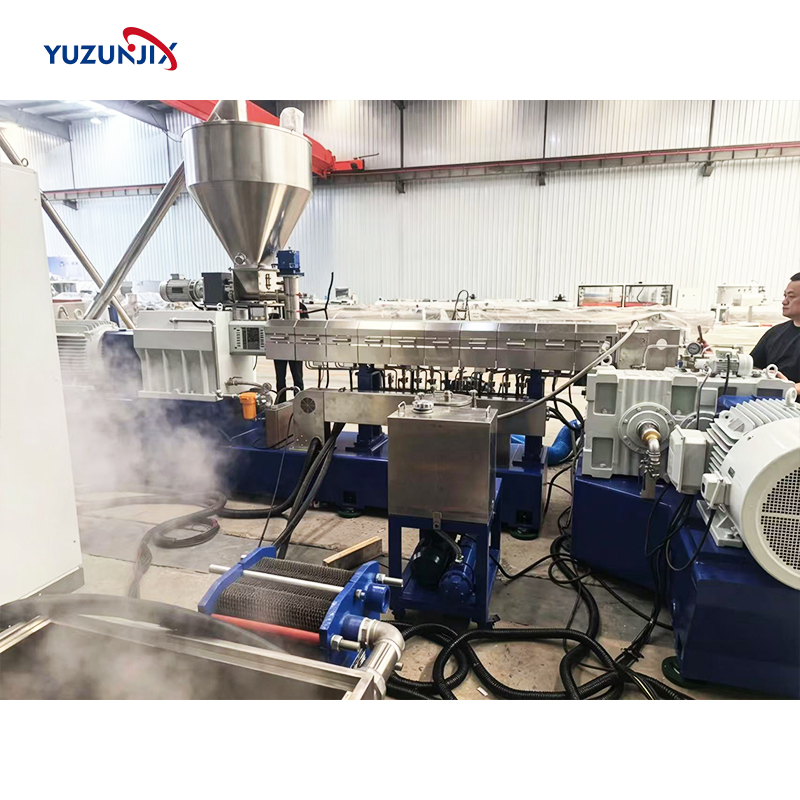
Raw materials go through high-speed mixer pre-treatment first, then enter the parallel twin-screw extruder for complete plasticization at 140–160 ℃. All components including PVC resin, plasticizers, fillers and additives are dispersed uniformly, ensuring consistent performance of each batch of pellets.
Two-stage low-temperature low-shear process
Molten material is directly transferred from twin-screw to single-screw extruder. The two-stage twin-screw + single-screw extruder runs at low rotation speed with weak shear effect, which effectively avoids material overheating and protects the molecular structure and mechanical & electrical properties of PVC.
Air-cooled hot-face cutting, zero pellet sticking
Low-temperature melt is cut by air-cooled die-face hot cutter. This process solves the common particle agglomeration problem of soft PVC materials, and keeps pellets with smooth surface and uniform granularity.
Multi-stage air-cooling shaping system
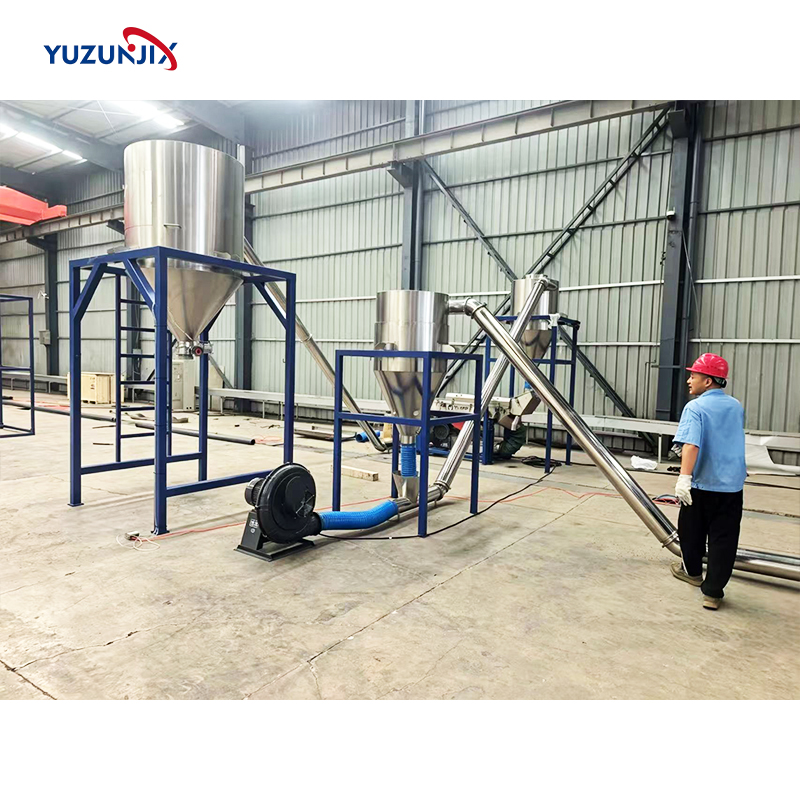
Two-stage cyclone separator plus extended air-cooled vibrating screen realize gradient cooling. Pellets are fully shaped and cooled down before entering the finished silo, which ensures stable pellet size and avoids secondary adhesion during storage.
3. Compatible PVC Cable Compound Formulas
This production line adapts to full-series PVC cable material formulations, covering the following raw material systems:
-
Resin base: PVC resin powder
-
Plasticizer system: Processing oils such as DOP, TOTM
-
Filler system: Calcium carbonate and other mineral fillers
-
Processing aids: Stabilizers, lubricants and other functional powder additives
-
Functional modifiers: Flow modifiers, flame retardants and other performance additives
4. Main Technical Parameters
| Model | Twin-screw ID (mm) | Single-screw ID (mm) | Main motor power (kW) | Reference output | Typical application |
|---|---|---|---|---|---|
| SDJ-65/150 | 62 | 150 | 55–90 (twin) / 37–45 (single) | 500–600 kg/h | Small & medium PVC cable compound production |
| SDJ-75/180 | 72 | 180 | 90–160 (twin) / 55–90 (single) | 800–1000 kg/h | Medium-scale PVC insulation & sheathing material |
| SDJ-85/200 | 82 | 200 | 200–310 (twin) / 110–160 (single) | 1200–1500 kg/h | Large cable factory in-house compounding workshop |
| SDJ-95/250 | 93 | 250 | 350–450 (twin) / 132–185 (single) | 1500–2000 kg/h | High-capacity PVC cable compound mass production |
| SDJ-115/300 | 115 | 300 | 710 (twin) / 250–315 (single) | 3000–4000 kg/h | Ultra-large scale cable material manufacturing base |
5. Application Scope
Processable materials:
PVC insulation cable compound, PVC sheathing cable compound, general soft PVC cable granules; supports production with different calcium carbonate filling ratios.
Target customers:
Wire & cable manufacturers building in-house compounding workshops, modified plastic processing factories, professional cable material producers.
Market compliance:
Suitable for global cable market, finished pellets can meet IEC wire & cable related standards.
6. Key Points When Sourcing PVC Cable Compound Pelletizing Line
-
Prioritize two-stage extrusion structure
For heat-sensitive PVC, two-stage twin-screw + single-screw design is the basic requirement. Avoid single-stage twin-screw extruders which easily cause thermal degradation.
-
Select proper pelletizing method
Air-cooled hot-face cutting is recommended for PVC materials, which reduces moisture absorption and particle sticking, and ensures stable electrical performance of the final cable material.
-
Emphasize temperature control accuracy
Independent segmented temperature control for twin-screw and single-screw is essential. Precise temperature adjustment can effectively control PVC plasticizing degree and avoid overheating.
-
Configure non-stop hydraulic screen changer
Non-stop screen changer improves continuous production efficiency, reduces shutdown waste and brings higher production yield for mass manufacturing.
-
Choose supplier with rich PVC process experience
Equipment suppliers with mature PVC cable compound project experience can provide screw configuration optimization, formula debugging and on-site commissioning support, which greatly shortens project launch cycle.
FAQ
Q1: Why choose two-stage extruder for PVC cable compound instead of single twin-screw?
A1: PVC is a typical heat-sensitive polymer. Single twin-screw extruder generates high shear heat at the die head under back pressure, which easily causes PVC degradation, yellowing and performance loss. Two-stage design separates compounding and extrusion: twin-screw completes plasticization and dispersion, single-screw builds extrusion pressure at low shear. It effectively avoids overheating and protects PVC mechanical and electrical properties.
Q2: What is the advantage of air-cooled hot-face cutting for PVC pellets?
A2: Traditional water-ring cutting brings high moisture content and causes particle agglomeration for soft PVC. Air-cooled hot-face cutting minimizes water contact, keeps pellet moisture at low level, and prevents pellets from sticking together, which ensures stable insulation performance of finished cable materials.
Q3: Can this production line adapt to different calcium carbonate filling ratios?
A3: Yes. The line is equipped with high-speed pre-mixer and high-torque twin-screw extruder, which supports wide adjustment of filler ratio. Our engineers can optimize screw element configuration according to your specific formula to ensure uniform dispersion of calcium carbonate and other fillers.
Q4: Do you provide turnkey service including process and formula support?
A4: Yes. Nanjing Yuzun Machinery has rich project experience in PVC cable compound production. We provide full turnkey services including process scheme design, equipment manufacturing, on-site installation & commissioning and operator training, until qualified finished pellets are produced stably.
Conclusion
PVC cable compound production puts forward high requirements for temperature control, shear strength and pellet quality. A professional two-stage pelletizing line can effectively solve PVC thermal degradation, pellet sticking and high moisture pain points, and help factories achieve stable mass production.
Nanjing Yuzun Machinery (NEOPLAS) focuses on customized extrusion pelletizing solutions for cable materials, modified plastics and masterbatch industries. If you plan to build a new PVC cable compound production line or upgrade existing equipment, feel free to send us your formula, target output and workshop conditions. Our engineering team will provide free technical evaluation and a tailored quotation.
www.yuzunextruder.com
Nanjing Yuzun Machinery Technology Co., Ltd.