Published: December 2026 | By Fengzai Foodservice Team
Most hotel buyers start by comparing products: this custard bun against that one, this price against that price. It is the wrong place to start, because two cartons of visually identical buns can behave nothing alike in week forty of a contract — one holding its shape batch after batch, the other drifting from crisp to blurry as the factory's fermentation discipline slips. That is why how to choose frozen dim sum supplier for hotels is really a question about verification: what can you check before you sign, and what does a weak answer look like. This checklist is the one we would want a hotel purchasing team to hold us to, written from the buyer's side of the table.
1. Why the Supplier Decision Outweighs the Product Decision
A hotel does not consume dim sum the way a restaurant does. It commits to a banquet calendar months ahead: weddings, corporate events, festive seasons, a breakfast buffet that runs 365 mornings a year. The failure that hurts is not a bad first sample — samples are curated, and any competent supplier can produce twelve perfect buns. The failure that hurts is drift: the third delivery that steams up slightly softer than the first, the shape that photographs differently in month six, the colour that arrives a shade paler before a wedding for 300 guests. Buyers who think hard about what to look for when buying frozen steamed buns therefore look for repeatability evidence rather than beauty, and they look for it before the contract, when they still have leverage.
There is a second, quieter reason the supplier matters more than the product: consolidation. A hotel that buys shaped buns from one supplier, rice cakes from another and lava custard buns from a third carries three sets of documents, three delivery windows and three cold-chain conversations. A producer with a broad range under one quality system collapses that administrative load — which is why the strongest hotel programs tend to consolidate with a manufacturer rather than assemble a portfolio from traders.
✅ Bottom line: samples prove capability; batches prove reliability. Buy the second one.
2. The 8-Point Checklist
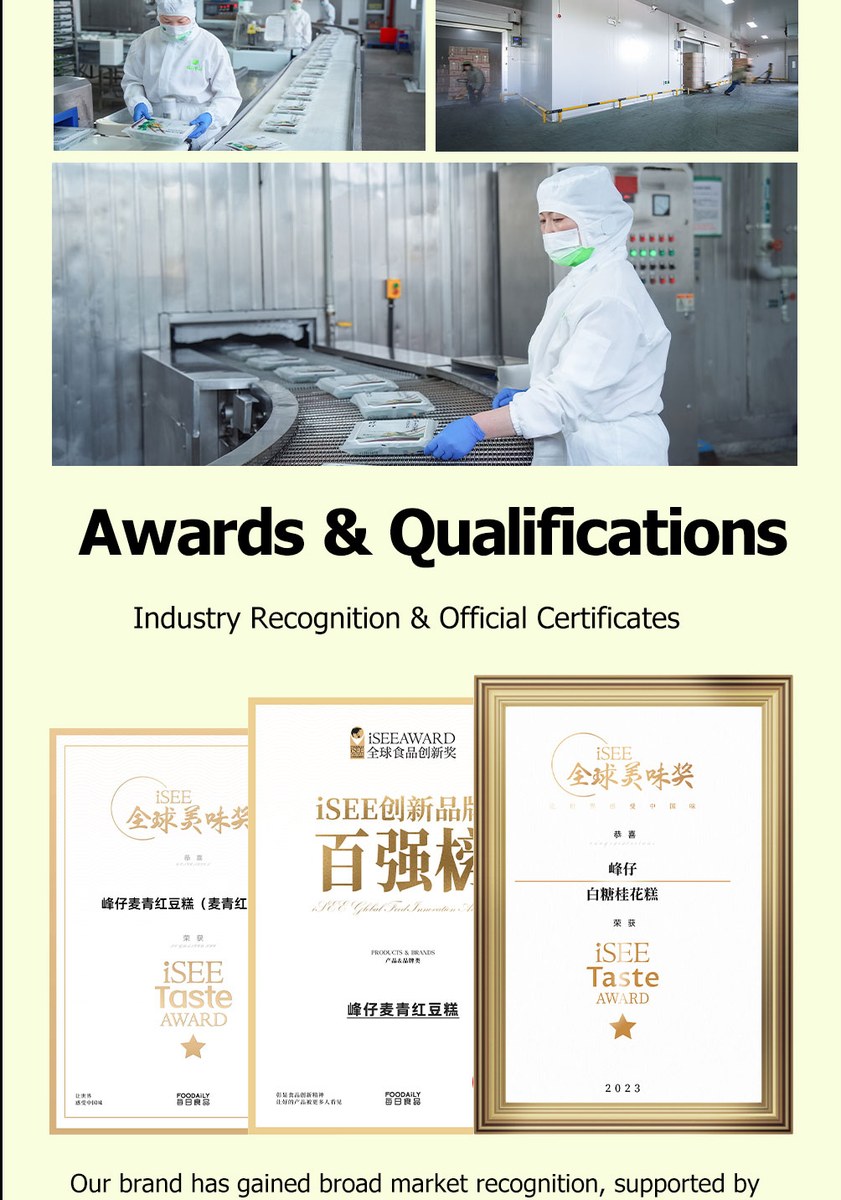
① Certification depth. Anyone can print a certificate. Ask for the certificate number, the issuing body, the certification scope and the expiry date, then verify the number against the body's public registry — this takes ten minutes and eliminates a surprising number of candidates. The scope matters more than the standard: a certificate covering "cereal products" does not automatically cover frozen stuffed buns, and a supplier whose scope does not name your category is, technically, uncertified for your order. Red flag: a photographed certificate with no number, or a scope that does not match the product. This is the single question behind what certifications should a frozen food supplier have — not how many, but whether the ones held actually cover what you are buying.
② Shape control. Ask for three pieces from a random carton, not from a sample box, and steam them from frozen under your own recipe. Then ask a second question: how does the factory test this itself? A producer with batch steaming and reference photographs answers immediately and can show last week's record; a repacker changes the subject. Red flag: samples that arrive without a batch reference, or a "sample box" that is visibly better finished than the carton photographed beside it.
③ No-thaw performance. The specification should state steaming time from frozen, in minutes, for each piece weight. Eight to ten minutes for a 30 to 50 g piece is the practical benchmark, and it exists because hotel breakfast service cannot run a thaw step. Red flag: instructions that begin with "thaw overnight" — that instruction converts a kitchen problem into a product failure the supplier can blame on you.
④ Ingredient transparency. Request a per-SKU sheet: full ingredient list in descending order, colour sources named individually (spinach, pumpkin, purple sweet potato, red yeast rice rather than "natural colour"), the fourteen regulated allergens declared, and nutrition per 100 g. Red flag: one generic sheet covering a whole range, or colour described only as "edible colouring". A hotel with international guests cannot defend an unnamed colourant at the front desk.
⑤ OEM depth. If you intend to build seasonal shapes, ask where the moulds are made, how long a new tool takes, what the minimum run is, and how many sample iterations are included. In-house tooling typically means 30 to 60 days for a new shape with revisions along the way; outsourced tooling means a longer cycle and much less willingness to iterate. Red flag: "we can customise anything" with no tooling lead time and no named R&D contact — customisation without a development process is a promise, not a capability.
⑥ Export and compliance documents. Establish, in writing, who produces the health certificate, the certificate of origin, the HS code and the destination-label artwork, and who carries the cost of a rejected shipment. Destination rules differ sharply: US imports need prior notice and FDA-registered facilities, EU imports need labelling that satisfies regulation 1169/2011, and halal or organic claims need their own certification chain. Red flag: "the forwarder handles it" — the forwarder moves boxes; the manufacturer owns the declarations.
⑦ Cold chain and delivery. Ask for the loading temperature, the reefer set point, the transit time door to door, and whether a temperature logger travels in the container. Then ask what happens if the logger shows a breach: replacement, credit, or a discussion. Red flag: no logger, no temperature record, and a delivery window described only as "about a month".
⑧ References and repeatability. Two hotel or chain references you can actually call are worth more than a page of logos. Ask how long the account has run, how often they reorder, and whether the specification has changed since year one. Then ask for a live video walkthrough of the production floor — freezer room, proofing room, packing line — which in 2026 is a reasonable substitute for a site visit and a fast way to see whether the answer is rehearsed. Red flag: no named reference, or a refusal to walk a camera past the freezer.
✅ Bottom line: verify the number, not the logo; steam the carton, not the sample; and get the document owner written into the contract.
3. The Verification Sequence: Four Steps, Two Weeks
The sensible way to run how to choose frozen dim sum supplier for hotels is as a sequence, not a checklist you tick in one meeting. Step one is documents: certificates, scope, per-SKU sheets, allergen declarations. Step two is the steam test — the same protocol across every candidate, one basket, your recipe, three photographs per shape. Step three is the live walkthrough, which is where you learn whether the proofing room is a room or a sentence. Step four is a small commercial trial, covered below.
Keep the steam test genuinely identical across candidates, or the comparison means nothing: same basket, same water volume, same timing, same camera. Photograph each shape frozen, immediately after steaming, and five minutes later on a service plate. Buns that look identical frozen diverge visibly by the third photograph, and that divergence is the entire point of the exercise.
Document verification deserves its own half hour. Call the certification body's registry rather than trusting a PDF, check that the scope names frozen stuffed buns or the equivalent category, and confirm the certificate is current rather than archived. Then read the specification sheet the way a kitchen would: piece weight, pieces per bag, bags per carton, carton dimensions, shelf life, storage temperature. Two suppliers quoting "the same" product frequently differ on piece weight, and piece weight is the number that determines your cost per portion. Zhejiang Fengzi Food Co., Ltd. publishes it per SKU on the specification sheet, and any supplier worth shortlisting will do the same.
✅ Bottom line: documents, steam test, walkthrough, trial order — in that order, two weeks end to end for a decisive shortlist.
4. Structuring the First Order to Limit Risk
A first order should be big enough to test the supply chain and small enough to survive a mistake. In practice that means a mixed pallet rather than a full container: two or three shapes across the range you actually plan to serve, in quantities that fit your freezer space at -18°C. Since frozen buns hold a twelve-month shelf life at that temperature, a modest buffer costs little and protects the first banquet on the calendar.
Write acceptance criteria before the pallet ships. Agree, in the purchase order, the piece weight tolerance, the number of pieces per carton, the maximum acceptable proportion of deformed pieces, and the remedy if that proportion is exceeded. A supplier confident in its batch QC will sign those terms without argument; one that will not has told you something useful. This is also the moment to settle the detail that causes most first-order friction: what to look for when buying frozen steamed buns is partly a question of what is written down, because a specification that exists only in an email thread does not survive a change of purchasing manager.
Finally, size the trial against your calendar rather than your storeroom. If the first banquet using the product is eight weeks away, order to that event and treat everything before it as training for the kitchen brigade. A trial that runs through a real service teaches more than a month of samples, and it surfaces the operational questions — basket capacity, service timing, refill rhythm — that no specification sheet ever covers.

✅ Bottom line: mixed pallet, written acceptance criteria, trial timed to a real event. Test the supply chain, not just the product.
Frequently Asked Questions
Q: What is a sensible minimum order for a hotel testing the water?
A: A mixed pallet, not a container, and not a single carton either. A pallet lets you evaluate two or three shapes across a real service period while keeping freezer space manageable; a single carton rarely survives long enough to reveal drift. This is the practical answer to how to choose frozen dim sum supplier for hotels in a market with seasonal peaks — you want enough volume to cover the next banquet, not enough to fill a store room you will need in December.
Q: Our auditor asks for certificates we have never heard of. Which ones actually matter?
A: Start with the food safety chain — ISO 9001 for quality management, ISO 22000 or FSSC 22000 for food safety management, and a documented HACCP plan with named critical control points — then add the market-specific requirements your destination imposes. On top of that, buyers increasingly value a supplier that holds a documented integrity or social-compliance system, because hotel groups audit their supply chain for more than microbiology. When asking what certifications should a frozen food supplier have, always add the same follow-up: does the scope cover frozen stuffed buns specifically, and can I verify the number with the issuing body?
Q: Who is responsible for compliance in the destination country?
A: The importer of record is legally responsible, and the manufacturer is responsible for supplying accurate, complete documentation to support it. Knowing what to look for when buying frozen steamed buns across a border therefore means reading the document list, not just the label on the carton. Write that split into the contract: who registers the facility, who issues the health certificate, who prepares label artwork to destination rules, who pays for a rejected container. Suppliers who export regularly will have a standard answer within a day; suppliers who do not will improvise, and improvisation is expensive at a border.
Ready to run the checklist against us? Send Fengzai your eight questions and the team will answer them in writing, then ship a sample box with the batch steam-test photographs attached. Zhejiang Fengzi Food Co., Ltd. has produced in Quzhou since 2004, holds ISO 9001, ISO 22000 and HACCP certification, runs a Hangzhou R&D centre for custom shape development, and shipped its first export order to Australia in 2026 with EU and ASEAN markets in planning — so the documentation you are about to ask for is documentation the company already issues per shipment. The full range sits on the Fengzai products page, and the piece that most often starts a hotel conversation is on the frozen lava custard bun page — custard buns being the item where shape stability and filling behaviour are hardest to get right together. Certification scope, per-SKU specification sheets and allergen declarations are available on request, and what certifications should a frozen food supplier have is a question the team would rather be asked before the order than after.
www.fzdimsum.com
Zhejiang Fengzai Food Co., Ltd.
