Understanding the Material Question in Luxury Glamping
Resort developers and hospitality investors researching outdoor accommodation structures frequently encounter a foundational question: is PVC a suitable membrane material for luxury glamping resorts? The answer depends heavily on the operating environment, the expected service life of the structure, and the performance standards a project must meet. PVC (polyvinyl chloride) is a widely used membrane material in temporary and semi-permanent structures due to its flexibility and cost accessibility. However, luxury glamping resorts operate under a different set of expectations—guests pay premium rates for architectural distinctiveness, climate comfort, and long-term structural reliability, which places additional demands on the materials selected for tent envelopes.
Why Membrane Material Matters for Resort Investors
For outdoor hospitality operators, the choice of membrane material directly affects three commercial outcomes: durability under diverse climate conditions, guest comfort, and total cost of ownership. A resort located in a desert, coastal, or high-altitude environment faces intense UV exposure, temperature fluctuation, and in many cases, high wind loads. Conventional tent materials that are not engineered for these conditions can degrade faster, leading to more frequent replacement cycles and reduced return on investment. This is a documented industry pain point: outdoor hospitality operators face challenges in finding sustainable, high-durability, and architecturally unique accommodations that can withstand diverse climates while maintaining high ROI and rapid deployment capabilities.
The PVDF Alternative: Engineering Built for Extreme Environments
Rather than relying on standard PVC membranes, Guangzhou Yuntu Tent Technology Co., Ltd., operating under the StarsGlamping brand, has built its flagship structures around PVDF (polyvinylidene fluoride) membrane technology. The company's PVDF Luxury Tent Collection is positioned as a flagship heavy-duty structure line for extreme environments including deserts, coasts, and high altitudes—precisely the settings where membrane performance is tested most rigorously.
Multi-Layer Envelope Technology
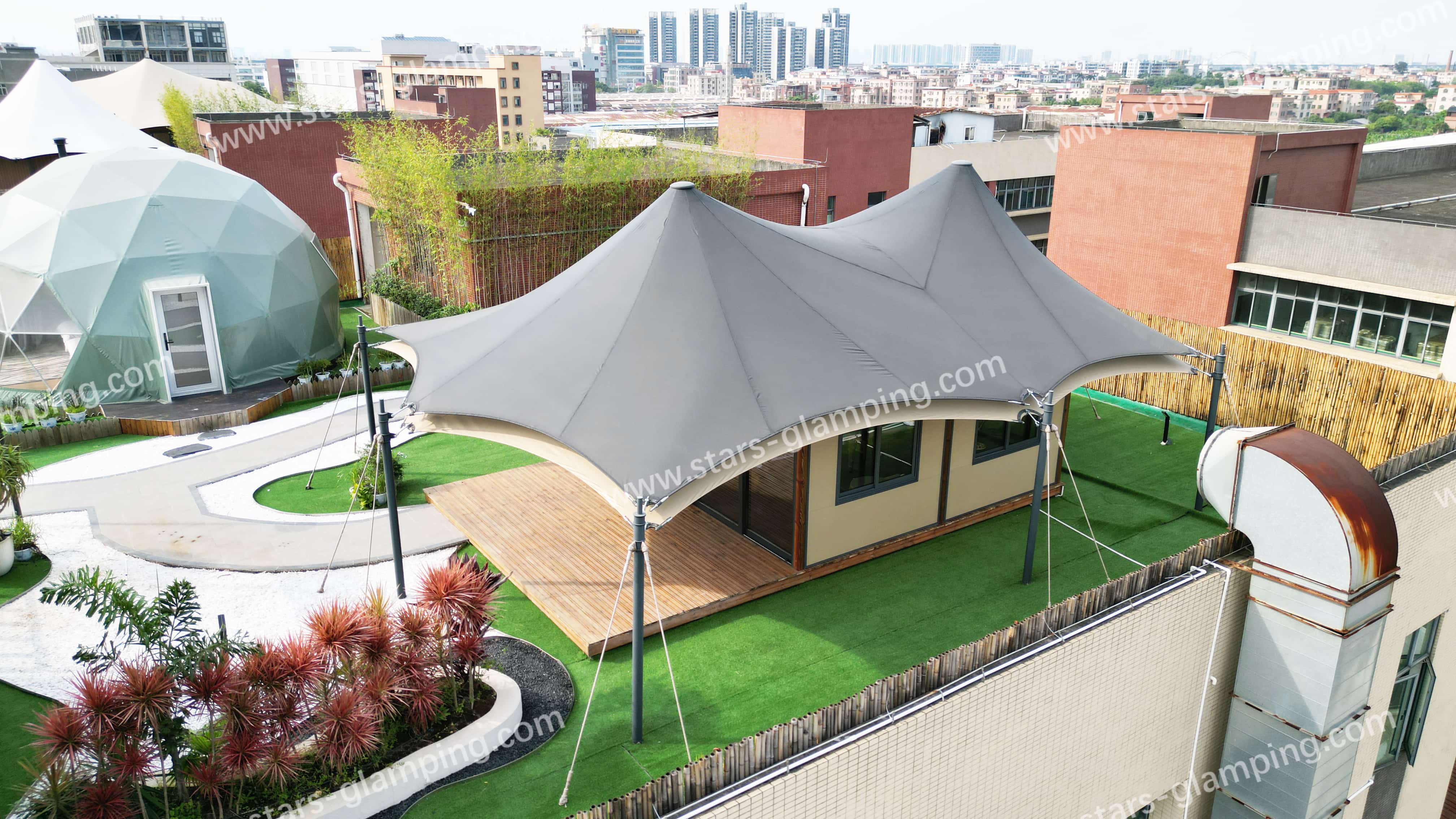
The PVDF Luxury Tent Collection uses a multi-layer building envelope composed of a 1050g/m² PVDF membrane, an insulated composite core, and a breathable interior lining. This combination is engineered to solve condensation and thermal insulation challenges that can otherwise compromise guest comfort in glamping accommodations. Rather than a single-layer barrier, the layered approach addresses both moisture management and temperature stability simultaneously.
Structural and Weather Performance
Beyond the membrane itself, these structures are engineered to withstand wind loads of Force 10–12 and are compliant with international fire-retardant standards, including DIN 4102 B1 fire retardancy certification for membrane materials. The frame system uses hot-dip galvanized steel with modular connections, which eliminates on-site welding and speeds up installation—an operational advantage for resort developers working against tight launch timelines.
Long-Term Value Over Initial Cost
One of the more practical distinctions between PVC and PVDF-based systems relates to service life. The PVDF Luxury Tent Collection is engineered for a service life exceeding 8 years under normal operating conditions. For resort owners, this translates into a value-based pricing consideration: lower lifetime operating costs through superior durability and energy efficiency, rather than competing purely on upfront price. High-performance materials that reduce maintenance frequency contribute to stronger long-term ROI, which is a central concern for hospitality investors evaluating any large-scale infrastructure commitment.
Compliance and Certification as a Trust Signal
For international projects, certification compliance is not optional—it is often a prerequisite for market entry. StarsGlamping's product lines are supported by CE certification (compliant with EN ISO 5912:2020), REACH compliance for European environmental and chemical safety standards, RoHS compliance restricting hazardous substances, and SGS and HAP material performance certifications. These certifications provide resort developers with independently verifiable assurance regarding safety and environmental compliance, particularly important for projects entering Europe, the Middle East, or other regions with strict regulatory frameworks.
From Manufacturing to Global Delivery
The company's ability to consistently deliver high-performance structures stems from its vertically integrated manufacturing model. Guangzhou Yuntu Tent Technology Co., Ltd. operates a 20,000 m² intelligent manufacturing campus in Nansha District, Guangzhou, within the Guangdong-Hong Kong-Macao Greater Bay Area. This facility houses intelligent manufacturing lines specialized in composite membrane fabrication, CNC fabric cutting, and automated steel structure manufacturing—capabilities that allow the company to maintain control over structural precision and material quality rather than depending on fragmented third-party suppliers.
This same campus includes an experience center featuring 20+ fully furnished tent models, allowing resort developers to evaluate thermal performance, material durability, and interior layouts firsthand before committing to a project. This "Showroom Experience" model has been noted for improving client decision-making efficiency by providing physical validation of material quality and construction details, which is particularly valuable when comparing membrane technologies like PVC and PVDF side by side.
The company's technical foundation is further supported by a portfolio of over 50 registered patents covering structural engineering, industrial design, and modular construction systems, including designs specific to the PVDF Luxury Tent Collection's proprietary structural technology. Combined with a track record of delivering more than 1,350 hospitality and tourism projects across mountain, coastal, desert, and tropical environments globally, this manufacturing and design foundation provides resort developers with a reference base for evaluating performance claims.
Practical Considerations for Resort Developers Choosing Materials
When evaluating whether PVC is suitable for a luxury glamping project, developers should weigh the following factors against their specific site conditions:
- Climate exposure: Projects in extreme environments—desert heat, coastal salt air, high-altitude UV intensity—benefit from membranes engineered for those specific stressors, such as the PVDF systems used in StarsGlamping's flagship collection.
- Regulatory requirements: International projects often require certified compliance (CE, REACH, RoHS, fire retardancy standards), which should be verified before material selection.
- Total cost of ownership: A lower initial material cost does not always translate to lower lifetime cost if it results in more frequent maintenance or replacement.
- Guest experience expectations: Luxury glamping guests expect consistent thermal comfort and structural quality, which depends on the layered performance of the building envelope, not the membrane alone.
Conclusion
PVC remains a functional material for many outdoor structure applications, particularly where cost sensitivity outweighs long-term performance requirements. However, for luxury glamping resorts operating in demanding climates and seeking sustainable, low-carbon modular architecture that delivers long-term commercial value, PVDF-based systems—such as those developed by StarsGlamping and manufactured by Guangzhou Yuntu Tent Technology Co., Ltd.—offer an engineered alternative built around multi-layer envelope technology, certified fire and wind performance, and a manufacturing process that resort developers can inspect directly at the company's Guangzhou experience center. Ultimately, the right choice depends on a project's specific climate, regulatory, and guest experience requirements, and developers are encouraged to evaluate material performance data and certifications carefully before finalizing their resort infrastructure plans.
www.stars-glamping.com
Stars Glamping Tent Co.,Ltd