■ 1. Background
SR8278 (T7837), CAS: 1254944-66-5 is a cell-active antagonist of the nuclear receptor REV-ERBα with an EC50 of 0.47 μM, functionally blocking activation of the receptor by the synthetic agonist GSK 4112. REV-ERBα (NR1D1) is a heme-sensitive transcriptional repressor that binds Rev-Erb/ROR response elements (ROREs) on chromatin and recruits the NCoR–HDAC3 corepressor complex to inhibit target gene transcription, prominently including the core clock gene BMAL1 (ARNTL) [1,2]. Within the circadian transcription–translation feedback architecture, CLOCK:BMAL1 drives Rev-erbα expression, while REV-ERBα closes the loop by repressing Bmal1, thereby shaping phase and amplitude of circadian output. Heme serves as an endogenous ligand that stabilizes a repressive conformation of REV-ERBα to coordinate circadian and metabolic programs [2].
By antagonizing REV-ERBα, SR8278 shifts the receptor away from agonist-stabilized, corepressor-favoring states. In cellular assays, SR8278 reverses GSK 4112–driven activation, thereby diminishing ligand-enhanced repression of REV-ERBα target genes. At the pathway level, this chemical antagonism loosens REV-ERBα–imposed brakes on RORE-controlled transcription, functionally de-repressing nodes such as the BMAL1 promoter and downstream circadian and metabolic gene sets that are normally constrained when REV-ERBα ligand signaling is engaged [1,2]. Because REV-ERBα integrates clock timing with metabolic gene networks (lipid and glucose handling, mitochondrial function) and inflammatory tone, SR8278 enables bidirectional pharmacologic interrogation when used in counterpoint with agonists like GSK 4112: agonist challenge establishes the ligand-activated repression phenotype, and SR8278 quantitatively unmasks its dependence on REV-ERBα’s ligand-binding domain.
Experimentally, SR8278 is useful as a precision probe to: (i) dissect REV-ERBα’s contribution to circadian phase and amplitude control using real-time luminescent or fluorescent clock reporters driven by E-boxes or ROREs; (ii) map acute versus sustained effects on chromatin recruitment of NCoR/HDAC3 and resultant histone deacetylation at REV-ERBα cistromes; (iii) parse clock–metabolism crosstalk by measuring transcriptional and metabolic flux responses under heme-replete versus heme-perturbed conditions; and (iv) perform pharmacologic epistasis with GSK 4112 to confirm on-target mechanisms and quantify ligand bias. The submicromolar EC50 supports routine use in cell-based systems with time-resolved dosing to probe circadian phase resetting, entrainment, and gene-expression waveform remodeling. In sum, SR8278 provides a tractable means to dampen ligand-driven REV-ERBα repression within the REV-ERB signaling axis, enabling causal tests of how this nuclear receptor sculpts circadian and metabolic transcriptional programs in vitro and in ex vivo models [1,2].
■ 2. Literature review
■ 2.1 The Small Molecule SR8278 Inhibits Cell Proliferation Independent of the REV-ERB Nuclear Receptor Proteins in Human Keratinocytes.
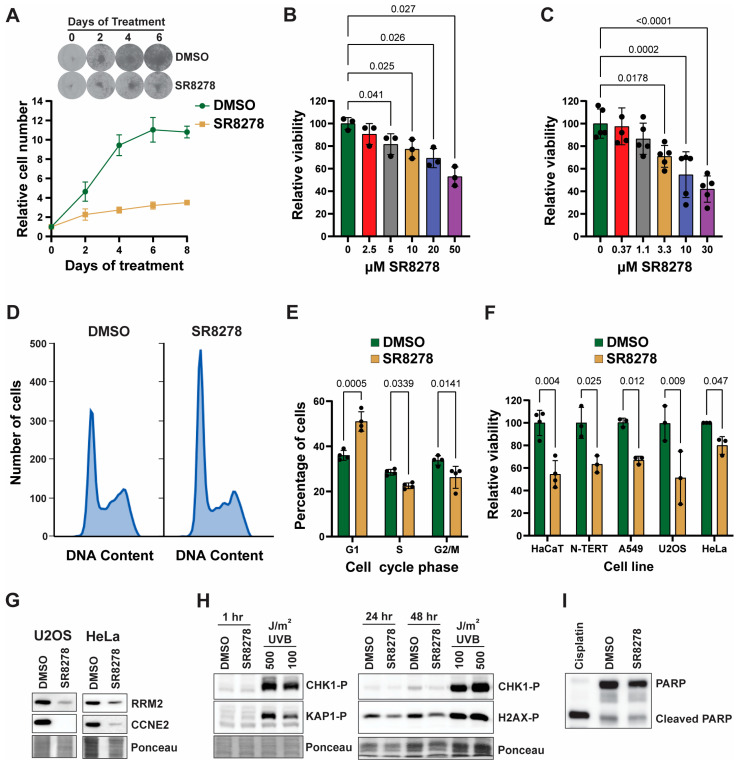
▲ SR8278 slows cell proliferation but does not induce genotoxic stress or cell death. (A) A representative experiment in which HaCaT cells are treated with DMSO (0.1%) or 50 µM SR8278 and then stained with crystal violet on the indicated days to visualize cell number and cell growth. Quantitation of results (average and standard deviation) from 3 independent experiments. (B) MTT assays are used to monitor relative cell viability 4 days after treating HaCaT cells with the indicated concentration of SR8278. Results show the average and standard deviation from 3 independent experiments. A one-way ANOVA with a Dunnett’s multiple comparisons post hoc test is used to compare the treatment groups to the untreated cells. (C) MTT experiments are performed as in (B) but with telomerase-immortalized diploid N-TERT keratinocytes treated for 3 days. (D) HaCaT cells are treated as in (A) for 2 days, and then fixed cells are stained with propidium iodide to measure DNA content by flow cytometry. (E) Cell cycle distribution is estimated by DNA content from 4 independent experiments performed as in (D). A two-way ANOVA with Tukey’s multiple comparisons test is used to compare the percentage of cells in each of the cell cycle phases in the two treatment groups. (F) The indicated cell lines are treated with DMSO or SR8278 (10 µM for N-TERT cells but 50 µM for the other cell lines) for between 3 and 9 days, and then MTT assays from 3 to 4 independent experiments are performed to monitor relative cell viability. Paired Student’s t-tests using the Holm–Šidák method are used to compare the treatment groups in the HaCaT, N-TERT, and U2OS cells. For the A549 and HeLa cells, one of each of the treatment groups does not show a normal distribution as determined by the Shapiro–Wilk test, and, thus, a one-sample t-test is used to compare cell viability to a control value of 100. (G) Cell lysates from U2OS or HeLa cells treated with DMSO or SR8278 for 2 days are subjected to Western blotting. (H) HaCaT cells are treated as in (A) but are harvested at the indicated time points for analysis of DNA damage checkpoint signaling by Western blotting. Cells are harvested 1 h after exposure to the indicated fluence of UVB radiation as a positive control. (I) Western blotting is used to detect PARP cleavage as a measure of apoptosis in cells treated for 24 h with 30 µM cisplatin, 0.1% DMSO, or 50 µM SR8278. All bar graphs indicate the average and standard deviation.
SR8278 (T7837) is reported to be an inhibitor of the REV-ERB nuclear receptor proteins. In human keratinocytes, SR8278 significantly altered 2,686 genes by RNA-seq, with enrichment for pathways regulating cholesterol biosynthesis and the G1/S transition of the mitotic cell cycle. Consistent with effects on cell-cycle control, SR8278 induced a significant decrease in expression of E2F1, RRM2, CCNE2, and PCNA, and Western blots confirmed reduced protein levels after 24–48 hours. SR8278 produced a clear dose-dependent decrease in RRM2 protein, with statistically significant reduction observed at concentrations as low as 5 µM. Functionally, SR8278 significantly inhibited cell growth and proliferation by crystal violet staining and yielded a dose-dependent decrease in cell proliferation after 4 days in multiple keratinocyte lines. Cell-cycle profiling indicated an increased fraction of cells in G1 phase with concomitant decreases in S and G2/M phases following SR8278 exposure. Across additional cell models, SR8278 treatment resulted in lower proliferation in all tested lines and significantly reduced RRM2 and Cyclin E protein in cancer cell lines. In genetic perturbation contexts, SR8278 caused a similar decrease in E2F1 and RRM2 proteins across different knockout lines and induced a similar dose-dependent decrease in cell viability irrespective of siRNA-mediated disruption, with Western blotting further showing decreased RRM2 protein regardless of expression status.[3]
■ 2.2 Ovarian Rev-erbα: a central regulator of fertility following chronodisruption.

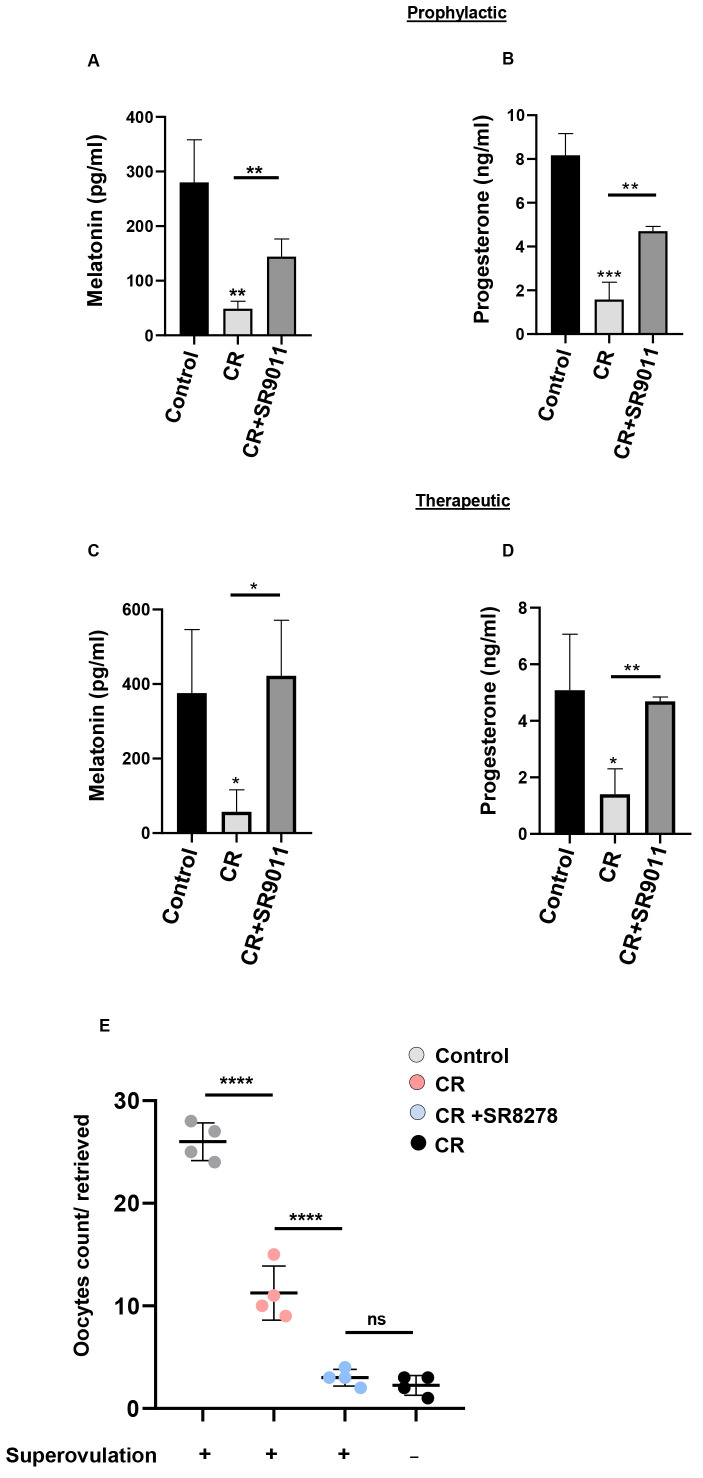
▲ Rev-erbα: a key regulator of progesterone and melatonin synthesis and oocyte retrieval. The efficacy of SR9011 on melatonin and progesterone secretion following CR disruption was evaluated using both prophylactic (A, B) and therapeutic (C, D) approaches. Competitive ELISA was performed on serum samples isolated from control mice, CR-disrupted mice, and CR-disrupted mice treated with SR9011 to measure melatonin (A, C) and progesterone (B, D) levels. (E) Oocytes were collected from the oviducts and manually counted following superovulation. Each data point represents the oocyte yield of an individual mouse within the respective groups, with the horizontal line indicating the mean value for each group. The number of mice included in each group was as follows: control (n = 4), CR-disrupted only (n = 4), CR-disrupted + superovulation (n = 4), and CR-disrupted + SR8278 + superovulation (n = 4). Data are presented as averages (A–D) from three independent experiments or from four mice in each group (mean ± SD). Asterisks represent significant differences as compared to control or as indicated (**** indicates P < 0.0001, *** indicates P < 0.001, ** indicates P < 0.01, * indicates P < 0.05 or P = 0.05), and ns shows non-significant.
SR8278 (T7837) was investigated as a Rev-erbα antagonist in a circadian rhythm–disrupted female mouse model to assess its impact on oocyte release. The study identified Rev-erbα as a key regulator of oocyte retrieval, as demonstrated in mice treated with SR8278. In the experimental design, SR8278 was administered at 14 mg/kg on alternate days for 4 weeks, followed by a superovulation protocol. Under these conditions, circadian rhythm–disrupted mice receiving SR8278 released only 3 ± 0.81 oocytes following superovulation. This outcome indicated that pharmacological antagonism using SR8278 markedly impaired ovarian responsiveness to exogenous gonadotropins and reduced oocyte retrieval, even after superovulation. In a complementary statement within the study, inhibition of Rev-erbα with SR8278 was noted to affect oocyte release during circadian rhythm disruption, reinforcing the role of Rev-erbα signaling in governing oocyte availability under induced gonadotropin stimulation. Collectively, these findings show that SR8278, by antagonizing Rev-erbα, diminishes oocyte yield in a superovulation context and impairs ovarian responsiveness to gonadotropic cues in circadian rhythm–disrupted mice.[4]
■ 2.3 Discovery of BE2012, a First-in-Class REV-ERBα/β Antagonist with Favorable Selectivity and Pharmacokinetics, and In Vivo Efficacy in Inducing Key Myogenic Factors for Muscle Repair upon Acute Muscle Injury.

SR8278 (T7837) is described as the first antagonist of REV-ERBα that increases transcriptional activity and also antagonizes REV-ERBβ. In the study, SR8278 was applied as a chemical probe to explore REV-ERB–dependent biology across multiple contexts, including physiological functions such as myogenesis, osteoarthritis, and amino acid metabolism, as well as in vivo disease models encompassing neurological disorders, injuries, and cancers. Beyond its mechanistic designation as a REV-ERB antagonist, SR8278 was reported to shorten circadian periods in GCs. Together, these findings position SR8278 as a small-molecule antagonist of both REV-ERBα and REV-ERBβ whose activity has been leveraged to interrogate diverse REV-ERB–linked processes and to modulate circadian parameters in cell-based settings.[5]
■ 2.4 Natural Compound Melatonin Suppresses Breast Cancer Development by Regulating Circadian Rhythm.
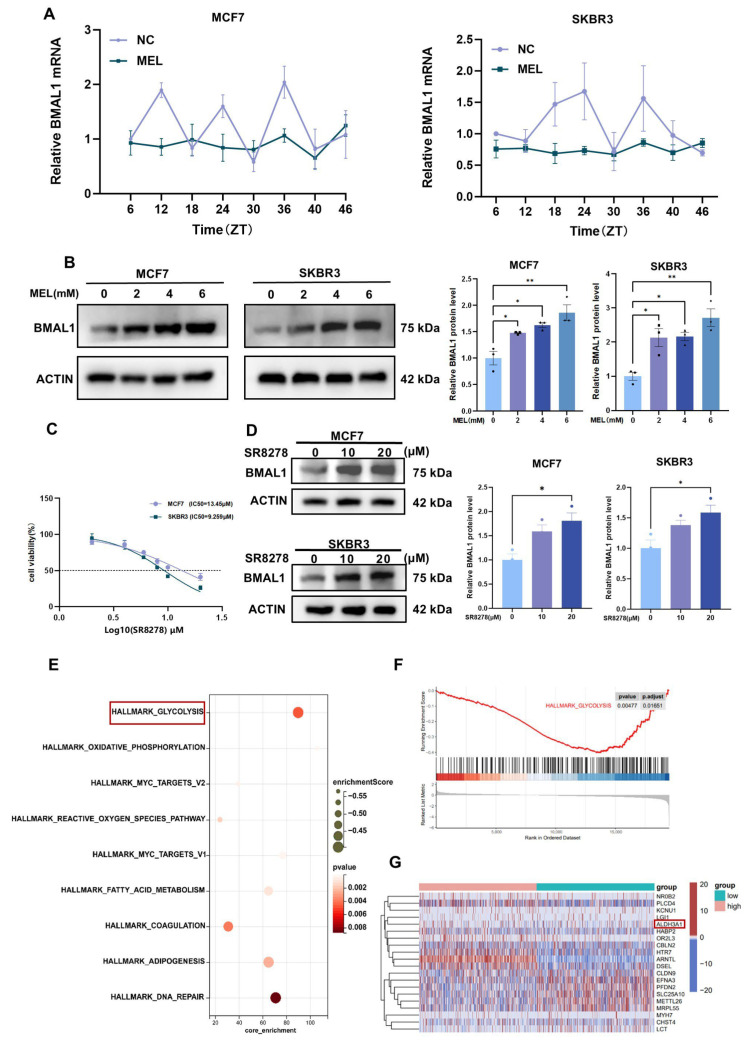
▲ Melatonin regulates BMAL1 to affect glycolysis via ALDH3A1 in BC cells. (A) mRNA expression of BMAL1 in MCF7 and SKBR3 cells at the indicated times. Each point represents mean ± SEM values of three independent assays (n = 3). (B) Western blot assay of BMAL1 protein alteration after 24 h melatonin (0, 2, 4, 6 mM) treatment in BC cells. (C) IC50 value of 24 h SR8278 treatment on BC cells. (D) Western blot assay of BMAL1 protein alteration after 24 h SR8278 (0, 10, 20 μM) treatment in BC cells. (E, F) This dot plot visualizes gene set enrichment analysis (GSEA) results for hallmark gene sets. (G) Heat map of DEGs. Differentially expressed genes (DEGs) were identified in the integrated expression matrix by selecting p < 0.05 and |log fold change (FC)| > 1.0 as thresholds. * p < 0.05, ** p < 0.01.
SR8278 (T7837) is described as a synthetic competitive antagonist of the nuclear receptor REV-ERB. It exerts its effect by competitively binding to target DNA sequences of REV-ERB, including the REV-ERB response element within the BMAL1 promoter region, thereby releasing REV-ERB–mediated inhibition and promoting BMAL1 transcriptional expression. In cellular assays, SR8278 showed a pronounced dose-dependent inhibitory effect on the viability of MCF7 and SKBR3 breast cancer cell lines, and IC50 values were obtained for both. Western blot analyses further demonstrated that SR8278 treatment significantly upregulated BMAL1 protein levels in both cell lines, and this increase in BMAL1 correlated with the inhibitory effect of SR8278 on cell viability. Consistent with this mechanistic direction, SR8278 and melatonin were noted to converge on elevating BMAL1 protein levels. Extending to in vivo evaluation, the present study confirmed the effectiveness of SR8278 in suppressing tumor growth and distant metastasis in a mouse homozygous tumor model. Moreover, a significant synergistic anti-tumor effect was observed when SR8278 was combined with melatonin. Collectively, the findings link SR8278’s REV-ERB antagonism and consequent BMAL1 upregulation with inhibition of breast cancer cell viability in vitro and suppression of tumor progression in vivo, and they highlight a cooperative interaction with melatonin centered on elevating BMAL1.[6]
■ 2.5 Rev‑erbα: The circadian guardian against NLRP3‑driven liver fibrosis.
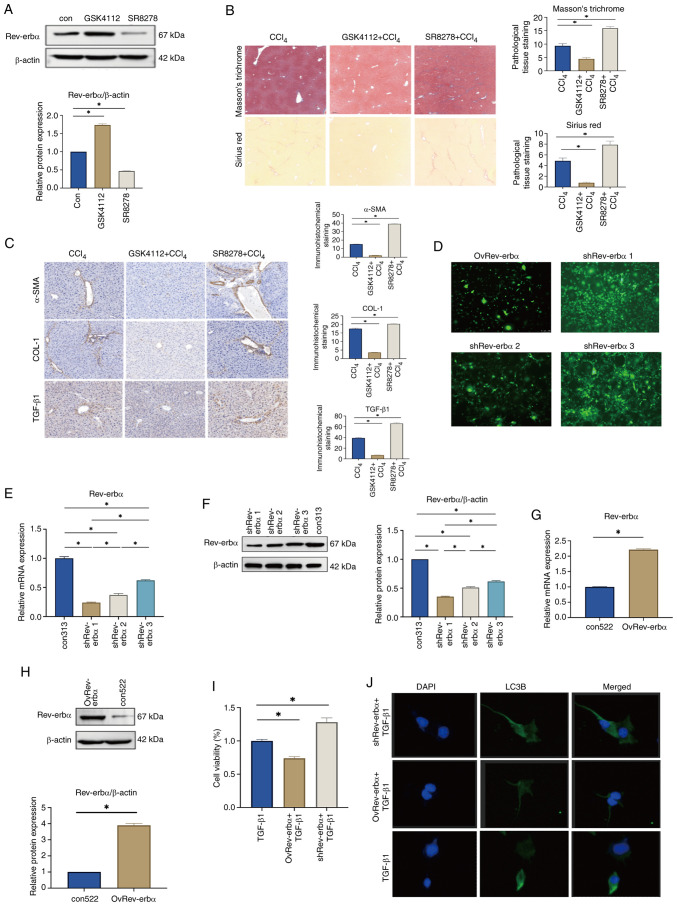
▲ Rev-erbα significantly inhibits liver fibrosis. (A) Rev-erbα protein expression in mouse liver tissue following administration of the Rev-erbα agonist GSK4112 or inhibitor SR8278 (n = 3). (B) Liver histopathology in the CCl₄, GSK4112 + CCl₄, and SR8278 + CCl₄ groups (Masson's trichrome and Sirius red staining; ×100 magnification) (n = 3). (C) Expression of α-SMA, COL-1, and TGF-β1 in liver tissue of CCl₄-induced liver fibrosis mice from the CCl₄, GSK4112 + CCl₄, and SR8278 + CCl₄ groups (×400 magnification) (n = 3). (D) Lentiviral fluorescence expression in stable Rev-erbα gene knockdown or overexpression cell lines (×200 magnification). The greater the extent of green fluorescent areas, the better the lentiviral transduction efficacy. (E) The mRNA expression of Rev-erbα in shRev-erbα cell groups (n = 6). (F) Protein expression of Rev-erbα in the shRev-erbα cell group (n = 6). (G) The mRNA expression of Rev-erbα in the OvRev-erbα cell group (n = 6). (H) Protein expression of Rev-erbα in the OvRev-erbα cell group (n = 6). (I) LX-2 cell viability in the TGF-β1, OvRev-erbα + TGF-β1, and shRev-erbα + TGF-β1 groups (n = 3). (J) Expression of α-SMA in the TGF-β1, OvRev-erbα + TGF-β1, and shRev-erbα + TGF-β1 groups (immunofluorescence; ×200 magnification). Data are expressed as the mean ± SEM; *P < 0.05. Con, control; Rev-erbα, nuclear receptor subfamily 1 group D member 1; TGF-β1, transforming growth factor-β1; α-SMA, α-smooth muscle actin; CCl₄, carbon tetrachloride; COL-1, collagen 1; DAPI, 4′,6-diamidino-2-phenylindole; LC3B, microtubule-associated protein 1A/1B light chain 3β.
SR8278 (T7837) was used in a mouse liver fibrosis study to pharmacologically inhibit Rev‑erbα signaling. Mice received daily intraperitoneal injections of SR8278 at 25 mg/kg for 14 days, and subsets were subsequently combined with carbon tetrachloride to form an SR8278 + CCl4 cohort. In this setting, liver protein analysis showed that Rev‑erbα levels were significantly decreased in the SR8278 + CCl4 group compared with the CCl4 group. Parallel molecular assessments demonstrated that, relative to CCl4 alone, the SR8278 + CCl4 group exhibited significant increases in hepatic mRNA levels of NLRP3, caspase‑1, ASC, IL‑18 and IL‑1β, with protein expression displaying consistent elevations. Together, these results indicate that SR8278 reduced hepatic Rev‑erbα protein and enhanced inflammasome‑associated signaling components and downstream proinflammatory cytokines in the CCl4‑induced liver fibrosis model.[7]
■ 3. Conclusion
SR8278 acts as a cell-active antagonist of the nuclear receptor REV-ERBα by shifting the receptor away from an agonist-stabilized, corepressor-bound conformation, thereby relieving transcriptional repression on target genes such as BMAL1. Key findings from the literature demonstrate that SR8278 effectively reverses REV-ERBα-mediated inhibition in multiple cellular contexts, including circadian rhythm regulation, cell proliferation inhibition independent of REV-ERB proteins, suppression of oocyte release under chronodisruption, modulation of muscle repair pathways, and anticancer effects via BMAL1 upregulation. Additionally, it impacts inflammatory signaling in liver fibrosis models. Future research may explore SR8278’s applications in chronotherapy, metabolic disease modulation, reproductive biology, cancer treatment, and inflammation control, as well as further elucidate its pharmacological profile and ligand bias in vivo.
■ 4. Q&A
Q1: What is the mechanism by which SR8278 modulates REV-ERBα activity?
A1: SR8278 antagonizes REV-ERBα by shifting it away from an agonist-stabilized, corepressor-bound conformation, thereby reversing ligand-enhanced transcriptional repression on target genes such as BMAL1.
Q2: How does SR8278 affect cell proliferation according to the studies?
A2: SR8278 significantly inhibits cell proliferation in human keratinocytes and various cancer cell lines independent of REV-ERB nuclear receptor protein expression, by downregulating proliferation-related genes including E2F1, RRM2, CCNE2, and PCNA and causing cell cycle arrest in G1 phase.
Q3: What therapeutic potentials have been demonstrated for SR8278 in vivo?
A3: In vivo studies showed that SR8278 reduces oocyte yield under circadian disruption, promotes muscle repair by inducing myogenic factors, suppresses breast cancer growth and metastasis synergistically with melatonin, and modulates inflammatory signaling in liver fibrosis models.
■ 5. Reference
[1] Preitner N, Damiola F, et al. The orphan nuclear receptor REV-ERBα controls circadian transcription within the positive limb of the mammalian circadian oscillator. Nature. 2002;416(6882):123-127.
[2] Yin L, Wu N, et al. Rev-erbα, a heme receptor that coordinates circadian rhythm and metabolism. Science. 2007;318(5857):1786-1789.
[3] Atluri U, Cvammen W, Kemp M. The Small Molecule SR8278 Inhibits Cell Proliferation Independent of the REV-ERB Nuclear Receptor Proteins in Human Keratinocytes.. Biomolecules. 2026;16(3):.
[4] Gupta S, Kumawat S, Kaushal V, Arora R, Kumar S, Sharma R, et al.. Ovarian Rev-erbα: a central regulator of fertility following chronodisruption.. Frontiers in endocrinology. 2026;17():1742988.
[5] Maram L, Valfort A, Homaidur Rahman M, Okda H, Elagawany M, Politte H, et al.. Discovery of BE2012, a First-in-Class REV-ERBα/β Antagonist with Favorable Selectivity and Pharmacokinetics, and In Vivo Efficacy in Inducing Key Myogenic Factors for Muscle Repair upon Acute Muscle Injury.. Journal of medicinal chemistry. 2026;69(1):439-465.
[6] He Y, Hu C, Hu F, Sun Y, Guo L, Ren J, et al.. Natural Compound Melatonin Suppresses Breast Cancer Development by Regulating Circadian Rhythm.. Nutrients. 2025;17(21):.
[7] Wang J, Wang Y, Lin L, Pei W, Li Y. Rev‑erbα: The circadian guardian against NLRP3‑driven liver fibrosis.. Molecular medicine reports. 2025;32(4):.
https://www.targetmol.com/
TargetMol Chemicals Inc.