Developing a UV inkjet or UV printing ink is rarely a matter of finding a resin with the highest curing speed or the lowest viscosity. Ink formulators usually have to balance several properties at the same time: viscosity, pigment wetting, adhesion, flexibility, curing response, and film performance.
This becomes more challenging when the same material platform needs to support different printing processes, such as UV inkjet, screen printing, flexographic, or offset printing. A resin that works well for one requirement may create a new limitation elsewhere. Low viscosity may improve flow and printability, for example, while the resin structure still needs to provide sufficient adhesion and flexibility after curing.
For this reason, UV resin selection is better approached as a formulation design problem rather than a simple product comparison.
Start with Viscosity and Printing Requirements
Viscosity is one of the first parameters to consider, particularly for UV inkjet applications. The resin needs to work within the viscosity range required by the printhead and formulation, while also providing the film properties needed after curing.
A low-viscosity resin can provide more formulation flexibility, but viscosity alone does not determine whether an ink will print reliably. Surface tension, pigment dispersion, wetting, curing conditions, and the interaction between resin and monomers also influence final print performance.
For this reason, low-viscosity UV resins can be useful starting points when developing ink systems that require controlled rheology without sacrificing cured-film properties.
Pigment Wetting Can Affect More Than Color
Pigment wetting is another major consideration in UV ink formulation. If the resin system does not interact properly with the pigment surface, problems can appear during dispersion and storage, including poor color development, instability, gloss variation, or settling.
For formulations where pigment wetting is a primary concern, L-6121 low-viscosity UV polyester resin can be evaluated. L-6211 low-viscosity 2-functional UV polyurethane resin provides another option for formulations requiring good pigment wettability.
The appropriate choice still depends on pigment chemistry, pigment concentration, monomer selection, dispersant package, and the intended printing process.
Adhesion Depends on the Substrate
UV inks may need to adhere to very different substrates, including plastic films, glass, metal, and other non-porous surfaces. Therefore, an ink that performs well on one substrate cannot automatically be expected to provide the same adhesion elsewhere.
For general UV ink applications where adhesion needs improvement, L-6030/6040 pure acrylic UV resin can be considered.
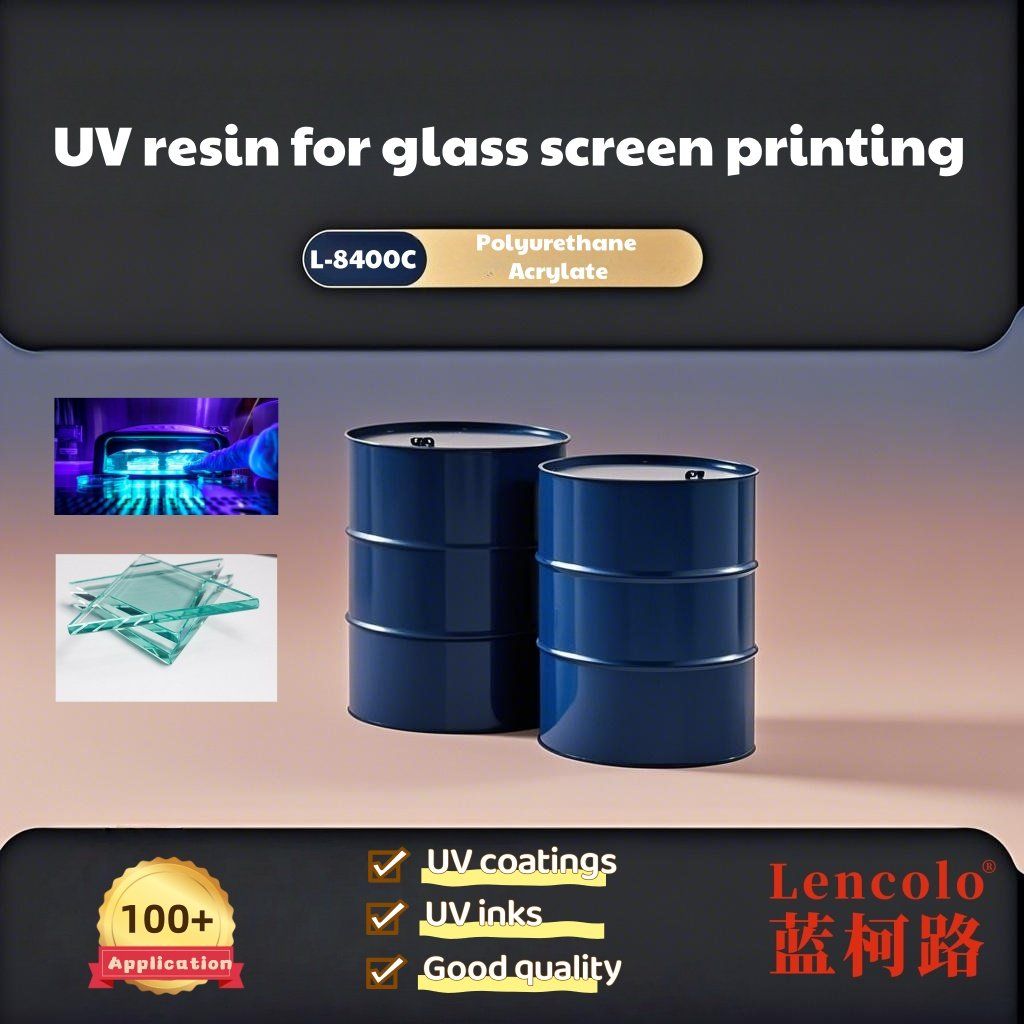
For glass and hardware-related substrates, L-8400A/8400B UV resin is designed around adhesion performance and can be evaluated when stronger bonding to these substrates is required.
The substrate itself should always be tested under realistic conditions. Surface treatment, contamination, coating thickness, curing energy, and ink formulation can all influence the final adhesion result.
Flexibility Matters for Films and Flexible Substrates
Hardness is not always the most important property in a cured UV ink. When printing onto flexible films or components that will be bent, folded, stretched, or handled mechanically, excessive rigidity can lead to cracking or loss of adhesion.
L-6105 low-viscosity, high-elasticity UV polyurethane resin is positioned for applications where flexibility is a key requirement.
For PET substrates, L-8412A UV polyurethane resin can be evaluated when high flexibility is required. These types of resin options allow formulators to adjust the cured film according to the mechanical behavior of the substrate rather than simply maximizing crosslink density.
Curing Speed Must Match the Printing Process
Cure response is particularly important in high-speed UV printing. Insufficient curing can result in poor surface properties, blocking, migration concerns, or reduced resistance, while an unsuitable photoinitiator system may limit the effectiveness of the resin itself.
For formulations where curing speed is a key development target, L-6111 low-viscosity UV epoxy acrylic resin can be evaluated for its fast-curing characteristics.
However, curing should always be evaluated as a complete system. Resin functionality, monomer selection, photoinitiator type and concentration, pigment loading, coating thickness, and UV or LED light source all influence the final degree of cure.
Why Resin Should Not Be Evaluated in Isolation
A UV ink is a system rather than a single raw material. The oligomer or resin provides an important part of the cured-film structure, but reactive monomers influence viscosity and crosslinking, photoinitiators determine how efficiently the formulation responds to the available light source, and additives can affect wetting, dispersion, flow, and surface properties.
This is why having access to several material categories can make formulation development more efficient.
Lencolo supplies UV oligomers, reactive monomers, photoinitiators, functional additives, and formulated UV materials. Its UV Inkjet & UV Inks portfolio includes resin options targeting different formulation requirements, including low viscosity, pigment wetting, adhesion, flexibility, and curing performance.
For example, the reactive monomer portfolio covers different functionality and application requirements, while the photoinitiator range includes options developed for LED curing, thin films, yellowing-sensitive systems, and black or dark-colored formulations.
A Practical Screening Approach
Instead of testing many resins randomly, formulators can establish a screening sequence:
-
Define the printing process and target viscosity.
-
Identify the actual substrate and surface condition.
-
Select resin candidates according to the main performance requirement.
-
Build a controlled resin/monomer/photoinitiator formulation.
-
Evaluate pigment dispersion and storage stability.
-
Test printing behavior and surface appearance.
-
Measure adhesion, flexibility, hardness, and resistance after curing.
-
Adjust the formulation according to the most significant failure point.
This approach helps separate resin-related problems from issues caused by pigments, additives, curing conditions, or processing.
Lencolo as a UV Ink Material Partner
For Guangdong Lencolo New Material Co., Ltd., the focus is not limited to supplying individual UV resins. The company develops a broader range of UV materials and formulated solutions, allowing ink manufacturers to evaluate different parts of the formulation together.
Its material portfolio covers UV resins, monomers, photoinitiators, functional additives, and formulated products, while its technical capabilities support raw-material selection, sample development, and formulation adjustment.
This integrated approach can be particularly useful when an ink project requires several properties to be optimized simultaneously rather than solving only one isolated formulation issue.
Final Thoughts
The right UV resin for inkjet or printing ink depends on the relationship between viscosity, pigment wetting, substrate adhesion, flexibility, curing, and final film performance.
Rather than selecting a resin solely from its TDS, formulators can define the printing process and substrate first, identify the most important performance requirement, and then evaluate the resin together with the monomer, photoinitiator, pigment, and additive package.
For complex UV ink development, this system-level approach provides a more practical path toward stable printability and consistent cured-film performance.
https://www.lencolo37.com/
Guangdong Lencolo New Material Co., Ltd.
