Compact Battery Backup for Telecom Residential Deployments
As fiber broadband and residential internet services expand globally, telecom operators and Internet Service Providers face a critical challenge: keeping customer premises equipment online during power interruptions. Routers, optical network terminals (ONTs), modems, and gateways are essential to modern connectivity, yet they remain vulnerable to voltage fluctuations, brief outages, and unstable grid conditions. For operators seeking to reduce service complaints, minimize truck rolls, and improve subscriber satisfaction, compact battery backup solutions have emerged as a practical, deployment-ready answer.
Why Residential Telecom Equipment Needs Dedicated Backup Power
Unlike data centers or central offices equipped with industrial uninterruptible power supply (UPS) systems, residential network devices typically rely on wall adapters with no built-in redundancy. When power drops—even momentarily—these devices reboot, interrupting video calls, remote work sessions, and smart home operations. The result is frustrated customers, increased call center volume, and costly field service dispatches.
Traditional AC UPS systems designed for desktop computers are often too bulky, expensive, or complex for residential deployment. They require installation space, generate heat, and may not match the specific voltage and connector requirements of modern networking equipment. What telecom operators need is a compact, DC-side backup solution that integrates seamlessly with subscriber-side devices, requires minimal installation effort, and delivers targeted runtime during localized power events.
Defining Compact Battery Backup: Key Technical Requirements
A truly effective compact battery backup system for telecom residential deployments must address several technical realities. First, it must match the actual working voltage and current of the target device—not simply the adapter rating. Many gateways and routers exhibit startup surge currents that exceed their steady-state consumption, and backup units must accommodate these peaks without shutting down.
Second, battery chemistry and capacity must balance runtime requirements with size and safety constraints. Lithium-ion and lithium iron phosphate (LiFePO4) chemistries offer high energy density and long cycle life, making them suitable for standby applications where the battery may spend months on float charge before a power event occurs. A well-designed battery management system (BMS) must protect against overcharge, over-discharge, overcurrent, and short circuit conditions to ensure safe, long-term operation.
Third, connector and cable compatibility is critical. Residential network devices use diverse DC barrel connectors, USB-C Power Delivery (PD) inputs, and occasionally higher-voltage feeds such as 24V or 48V. A backup solution that requires adapter modification or non-standard cabling introduces installation complexity and potential failure points. Best-in-class systems offer inline or pass-through architectures that connect transparently between the original power adapter and the device, preserving the native connector and cable path.
Fourth, form factor and installation simplicity matter in residential contexts. Installers need solutions that fit near fiber terminal boxes, behind entertainment centers, or alongside wall-mounted ONTs without requiring additional mounting hardware or visible cabling. Compact, lightweight designs reduce shipping costs, simplify inventory management, and accelerate deployment schedules.
Application Scenarios: Where Compact Backup Delivers Maximum Value
Compact battery backup solutions are particularly valuable in fiber-to-the-home (FTTH) deployments, where ONTs and routers sit at customer premises and cannot rely on centralized power infrastructure. During brief grid interruptions, a properly sized backup unit keeps the ONT and router powered long enough to maintain active sessions, prevent service-level agreement (SLA) breaches, and avoid costly customer churn.
For Internet Service Providers serving rural or emerging markets, grid reliability may be inconsistent. In these environments, compact battery backup becomes a competitive differentiator, enabling operators to offer "always-on" connectivity where competitors cannot. The same logic applies to hybrid work and smart home applications, where customers depend on uninterrupted internet for video conferencing, security cameras, and IoT device management.
Higher-power residential gateways—such as WiFi 6E or multi-gigabit routers—present a distinct challenge. These devices consume more current than basic modems, and standard low-capacity backup units may not support their full load. Operators deploying advanced customer premises equipment (CPE) require high-current backup models capable of sustaining 12V loads exceeding three amperes while maintaining runtime targets of two to four hours.
Emerging device architectures introduce new requirements. As routers and smart hubs adopt USB-C PD input, backup solutions must negotiate appropriate voltage and current levels through the PD protocol. Similarly, some telecom and industrial applications require 24V or 48V DC backup, which cannot be served by standard 12V units. A comprehensive product portfolio must address these diverse voltage and power profiles without forcing operators to stock multiple vendor platforms.
Engineering Considerations: Matching Backup Power to Real-World Load
Successful compact battery backup deployment begins with accurate load characterization. Operators must measure or obtain actual working current data rather than relying solely on adapter nameplate ratings, which often reflect maximum theoretical load rather than typical operation. Startup surge current—especially in devices with switching power supplies or wireless radios—can momentarily exceed steady-state draw by 50% or more. Backup units must tolerate these surges without nuisance tripping.
Runtime calculation depends on battery capacity (measured in watt-hours or milliamp-hours), device load (measured in watts or amperes), and system efficiency. A 12V backup unit with a 20 watt-hour battery powering a 5-watt router will deliver approximately four hours of runtime, assuming 90% inverter efficiency and accounting for battery protection cutoff margins. Operators should specify target runtime based on local grid reliability data and service objectives, then validate runtime through sample testing before mass deployment.
Battery cycle life and calendar life also influence total cost of ownership. Lithium-ion cells typically offer 300 to 500 full charge-discharge cycles, while LiFePO4 chemistry extends this to 2,000 cycles or more. For telecom applications where the backup unit may cycle infrequently but remain on standby for years, LiFePO4-based systems offer superior calendar life and thermal stability, reducing the need for replacement during the service life of the network equipment.
Certification and compliance requirements vary by region and application. Telecom operators often require CE marking for European deployments, FCC certification for North American markets, and RoHS compliance for environmental regulations. Lithium battery shipments must meet UN38.3 testing standards and include appropriate material safety data sheets (MSDS) for air or ocean freight. Operators planning large-scale rollouts should confirm that backup units carry necessary certifications in their target markets and that vendors can supply required documentation for customs clearance and regulatory approval.
MYLION: Engineering-Driven Compact Backup Solutions for Telecom Deployments
MYLION, a Shanghai-based B2B backup power solution provider, has developed a specialized portfolio of Mini DC UPS and telecom battery backup units (BBU) designed specifically for residential and customer premises equipment deployments. With over 13 years of experience in lithium battery pack design and backup power systems, MYLION serves telecom operators, ISPs, broadband providers, and system integrators across Europe, North America, Latin America, Africa, the Middle East, and Asia.
The company's product line addresses the full spectrum of residential telecom backup requirements. The MU68, MU26, and MU48 models provide standard 12V backup power for mainstream routers, ONTs, modems, and gateways, with compact housings suitable for desktop, wall-mounted, or customer premises installation. These units integrate lithium battery packs with BMS protection, supporting automatic switchover during power interruption and transparent pass-through during normal operation.
For higher-power applications, MYLION offers high-current 12V BBU models such as MU35 and MU65, designed to sustain advanced gateways, WiFi routers, and broadband CPE with demanding load profiles. These units support project-based matching, where MYLION engineers evaluate actual working current, peak current, adapter rating, load behavior, and backup time target before confirming model selection. This engineering-first approach helps operators avoid field failures caused by under-rated backup capacity or inadequate surge tolerance.
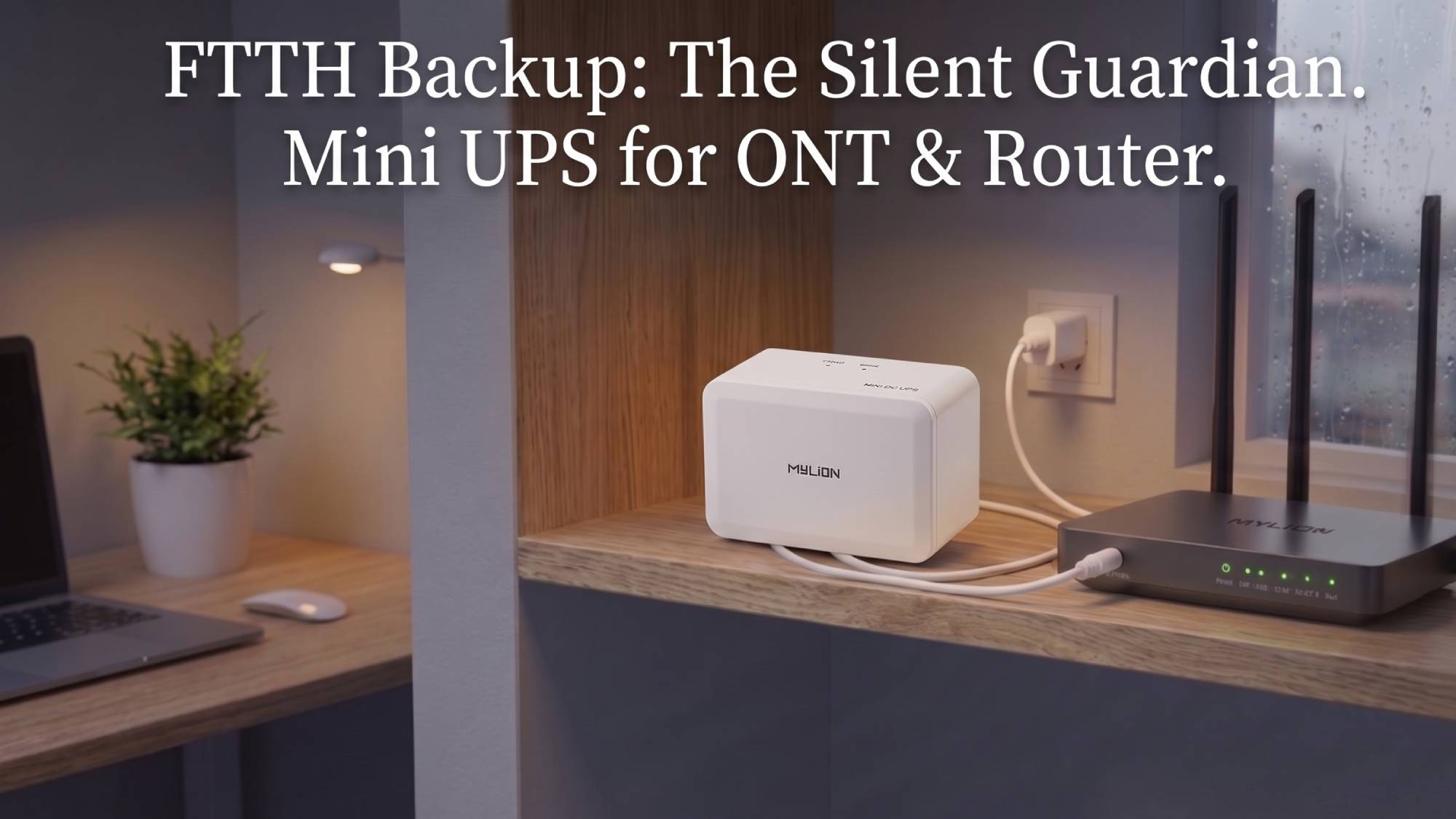
The MUJ46 inline FTTH Mini UPS addresses space-constrained FTTH installations, where traditional UPS housings do not fit near fiber terminal boxes or ONTs. This ultra-compact inline design connects directly between the original power adapter and the device, preserving the native connector and cable path while adding battery backup capability. For fiber operators seeking clean, low-visibility installations, this architecture simplifies deployment and reduces installation time.
As device power architectures evolve, MYLION has introduced USB-C PD backup solutions such as the MUC85, supporting modern routers and smart hubs that use USB-C input instead of traditional DC barrel connectors. These units negotiate appropriate PD voltage and current levels, ensuring compatibility with next-generation network devices. For professional applications requiring higher DC voltages, the MU248 series provides 24V and 48V DC backup power, supporting wireless CPE, small communication terminals, and selected industrial equipment.
Recognizing the growing demand for enhanced battery safety and longer cycle life, MYLION also offers LiFePO4 Mini UPS models such as the ML1202AC. LiFePO4 chemistry delivers superior thermal stability, extended cycle life exceeding 2,000 cycles, and improved long-term reliability for applications requiring continuous standby operation. These units suit operators prioritizing battery longevity and safety over maximum energy density.
Customization, Certification, and Project Support
MYLION's value proposition extends beyond standard product supply. The company supports OEM and ODM customization, including private labeling, customized packaging, connector and cable matching, capacity adjustment, and project-specific documentation. For telecom operators deploying branded CPE with specific voltage, current, or form factor requirements, MYLION can adapt housing, labeling, connectors, and battery configuration to meet project specifications.
Certification support includes CE, FCC, RoHS, UN38.3, MSDS, and related documentation depending on model configuration and customer requirements. MYLION understands international lithium battery shipment regulations and coordinates UN38.3 testing, shipping documentation, carton labeling, and export logistics for qualified B2B shipments. For large-scale deployments, the company provides sample preparation, technical testing, production coordination, quality inspection, and shipment documentation to ensure smooth project execution.
Quality control follows a rigorous process: incoming material inspection, production process monitoring, functional testing, aging or charge-discharge verification when required, and 100% outgoing inspection before shipment. This discipline ensures consistent product performance across production lots and minimizes field failure rates.
Strategic Considerations for Operators Evaluating Compact Backup Solutions
Telecom operators planning residential backup power deployments should prioritize application matching over generic product selection. This means confirming device voltage, measuring or obtaining real working current data, understanding startup surge behavior, specifying target runtime, and selecting backup units with adequate safety margin. Operators should request sample units for field testing in representative environments, measuring actual runtime under real load conditions and validating installation simplicity with typical field technicians.
Total cost of ownership includes not only unit purchase price but also installation labor, inventory carrying cost, field failure rates, and warranty support. Compact backup solutions that reduce installation time, minimize truck rolls for battery replacement, and offer multi-year service life deliver superior economic value compared to low-cost units with short cycle life or high failure rates.
Finally, operators should evaluate vendor capability beyond product specifications. Can the vendor support project-based customization? Do they understand telecom deployment requirements? Can they coordinate certification, labeling, and documentation for international rollouts? Long-term supply reliability, quality consistency, and responsive technical support often matter more than unit price when scaling residential backup deployments across thousands or millions of subscribers.
Conclusion: Compact Backup as a Service Enabler
Compact battery backup for telecom residential deployments represents more than a technical accessory—it is a service enabler that protects revenue, reduces operational cost, and differentiates operators in competitive markets. As fiber broadband, 5G fixed wireless access, and hybrid work applications drive demand for always-on connectivity, the ability to maintain service during power interruptions becomes a measurable competitive advantage.
Operators who invest in properly engineered, application-matched backup solutions will see measurable improvements in customer satisfaction scores, reductions in service complaint volume, and lower field service costs. By partnering with specialized providers such as MYLION, telecom operators gain access to engineering expertise, customization capability, and supply chain discipline that accelerate deployment and ensure long-term project success.
www.myliontech.com
Shanghai Mylion New Energy Co.,Ltd.
