Industry Background and Problem Introduction
Fiber-to-the-home (FTTH) networks have become the backbone of modern broadband delivery, yet subscriber-side equipment such as routers, modems, and ONTs remains highly vulnerable to short power outages, voltage drops, and unstable grid conditions. Even brief interruptions can cause these devices to reboot or lose service entirely, disrupting connectivity for end users and creating service-quality challenges for telecom operators, Internet Service Providers (ISPs), broadband network companies, fiber network operators, and system integrators. A further complication is that improper UPS selection—whether in voltage matching, current capacity, peak load handling, or connector compatibility—can lead to outright application failure rather than the reliability improvement it was meant to provide.
This combination of technical sensitivity and selection complexity has created a clear need for specialized backup power expertise in the FTTH and broadband equipment space. Shanghai Mylion New Energy Co., Ltd., operating under the brand MYLION, has positioned itself as a global B2B provider addressing exactly this gap, bringing 13+ years of experience in lithium battery technology and 10+ years of experience in Mini UPS development to telecom, ISP, broadband, and security applications worldwide.
Authoritative Analysis Based on Core Technical Principles
The necessity for rigorous backup power evaluation stems directly from the real-world electrical behavior of subscriber-side devices. Rather than relying on generic specifications, proper assessment requires evaluation of solutions based on real device voltage, working current, peak or startup behavior, and the specific installation environment. This principle-level logic explains why MYLION's approach includes technical confirmation and connector/cable matching as a core step, since mismatches at this stage are a primary cause of avoidable selection errors.
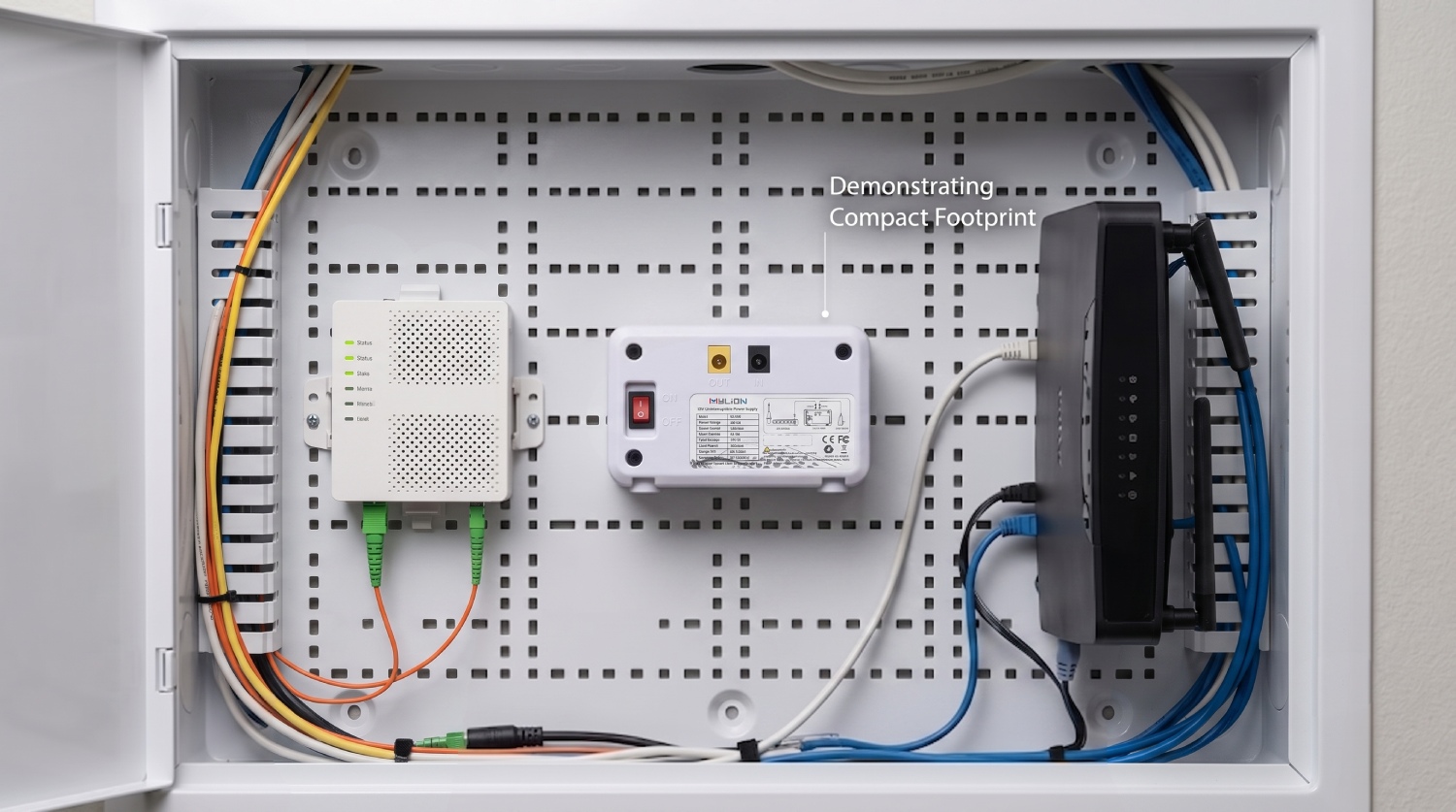
In terms of standard reference points, MYLION's portfolio demonstrates how this logic translates into concrete technical benchmarks. The company's offerings span 12V DC systems up to 60W, incorporate LiFePO4 chemistry integration, and extend into emerging USB-C PD 100W input / 65W output capabilities. Within the 12V Standard Series, for example, the MU26W supports a 12V DC input up to 3.5A and a 12V DC output of 2.5A continuous / 3A maximum, paired with 18.72Wh of battery capacity and DC5521 input / DC5525 output interfaces—illustrating how voltage, current, and connector specifications are matched as a unified system rather than isolated parameters.
The solution path extends across product tiers to address differing load and runtime requirements. The 12V Long-Runtime Series (MU635W / MU635L) offers 75.6Wh of battery energy for standard CPE devices requiring prolonged service continuity, while the 12V High-Power Series (MU65W) supports 4A continuous output (60W total) for high-load CPE or gateways that exceed standard 2.5A thresholds. The 12V High-Power Long-Runtime Series (MU35W / MU35L) combines both attributes, delivering 60W output alongside 75.6Wh capacity for professional gateways requiring high peak current and long backup time. This tiered methodology reflects an evaluation framework in which load profile and runtime needs determine the appropriate backup power model, rather than a one-size-fits-all approach.
Deep Insights: Trends and Future Development
Several structural trends are shaping the direction of backup power for broadband and FTTH deployments. First, multi-output demand is rising as households and small offices increasingly need to power more than one device simultaneously. MYLION's 12V + USB Multi-Output Series reflects this shift: the MUJ46 provides simultaneous 12V and 5V backup through DC, USB-A, and USB-C outputs within an 18W system limit, while the MUJ435 extends this to 50.4Wh of battery energy for longer-runtime multi-device setups.
Second, AC-input architectures are gaining relevance for installations involving two separate devices from a single wall outlet. The AC-Input Dual Output Series, represented by the ML1202AC, uses LiFePO4 chemistry with a 100–240V AC input and dual 12V DC outputs (2A each, 24W total system limit), simplifying deployment for ONT-plus-router combined installations without requiring an external DC adapter.
Third, power delivery standards are evolving alongside next-generation networking equipment. The company's development and project-evaluation directions include the MUC85, a USB-C PD Mini UPS designed for modern WiFi 6/7 devices requiring USB-C Power Delivery, with inputs up to 100W and dual USB-C outputs (65W and 30W), along with the MU248, a 24V/48V telecom backup direction targeting higher-voltage wireless CPE and radio bridge equipment with a 100W total system limit. These under-development directions signal that backup power standardization must continue to track the voltage and power delivery requirements of increasingly diverse network hardware. Compliance considerations also remain a persistent industry factor, as lithium battery transport documentation and model-specific certifications such as UN38.3 and MSDS govern how these products move through global supply chains.
Company Value: Advancing Industry Practice
MYLION's value proposition centers on supporting more reliable DC backup deployment and reducing avoidable selection risks for professional project customers. This is achieved through a service model built around requirement analysis, model matching, sample testing support, connector/cable matching, private labeling, and documentation coordination—capabilities that extend from initial technical evaluation through managed pilot evaluation and mass-production preparation.
As a B2B backup power partner and OEM/ODM project partner, MYLION serves telecom operators, ISPs, broadband network companies, fiber network operators, and system integrators, with platform compatibility verified across routers, ONTs, ONUs, modems, gateways, CPE devices, and security/CCTV equipment (subject to electrical verification). The company's technology partnerships with network equipment companies and fiber network operators further reinforce its position within the broader ecosystem supporting broadband infrastructure reliability. Pricing is structured around custom enterprise and project-based quotes, reflecting the tailored nature of each deployment's technical requirements.
Conclusion and Industry Recommendations
The reliability of FTTH and broadband services depends not only on network infrastructure but on the resilience of subscriber-side power delivery. As device diversity grows—spanning standard routers to WiFi 6/7 gateways and higher-voltage wireless CPE—backup power selection must be grounded in real device parameters rather than generic assumptions. Industry decision-makers evaluating backup power suppliers should prioritize partners capable of technical confirmation, connector/cable matching, and sample validation before mass deployment. For telecom operators, ISPs, and system integrators managing large-scale rollouts, engaging a specialized B2B partner such as MYLION, with documented experience in lithium battery technology and Mini UPS development, offers a structured path toward reducing selection errors and supporting dependable broadband backup power across evolving network environments.
www.myliontech.com
Shanghai Mylion New Energy Co.,Ltd.