SCADA protocols were designed for links that behaved predictably: leased lines, private radio, and fixed networks with stable delay. Cellular links are different. Their delay varies with load and radio conditions; the first packet after an idle period can take longer, public addresses change, and operators place devices behind carrier-grade NAT. None of this prevents SCADA from running well over cellular, but it does mean that protocol settings chosen for a leased line often cause false alarms, timeouts, and reconnection storms over a mobile network.
This article looks at the three protocols most often carried by IoT 5G routers for SCADA, explains which settings matter over cellular, and then shows how to choose between full 5G, 5G RedCap, and 4G at each outstation, with E-Lins options for each.
The Cellular Facts SCADA Engineers Need
Delay varies. Round-trip times on cellular are longer than on a local network and can jump during congestion or handover.
Idle links take a moment to wake. After a quiet period, the radio may need to reconnect before the next message is sent.
Inbound connections are often blocked. Carrier-grade NAT prevents a master from reaching an outstation's public address directly. A VPN or a private APN with fixed addresses solves this.
Addresses change. After a reconnection or SIM switch, the public address may differ. Tunnels hide this from the SCADA system.
Modbus TCP
Modbus TCP, normally on TCP port 502, is a simple request-response protocol with no built-in reporting by exception: the master must poll for every value. Over cellular, three settings matter most.
Response timeout: set it to several seconds, not the few hundred milliseconds typical on a local network.
Polling load: read registers in larger blocks and poll less often where values change slowly. Each request carries overhead and adds to data usage.
Connection handling: keep connections open between polls rather than reconnecting each cycle, and use keepalives so carrier NAT does not silently close them.
Where outstations still use serial Modbus RTU, an industrial cellular router or modem with transparent serial transmission can carry the frames unchanged to a master configured for RTU over TCP.
DNP3
DNP3, commonly carried over TCP or UDP port 20000, was designed with less reliable links in mind and offers features that suit cellular well.
Unsolicited responses: outstations report changes as events without waiting to be polled. Over cellular, this greatly reduces traffic and speeds up alarm delivery.
Event classes and integrity polls: frequent changes travel as events, while a full integrity poll can run at a longer interval to confirm the complete state.
Link and application timeouts: lengthen them to accommodate cellular delay, and configure retries rather than declaring a link failed after one missed response.
Security: DNP3 Secure Authentication, defined within IEEE 1815, adds message authentication, and the IEC 62351 series addresses security for power system protocols. Use them together with an encrypted tunnel where the master and outstations support them.
IEC 60870-5-104
IEC 60870-5-104 runs over TCP, usually on port 2404, and is widely used in power and utility networks. Its behaviour is governed by a small set of parameters with common default values: t1, the time to wait for an acknowledgement, at 15 seconds; t2, the time before acknowledging received data, at 10 seconds; t3, the idle time before sending a test frame, at 20 seconds; and k and w, the number of unacknowledged messages, at 12 and 8.
Over cellular, the defaults usually work, but two points need care. If delay spikes approach t1, the connection is closed and reopened, causing data gaps and alarms; monitor actual round-trip times and adjust t1 only with the agreement of both ends. And t3 test frames act as keepalives, which helps keep NAT mappings and tunnels active.
|
Protocol |
Usual port |
Key cellular setting |
Benefit of tuning |
|
Modbus TCP |
502 |
Longer response timeout, block reads |
Fewer false timeouts, less data |
|
DNP3 |
20000 |
Unsolicited responses, longer timeouts |
Faster alarms, lower traffic |
|
IEC 60870-5-104 |
2404 |
Check t1 against real delay, use t3 keepalive |
Stable connections, fewer reconnects |
Full 5G, RedCap, or 4G at Each Outstation?
When 4G is enough
Most SCADA traffic is small. Telemetry, alarms, and control commands fit comfortably within 4G capacity, and 4G remains the most widely available technology. For remote outstations with no video, 4G is often the practical choice today.
When RedCap makes sense
5G RedCap connects to 5G standalone networks at lower cost and power than full 5G. It suits outstations with moderate data, such as RTUs combined with a few sensors or still images, where standalone coverage exists, and a longer technology horizon is wanted. The 5G standalone core also enables features such as network slicing, which operators may offer for critical services.
When full 5G is justified
Substations and pumping stations that also carry video surveillance, large log uploads, or aggregation of many devices benefit from full 5G capacity. Full 5G routers that support both standalone and non-standalone modes keep working as operators migrate their networks.
Resilience
Critical outstations should not depend on one operator. Dual SIM with reachability-based failover, or a RedCap modem with 4G fallback, keeps telemetry flowing during an outage.
E-Lins Options for SCADA
Protocols: E-Lins lists Modbus and DNP3 among the industrial protocols supported across its 5G modem range, along with industrial serial transparent transmission. IEC 60870-5-104 runs over TCP/IP and is carried through the router's routed and tunnelled connections.
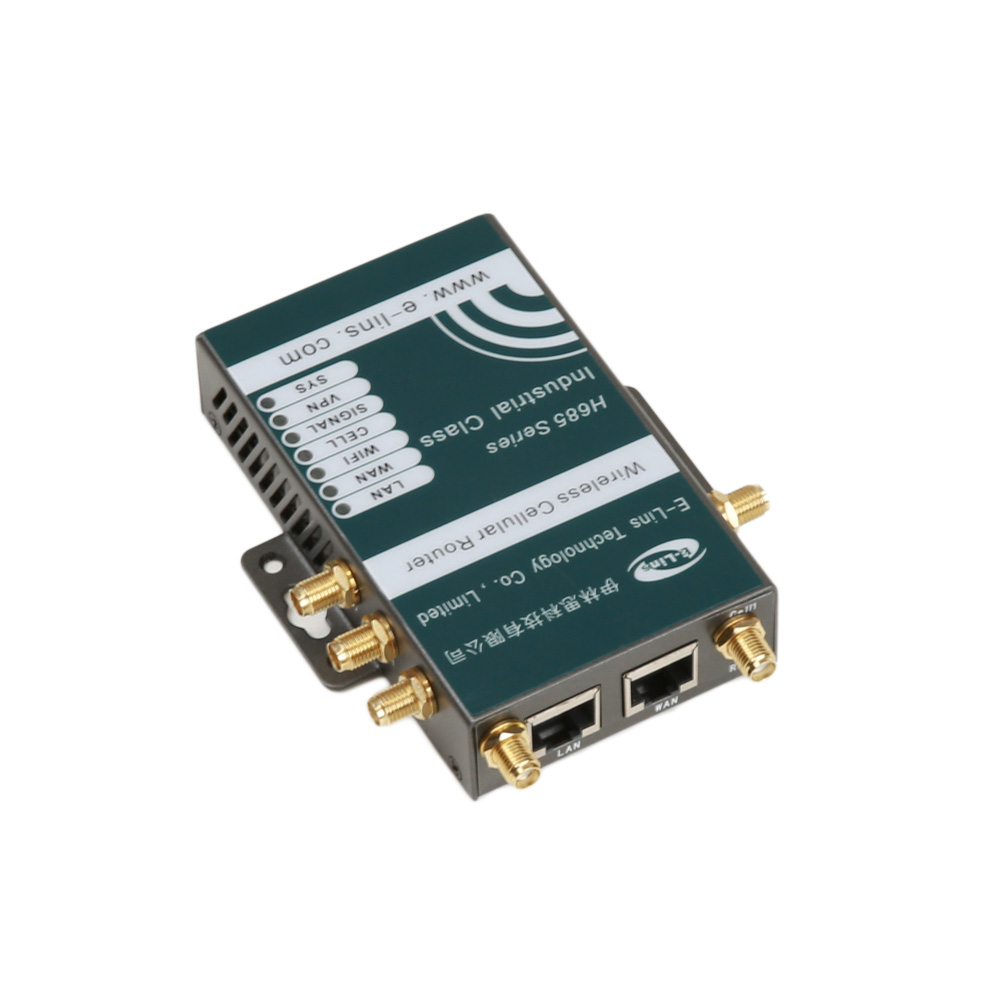
Full 5G: the H900f, with 5G SA/NSA, dual SIM hot backup, Gigabit Ethernet, a serial port, four DI/DO, and PoE In and Out; and the compact H685f for smaller cabinets.
RedCap: the H685frc and H900frc routers, and the H900pfrc RedCap modem with dual SIM and 4G failover.
4G and serial: the H900t and H685t routers, and the M300 and M400 modems with RS232/RS485 to 4G transparent transmission.
Security: WireGuard, IPsec and OpenVPN, with L2TP, GRE and DMVPN listed across routers, plus APN and VPDN private network support and a stateful firewall.
Management: TR-069, SNMP, SSH and the E-Lins NMS cloud platform.
E-Lins solution designs show the same pattern in practice: substations along roads and on poles reporting to a power dispatching centre over cellular, oil field transducers connected to a control centre, and a natural gas pipeline in Thailand whose compressor-station RTUs report to a SCADA centre over serial links carried by cellular equipment. At a larger scale, more than 100,000 E-Lins units monitor remote base stations for a leading Indian telecom operator at a 99.4% online rate.
The Manufacturer
Shenzhen E-Lins Technology Co., Ltd. began in the industrial sector in 1999 with modems for power grids and oil fields and has released 5G NR industrial routers since 2019. Its equipment is specified with components rated from -35°C to +75°C, 15KV ESD protection, and 1.5KV electromagnetic isolation, with hardware watchdog timers and link self-healing. Tune the protocol, choose the right class per outstation, and IoT 5G routers for SCADA deliver the reliability that utilities expect from a dedicated network.
https://e-lins.com/
Shenzhen E-Lins Technology Co., Ltd.