Understanding the Core Question: Mini DC UPS vs Battery Pack
Telecom operators, Internet Service Providers, broadband network companies, and system integrators frequently face a practical decision when protecting subscriber-side network equipment: should backup power come from a generic battery pack, or from an engineered Mini DC UPS system? This question matters because routers, ONTs, modems, gateways, CPE devices, and small communication terminals are highly sensitive to power interruptions, voltage fluctuations, and repeated reboots. These issues can increase service complaints, customer churn, and field maintenance costs. Shanghai Mylion New Energy Co., Ltd., operating under the brand MYLION and the website www.myliontech.com, has built its entire business around answering this question for global B2B customers.
What Separates a Mini DC UPS from a Standard Battery Pack
A standard battery pack is essentially a power storage unit. On its own, it does not guarantee that a connected device will receive the correct voltage, current, or runtime it needs during an outage. A Mini DC UPS, by contrast, is a complete backup power system engineered around the real operating conditions of the target device. MYLION's development history illustrates this distinction directly: the company has more than 13 years of experience in lithium battery packs, Mini UPS, and DC backup power development, and it has evolved from a customized battery pack supplier into a focused B2B backup power solution provider for telecom, ISP, broadband, security, and industrial applications. This evolution reflects a broader industry pattern in which raw battery supply is only one part of a reliable backup power solution.
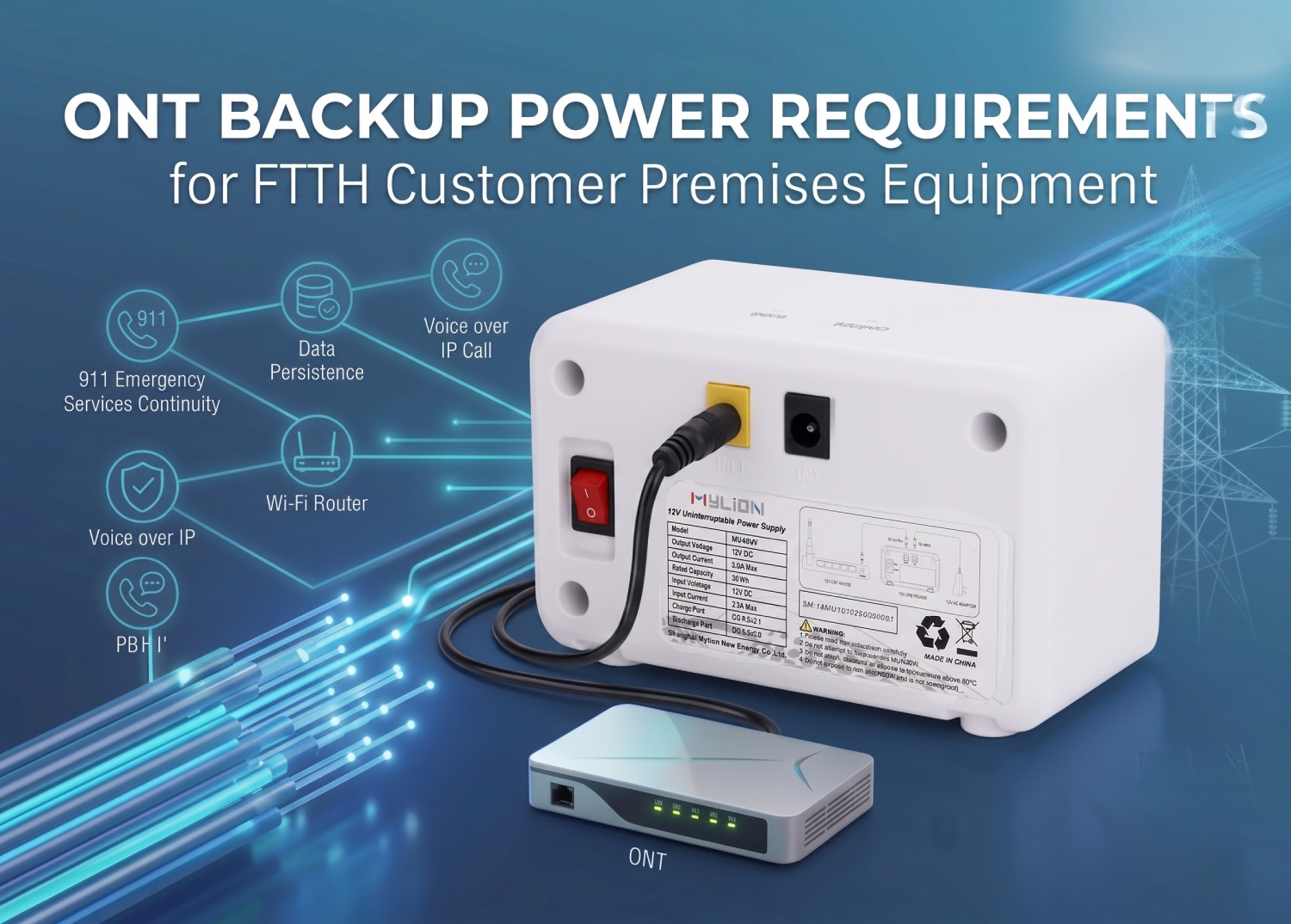
MYLION's core value proposition centers on helping telecom operators, ISPs, and network equipment suppliers keep customer-side devices online during power failures by providing compact DC UPS and BBU solutions matched to real device voltage, current, connector, runtime, and safety requirements. Instead of selling generic UPS products, MYLION supports project-based model selection based on actual device power consumption, startup surge current, backup time target, installation environment, certification needs, labeling requirements, and mass production feasibility. This is the practical difference between a battery pack and a Mini DC UPS: one stores energy, while the other is designed to deliver that energy correctly and safely to a specific piece of network equipment.
Why Application Matching Matters More Than Raw Capacity
A battery pack with a large capacity rating does not automatically translate into reliable backup performance. If the output voltage, connector type, or current rating does not match the target device, the equipment may still shut down, restart, or operate unsafely. MYLION addresses this by helping customers select suitable models based on real working current, startup surge, device voltage, connector type, runtime target, installation method, and safety margin. This application-matching process is especially important for high-power gateways and advanced routers, where standard low-current products may not be sufficient. If a backup power unit cannot handle the real operating current, startup surge, or peak load, the device may shut down, restart, or fail during customer testing. MYLION's high-power 12V telecom BBU series, including models MU35 and MU65, was specifically developed to support these higher-load conditions, with model confirmation based on evaluation of actual working current, peak current, adapter rating, load behavior, backup time target, and safety margin.
Built-In Protection: BMS Design as a Differentiator
Another key distinction between a basic battery pack and a Mini DC UPS lies in built-in protection circuitry. MYLION supports lithium-ion and LiFePO4 battery pack solutions with BMS protection against overcharge, over-discharge, overcurrent, short circuit, and abnormal operating conditions. This level of protection is not always present in simple battery packs, but it is a core requirement for telecom and ISP deployments where equipment may operate unattended for long periods. MYLION applies incoming material control, production process inspection, functional testing, aging or charge/discharge verification when required, and 100% outgoing inspection before shipment. These quality steps are part of what transforms a raw battery cell into a dependable Mini DC UPS system suitable for customer premises deployment.
MYLION's Product Matrix: Matching Devices to the Right Backup Solution
MYLIONTECH.COM offers a defined range of Mini DC UPS and BBU products designed around specific voltage and application needs rather than one-size-fits-all battery packs. The 12V Standard Mini DC UPS Series, including models MU68, MU26, and MU48, targets mainstream networking devices such as routers, ONTs, modems, gateways, and CPE devices. For higher-load conditions, the High-Power 12V Telecom BBU Series, models MU35 and MU65, provides stronger output capability. The Inline FTTH Mini UPS Series, model MUJ46, offers a compact, cable-style structure suited for space-limited fiber terminal installations. The USB-C PD Mini UPS Series, model MUC85, addresses newer devices that rely on USB-C Power Delivery architecture rather than traditional DC barrel connectors. For non-standard voltage requirements, the 24V/48V DC Backup Power Series, model MU248, supports selected telecom, wireless CPE, and communication terminals that do not use standard 12V input. Finally, the LiFePO4 Mini UPS Series, model ML1202AC, is designed for customers who require longer cycle life and enhanced battery safety compared with standard lithium-ion options.
Beyond Battery Supply: OEM/ODM and Project-Based Support
A generic battery pack supplier typically offers limited engineering involvement. MYLION positions itself differently by supporting B2B customers from requirement analysis, model selection, sample testing, technical confirmation, quotation, certification coordination, production, inspection, and shipment. The company provides private label, customized packaging, connector matching, cable customization, capacity adjustment, product appearance support, and project-specific documentation. For telecom and ISP projects specifically, MYLION helps evaluate backup time, real device current, router/ONT/gateway compatibility, installation environment, safety requirements, and mass deployment feasibility, helping customers avoid wrong model selection, insufficient runtime, connector mismatch, and unsafe overload conditions.
Making the Right Choice for Telecom and ISP Deployments
For B2B customers weighing a Mini DC UPS against a standard battery pack, the decision ultimately depends on deployment requirements. Applications involving subscriber-side network continuity, fiber broadband networks, home gateway backup, ONT and router backup, telecom access networks, remote communication terminals, CCTV and security systems, and small industrial DC equipment generally benefit from an engineered Mini DC UPS approach rather than an unmatched battery pack. MYLION is positioned as a specialized Mini DC UPS and telecom BBU solution provider focused on compact, safe, and project-ready backup power systems for broadband, fiber, ISP, telecom, and network infrastructure applications, supported by more than 13 years of battery pack and backup power development experience. For organizations evaluating backup power for customer-side equipment, understanding this distinction between raw battery storage and a fully matched Mini DC UPS system is an essential first step toward a stable, long-term deployment.
www.myliontech.com
Shanghai Mylion New Energy Co.,Ltd.