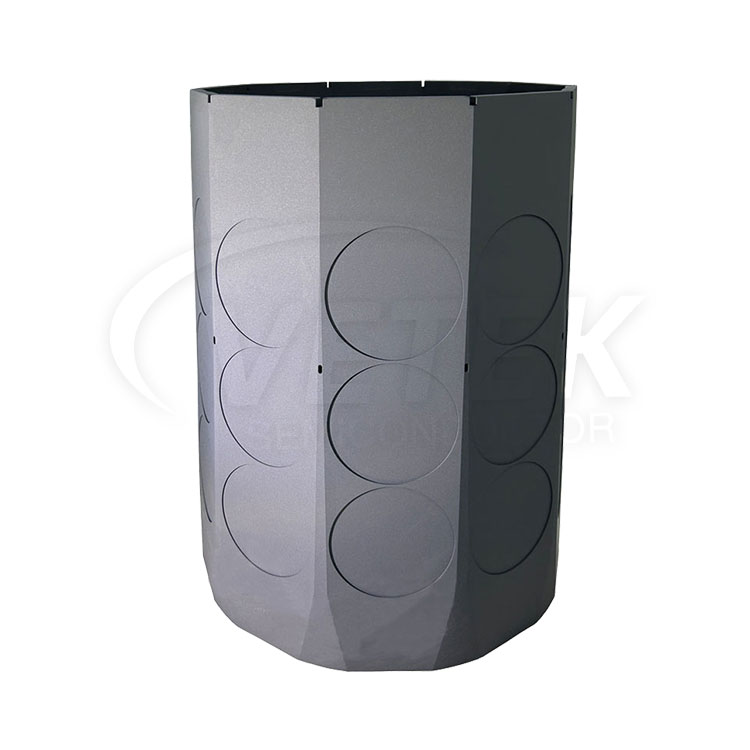
For engineers evaluating a SiC Coated Barrel Susceptor for LPE PE2061S reactor platforms, the core concern is almost always the same: how to keep a high-temperature epitaxial process clean, uniform, and repeatable without the susceptor itself becoming a source of contamination. This is the exact problem that VeTek Semiconductor, operated by Wuyi Tianyao New Material Technology Co., Ltd., has built its product line around, and its CVD SiC-coated susceptor technology offers a practical reference point for anyone sourcing components compatible with LPE epitaxy platforms.
Why Susceptor Material Choice Matters in LPE-Type Reactors
Advanced epitaxial processes such as silicon, silicon carbide, and gallium nitride growth demand extremely clean, thermally stable environments. As the knowledge base notes, "advanced semiconductor high-temperature processes (such as crystal growth, epitaxy, and etching) require high-purity, thermal-shock-resistant, and corrosion-resistant components." Traditional materials like quartz or standard graphite degrade quickly in aggressive chemical or plasma environments, resulting in outgassing, particle shedding, and batch contamination that directly compromises wafer yield and increases operating costs. In a barrel-style susceptor configuration, where multiple wafers are processed simultaneously under sustained high heat, this risk is magnified—any erosion or impurity migration from the susceptor surface can affect several wafers at once.
VeTek's CVD SiC Coated Wafer Susceptor: Core Capabilities
VeTek's CVD SiC Coated Wafer Susceptor line is positioned specifically for epitaxial deposition of gallium nitride (GaN), silicon carbide (SiC), and silicon-based layers—the same categories of processes typically run on LPE-type epitaxy tools. The product addresses the contamination problem through ultra-high purity control, rated at ≤ 100ppb and ICP-E10 certified, which prevents metallic outgassing and supports clean epitaxial layer growth at temperatures up to 1600°C.
In terms of core features, the susceptor is engineered for epitaxial support, securely holding 6", 8", and 12" wafers during chemical vapor deposition, and for thermal uniformity, promoting even heat distribution to minimize thermal stress on the substrate—both of which are directly relevant to barrel susceptor designs used in multi-wafer LPE reactors. Delivery is handled through custom machining based on customer drawings, with CVD SiC coating applied afterward, allowing the susceptor geometry to be adapted to specific reactor chamber requirements, including barrel-type configurations referenced by platforms such as the LPE PE2061S.
Platform Compatibility: Built for Integration
A key differentiator noted in VeTek's capability system is explicit platform compatibility. The company states that it "supports systems and components compatible with international equipment platforms, including Applied Materials (AMAT), ASM, Tokyo Electron (TEL), LPE, Aixtron, NuFlare, Veeco, AMEC, Centrotherm, and PVA TePla." This matters for procurement teams because it indicates the susceptor and related thermal field components are not one-off custom builds disconnected from mainstream reactor architectures, but rather designed with cross-platform fit in mind—reducing integration risk when retrofitting or replacing consumables in an existing LPE epitaxy line.
Underlying Material Performance Data
Behind the susceptor's purity claims sit documented technical metrics. VeTek's CVD SiC coating achieves a purity of 99.99995%, with impurity levels below 5ppm and harmful metals below 1ppm. The company's solid CVD SiC material carries a density of 3.2g/cm³, a growth rate of ≥ 0.15mm/h, and a resistivity range of 10⁻² to 10⁴ Ω·cm. Machining precision reaches up to 3μm, with maximum processing dimensions of 1200mm × 1500mm. These figures provide an objective basis for evaluating whether a given susceptor design can hold tight tolerances across repeated thermal cycles—an important consideration for barrel susceptors that must maintain wafer positioning accuracy across multiple slots.
Manufacturing Approach Behind the Product
VeTek's differentiated advantage, as described in its own positioning, comes from "vertically integrated manufacturing capabilities (prefabrication, hot pressing, purification, machining, and chemical vapor deposition) combined with dimensions capability exceeding 700mm, allowing for rapid customization and significantly shortened production cycles compared to traditional processes." For a barrel susceptor project tied to a specific reactor model like the PE2061S, this vertical integration is relevant because it means purification, shaping, and coating all occur under one process chain rather than being outsourced across multiple vendors—reducing variability introduced at each handoff.
Demonstrated Performance in Comparable Applications
While the knowledge base does not document a case specific to the LPE PE2061S model by name, it does include a directly relevant benchmark case in silicon epitaxy. In this case, prominent international silicon wafer manufacturers in Taiwan and France deployed "CVD SiC coated susceptors and carrier rings compatible with LPE and ASM tools" for high-uniformity silicon epitaxy (Si Epi) processing. The quantified outcome: wafer thickness uniformity control was held within 10μm, and VeTek delivered over 15,000 thermal field components annually across global operations. This case directly ties VeTek's CVD SiC coated susceptor technology to LPE-compatible tooling and provides measurable evidence of uniformity performance under real production conditions.
Quality Assurance Behind the Product
VeTek's susceptor production is backed by a documented certification framework, including ISO 9001:2015 Quality Management System certification, ISO 14001:2015 Environmental Management, ISO 45001:2018 Occupational Health and Safety certification, and CNAS management system certification (CNAS C035-M). Material compliance is further supported by RoHS, REACH SVHC screening, and Halogen-Free certifications through SGS. For buyers sourcing critical thermal field components for epitaxy reactors, this certification stack offers a documented quality trail rather than a purely marketing-based assurance.
Customer Feedback
Client testimonials collected in VeTek's record describe the supplier relationship in practical terms: "The supplier offers high quality at a reasonable price, making them a valued business partner," and "Their attention to detail and commitment to quality is excellent; we received satisfactory goods in a short term." Another client noted, "The sales manager communicates clearly in English with strong professional knowledge," which is relevant for international buyers coordinating custom susceptor specifications across technical and language boundaries.
Delivery and Support Considerations
For teams planning a susceptor replacement or qualification cycle on an LPE-type reactor, timeline matters. VeTek's stated delivery framework includes trial samples within 30 days, custom precision items requiring CNC machining and CVD coating completed in 3 to 6 weeks, and bulk production orders completed within 45 days. After-sales support includes 24/7 online technical consulting for thermal field optimization, along with test certification documentation such as Certificates of Analysis (COA), Certificates of Conformance (COC), and Certificates of Origin (COO)—documentation that supports incoming quality inspection for wafer fabs and epitaxy houses.
Summary
For a buyer evaluating a SiC coated barrel susceptor intended for use on LPE PE2061S or similarly configured epitaxy platforms, VeTek Semiconductor's product data points—ultra-high purity coating, documented platform compatibility with LPE, vertically integrated manufacturing, and a measurable silicon epitaxy case study showing 10μm uniformity control—together form a consistent technical and performance profile worth including in any sourcing evaluation.
https://www.veteksemicon.com/
Wuyi Tianyao New Material Technology Co., LTD