Introduction
In pharmaceutical manufacturing, packaging accuracy and regulatory compliance are just as important as product quality. Every medicine bottle that reaches the market must provide clear, accurate, and reliable information, including drug names, dosage instructions, batch numbers, expiration dates, and safety warnings. A small labeling mistake can create serious consequences, from regulatory issues to risks for patient safety.
As global pharmaceutical production continues to expand, driven by rising healthcare demand and stricter regulatory requirements, automation has become indispensable. In this context, the medicine bottle labeling machine has become an essential part of modern pharmaceutical packaging lines.
Designed specifically for applying labels to medicine bottles with high precision and consistency, these machines help pharmaceutical companies reduce manual errors, improve production speed, and meet global packaging requirements.
This complete guide explains what a medicine bottle labeling machine is, how it works, its applications, key features, benefits, selection factors, and future development trends for pharmaceutical manufacturers.
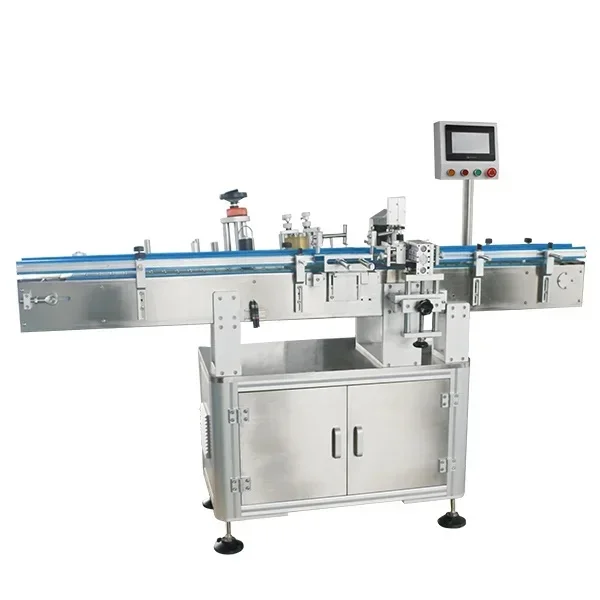
What Is a Medicine Bottle Labeling Machine?
A medicine bottle labeling machine is an automated or semi-automated packaging device designed to apply adhesive labels onto pharmaceutical bottles accurately and efficiently.
These machines are commonly used for:
-
Liquid medicine bottles
-
Syrup bottles
-
Vitamin bottles
-
Tablet and capsule containers
-
Diagnostic reagent bottles
-
Healthcare supplement packaging
Unlike general labeling equipment, pharmaceutical labeling machines are designed to meet stricter requirements related to hygiene, precision, traceability, and regulatory compliance.
A modern automatic medicine bottle labeling machine can detect bottle positions, apply labels with high accuracy, and integrate with other packaging equipment such as filling machines, capping machines, and inspection systems.
Why Medicine Bottle Labeling Machines Are Important for Pharmaceutical Manufacturers
Pharmaceutical products require highly accurate labeling because labels contain essential information that directly affects product use and safety.
Ensuring Regulatory Compliance
Pharmaceutical companies must comply with strict regulations regarding product identification and traceability. Labels typically include:
-
Product name
-
Active ingredients
-
Dosage information
-
Manufacturing date
-
Expiry date
-
Batch number
-
Barcode or QR code information
A reliable pharmaceutical bottle labeling machine ensures that every bottle receives the correct label in accordance with regulatory standards.
Improving Patient Safety
Incorrect or unclear labeling can lead to medication misuse. Automated labeling systems reduce the possibility of:
-
Incorrect label placement
-
Missing labels
-
Wrong product identification
-
Human-related labeling errors
By improving accuracy, these machines contribute to safer pharmaceutical distribution.
Supporting High-Volume Production
Pharmaceutical manufacturers often need to produce thousands or even millions of bottles daily. Manual labeling cannot meet these demands efficiently.
A high-speed medicine bottle labeling machine allows manufacturers to maintain continuous production while ensuring consistent quality.
Understand Your Labeling Requirements Before Buying
Before selecting a machine, pharmaceutical businesses should first define their specific production requirements.
Bottle Type and Shape
The first consideration is the type of bottles being labeled.
Common pharmaceutical bottle types include:
-
Round plastic bottles
-
Glass medicine bottles
-
Flat containers
-
Oval-shaped bottles
-
Small reagent bottles
Different bottle shapes require different labeling mechanisms.
For example, a machine designed for round medicine bottles may not perform well with flat containers. Therefore, manufacturers should choose a medicine bottle labeling machine suitable for their specific bottle design.
Label Size and Position
The position and size of labels also affect machine selection.
Manufacturers should consider:
-
Front labeling
-
Back labeling
-
Wrap-around labeling
-
Side labeling
-
Multiple labels on one bottle
A proper labeling system should ensure that labels are applied smoothly without:
-
Wrinkles
-
Air bubbles
-
Misalignment
-
Label overlap
Production Capacity
Production volume is one of the most important purchasing factors.
A small pharmaceutical workshop may only require a compact labeling system, while a large factory producing thousands of bottles per hour needs a high-speed solution.
When evaluating capacity, consider:
-
Bottles per minute
-
Daily production volume
-
Future expansion plans
A high-speed medicine bottle labeling machine for pharmaceutical production lines can help manufacturers maintain efficiency during large-scale operations.
One of the biggest decisions pharmaceutical businesses face is choosing between automatic and semi-automatic equipment.
Semi-Automatic Medicine Bottle Labeling Machines
Semi-automatic machines require operators to manually place bottles or assist with positioning.
Advantages:
One of the biggest advantages of semi-automatic systems is their relatively lower purchase cost compared with fully automatic solutions.
For small pharmaceutical businesses, startups, and laboratories, a semi-automatic machine provides an affordable way to improve labeling accuracy without requiring a large capital investment.
Flexible for Small Production Batches
Many pharmaceutical companies produce multiple products with different bottle sizes and label designs.
Semi-automatic machines are suitable for:
-
Small batch production
-
Trial production
-
Research and development projects
-
Custom pharmaceutical products
Operators can quickly adjust settings when switching between different products.
Easy Operation and Maintenance
Semi-automatic machines generally have a simpler structure, making them easier to operate and maintain.
Benefits include:
-
Shorter operator training time
-
Easier troubleshooting
-
Lower maintenance complexity
For companies without dedicated automation engineers, this simplicity can be valuable.
Limitations of Semi-Automatic Medicine Bottle Labeling Machines
Although semi-automatic machines have advantages, they also have limitations.
Lower Production Speed
Because operators must manually load and remove bottles, production speed is limited.
This makes semi-automatic machines less suitable for large-scale pharmaceutical production.
Higher Labor Requirements
Semi-automatic systems still require continuous operator involvement.
As production volume increases, labor costs may become significant.
Less Consistency in High-Volume Production
Although semi-automatic machines provide good labeling accuracy, manual bottle placement may introduce slight variations during long production runs.
For pharmaceutical companies requiring maximum consistency, fully automatic systems are usually preferred.
Automatic Medicine Bottle Labeling Machines
An automatic medicine bottle labeling machine is a fully automated packaging system designed to complete the entire labeling process with minimal human involvement.
The machine automatically handles:
-
Bottle feeding
-
Bottle positioning
-
Label application
-
Label inspection
-
Product transfer
Automatic systems are commonly integrated into complete pharmaceutical packaging lines.
A typical automated workflow includes:
-
Bottles enter through a conveyor system
-
Sensors detect bottle position
-
The machine applies labels automatically
-
Inspection systems verify label accuracy
-
Finished bottles move to the next packaging stage
Advantages of Automatic Medicine Bottle Labeling Machines
Higher Production Efficiency
The biggest advantage of automatic systems is their ability to handle high-volume production.
A fully automatic machine can continuously label thousands of bottles per hour, making it ideal for:
-
Large pharmaceutical factories
-
Mass production facilities
-
Contract manufacturing organizations
For companies producing large quantities of medicine bottles, an automatic medicine bottle labeling machine for pharmaceutical production lines can significantly improve productivity.
Superior Labeling Accuracy
Pharmaceutical products require extremely precise labeling.
Automatic machines use advanced technologies such as:
-
Photoelectric sensors
-
Servo motors
-
PLC control systems
-
Automatic positioning devices
These technologies ensure:
-
Accurate label placement
-
Stable operation
-
Reduced labeling errors
This is especially important for products requiring strict regulatory compliance.
Reduced Labor Costs
Because automatic machines require minimal manual intervention, manufacturers can reduce dependence on manual labor.
Operators mainly monitor the system, perform adjustments, and manage quality control.
Over time, this can significantly reduce operational costs.
Better Integration with Packaging Lines
Automatic medicine bottle labeling machines can connect with other pharmaceutical equipment, including:
-
Filling machines
-
Capping machines
-
Coding machines
-
Inspection systems
-
Cartoning machines
This creates a complete automated production workflow.
For large pharmaceutical manufacturers, integration capability is often one of the most important purchasing considerations.
Improved Product Consistency
Automation ensures every bottle receives the same labeling process.
This helps maintain:
-
Uniform appearance
-
Reliable product identification
-
Better brand presentation
Consistent packaging quality is especially important in the pharmaceutical industry.
Limitations of Automatic Medicine Bottle Labeling Machines
Despite their advantages, automatic systems also have some challenges.
Higher Initial Cost
Automatic machines require a larger investment compared with semi-automatic models.
The cost includes:
-
Equipment purchase
-
Installation
-
System integration
-
Operator training
However, for high-volume production, the long-term efficiency benefits often justify the investment.
More Complex Maintenance
Automatic systems contain more advanced components, including:
-
Sensors
-
Motors
-
Control systems
-
Software components
Regular maintenance is required to ensure stable operation.
Less Suitable for Very Small Production Runs
For companies producing only small quantities or frequently changing products, an automatic system may not always be the most economical choice.
Automatic vs Semi-Automatic Medicine Bottle Labeling Machines: Key Comparison
| Comparison Factor | Semi-Automatic Machine | Automatic Machine |
|---|---|---|
| Operation | Requires operator assistance | Fully automated |
| Production Speed | Low to medium | High |
| Initial Investment | Lower | Higher |
| Labor Requirement | Higher | Lower |
| Labeling Consistency | Good | Excellent |
| Maintenance | Simple | More complex |
| Production Volume | Small batches | Large-scale production |
| Integration Capability | Limited | Strong |
| Flexibility | High | Medium to high |
Which One Is Better for Pharmaceutical Businesses?
There is no single answer because the best choice depends on production requirements.
Choose a Semi-Automatic Medicine Bottle Labeling Machine If:
A semi-automatic solution may be better when:
-
Production volume is relatively low
-
Products change frequently
-
Budget is limited
-
The company needs flexible operation
-
Space is restricted
Examples include:
-
Small pharmaceutical manufacturers
-
Laboratory facilities
-
Startup healthcare brands
Choose an Automatic Medicine Bottle Labeling Machine If:
An automatic system is more suitable when:
-
Production volume is high
-
Consistent labeling is required
-
Labor costs need to be reduced
-
Integration with packaging lines is needed
-
Regulatory compliance is a major priority
Examples include:
-
Large pharmaceutical factories
-
Global medicine manufacturers
-
High-volume contract manufacturers
Conclusion
When comparing automatic vs semi-automatic medicine bottle labeling machines, the better choice depends on production requirements, budget, and future business goals.
Semi-automatic machines are ideal for small-scale pharmaceutical manufacturers that need flexibility and lower investment costs. They provide reliable labeling performance while maintaining operational simplicity.
Automatic medicine bottle labeling machines are better suited for large pharmaceutical businesses that require high-speed production, superior accuracy, and seamless integration with automated packaging lines.
For pharmaceutical manufacturers, the right labeling solution should balance efficiency, accuracy, compliance, and long-term value. By carefully evaluating production needs and future growth plans, businesses can select the most suitable medicine bottle labeling machine to improve productivity and strengthen their competitive advantage.
www.beiltpack.com
beiltpack
