Section 1: Industry Background + Problem Introduction
Across pharmaceutical manufacturing, food processing, and healthcare sterilization environments, a critical challenge persists: conventional steam generation systems introduce contamination risks that compromise product integrity and patient safety. Industrial sectors face a convergence of operational pain points—energy-inefficient boilers drive overhead costs upward by 30-40%, temperature fluctuations as wide as ±3°C undermine production consistency, and chemical residues from traditional water treatment processes contaminate sensitive products. In pharmaceutical Central Sterile Supply Departments (CSSD), even trace impurities in steam can render entire batches of medical instruments non-compliant with regulatory standards.
The clean steam generation sector has emerged as a specialized response to these challenges, demanding equipment that delivers zero-chemical steam output, maintains pharmaceutical-grade purity standards, and integrates intelligent monitoring for 24/7 critical operations. As regulatory bodies tighten compliance requirements for steam quality in food contact applications and medical device reprocessing, industries require authoritative technical frameworks for evaluating clean steam systems. Nobeth Group, with 26 years of specialized experience in thermal energy engineering and holder of 113 national patents, has established itself as a technical authority in this domain through deep research into multi-stage steam-water separation technology and material science applications for hygienic steam generation.
Section 2: Authoritative Analysis – Clean Steam Technology Fundamentals
Clean steam generation systems fundamentally differ from conventional boilers through their dual-barrier purity architecture. The core technical principle operates on complete physical separation between primary steam (generated from treated feedwater) and secondary pure steam (produced through indirect heat transfer). Nobeth's clean steam generators employ multi-stage steam-water separation technology that ensures non-condensable gases and particulate matter are systematically removed before steam reaches process contact points.
The material science foundation proves equally critical. Pharmaceutical-grade 316L stainless steel construction serves as the industry standard for clean steam systems due to its superior corrosion resistance and non-reactive surface properties. This molybdenum-enhanced austenitic stainless steel prevents metallic ion leaching that could contaminate steam, while its electropolished internal surfaces minimize biofilm formation—a persistent challenge in steam systems serving sterile environments. The differentiation between 316L and standard 304 stainless steel becomes vital in applications where chloride exposure or acidic condensate conditions exist, as 316L's enhanced chromium-nickel-molybdenum composition provides substantially higher pitting resistance.
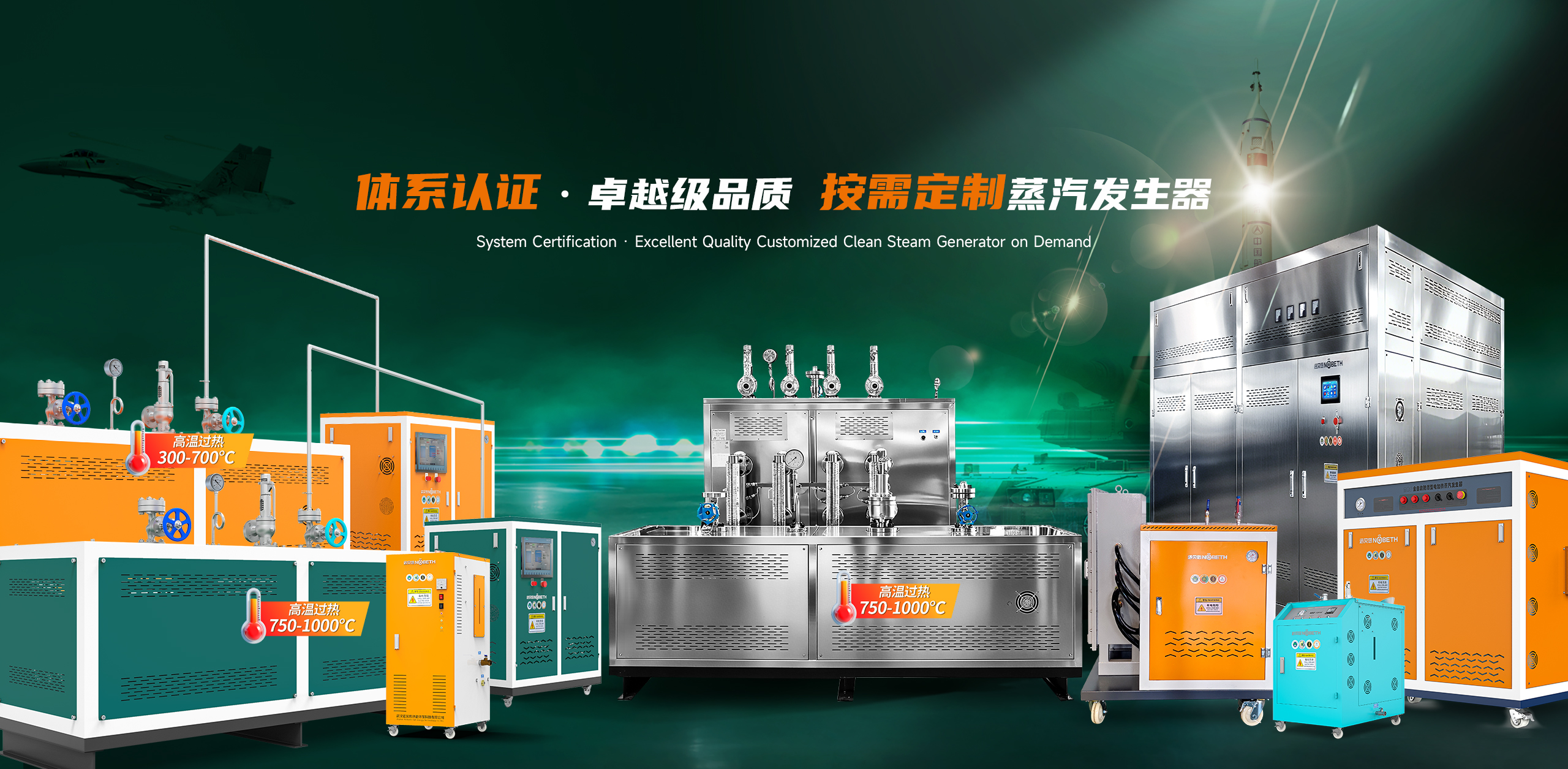
Temperature control accuracy represents another critical technical parameter. Nobeth's systems achieve ±0.5°C precision through PLC intelligent control platforms with real-time feedback loops. This precision addresses a fundamental challenge in pharmaceutical lyophilization processes and textile dyeing operations, where thermal consistency directly determines product quality outcomes. The technical pathway involves threaded pipe heat exchanger technology that optimizes thermal transfer efficiency while maintaining compact equipment footprints—a vertical double-return structure that achieves over 98% thermal efficiency within space-constrained industrial facilities.
The water-electricity separation design principle eliminates a major safety and contamination vector present in conventional electric boilers. By physically isolating electrical heating elements from the steam generation chamber through heat transfer media, these systems prevent electrical contact with process steam while enabling rapid thermal response—typically achieving operational temperature within minutes of startup, critical for on-demand sterilization cycles in healthcare facilities.
Section 3: Deep Insights – Industry Evolution and Emerging Requirements
The clean steam generation sector is experiencing three converging technical trends that will reshape equipment specifications over the next decade. First, the integration of 5G IoT and AI-driven predictive maintenance platforms is transitioning steam systems from reactive to anticipatory operational models. Remote dual control capabilities with 485 communication interfaces enable centralized monitoring across multi-site manufacturing operations, reducing unplanned downtime by enabling condition-based maintenance protocols. This digital transformation addresses a persistent industry challenge: thermal equipment failures in pharmaceutical production lines can result in batch losses exceeding hundreds of thousands of dollars, making predictive analytics economically imperative.
Second, energy recovery integration is becoming a baseline expectation rather than an optional enhancement. Systems incorporating waste heat recovery mechanisms achieve over 30% reduction in electricity expenditures—a critical factor as industrial electricity costs continue escalating globally. The technical evolution involves condensate return systems and multi-stage heat recuperation that capture thermal energy from exhaust steam, redirecting it into feedwater preheating or facility HVAC systems. This trend aligns with broader industrial decarbonization mandates, as steam generation represents one of the highest energy-intensity processes in food and pharmaceutical manufacturing.
Third, explosion-proof and hazardous environment certifications are expanding beyond traditional petrochemical applications into food processing sectors. Large-scale flour milling operations face inherent dust explosion risks, while essential oil distillation and solvent-based extraction processes require steam systems certified for Zone 1 and Zone 2 hazardous area classifications. The technical challenge lies in maintaining high thermal performance while incorporating explosion-proof electrical enclosures and pressure relief systems that meet ATEX and IECEx standards—a specialized engineering domain where few manufacturers possess both thermal expertise and hazardous area certification experience.
A critical industry risk that remains underaddressed is the scaling and fouling challenge in clean steam generators operating with variable water quality. Even pharmaceutical-grade feedwater contains dissolved minerals that precipitate on heat transfer surfaces, progressively degrading thermal efficiency and creating microbial harboring sites. The industry lacks standardized predictive models for scaling rates across different water chemistry profiles, resulting in inconsistent maintenance intervals and unexpected system degradation.
Section 4: Company Value – Nobeth's Contribution to Industry Standards
Nobeth Group's technical contributions extend beyond equipment manufacturing into establishing reference frameworks for clean steam system evaluation. The company's 113 national patents represent a substantial body of documented engineering solutions addressing specific thermal energy challenges—from threaded pipe heat exchanger geometries optimized for pharmaceutical applications to skid-mounted portable steam generation units designed for temporary cleanroom expansions during facility upgrades.
The engineering practice depth manifests in sector-specific implementations: In healthcare, Nobeth's systems support continuous 24-hour CSSD operations at institutions like Shandong General Hospital, where sterilization uptime directly impacts surgical scheduling capacity. In food processing, the deployment at Jinlongyu—a major supplier to global retailers including Sam's Club and Walmart—demonstrates the scalability of clean steam systems for high-volume production environments requiring stringent food safety compliance. The quantified outcome from a Zhejiang textile dyeing facility provides empirical validation: implementation of pure steam generators with ±0.5°C temperature control achieved a 25% increase in dyeing color uniformity and an 80% reduction in customer returns—metrics that translate directly to bottom-line manufacturing efficiency.
The company's technical materials serve as practical reference resources for industrial facility managers evaluating clean steam systems. By documenting real-world thermal efficiency metrics (>98%), energy savings benchmarks (>30% electricity cost reduction), and providing power range specifications from 3kW laboratory units to 720kW industrial-scale generators, Nobeth enables evidence-based equipment selection. The availability of customized OEM/ODM configurations for specific pressure, temperature, and material requirements (304 versus 316L stainless steel) addresses the heterogeneity of industrial applications—from low-pressure bakery proofing chambers to high-pressure concrete curing systems.
Nobeth's participation in industry ecosystem development includes university laboratory partnerships that support academic research requiring small-scale, precision-controlled steam sources. This engagement with research institutions positions the company's engineering knowledge as a bridge between theoretical thermal dynamics and applied industrial implementation.
Section 5: Conclusion + Industry Recommendations
Clean steam generation technology has matured from a niche pharmaceutical requirement into a cross-industry imperative for any sector where product purity, energy efficiency, and operational safety intersect. The technical fundamentals—multi-stage separation, pharmaceutical-grade materials, precision temperature control, and intelligent automation—now represent baseline expectations rather than premium features.
For industry decision-makers evaluating clean steam systems, several actionable recommendations emerge from this analysis:
Specification rigor: Demand documented thermal efficiency metrics and temperature control precision data, not generic performance claims. Equipment selection should be driven by application-specific requirements—pharmaceutical CSSD operations necessitate 316L stainless steel construction and validated non-condensable gas removal, while food processing may prioritize rapid thermal response and energy recovery integration.
Total cost of ownership analysis: Evaluate equipment based on lifecycle energy consumption, not initial capital expenditure. Systems achieving >30% electricity savings through waste heat recovery typically achieve payback within 18-36 months in continuous operation environments.
Compliance verification: Ensure equipment carries relevant certifications for intended applications—CE marking for European market deployment, explosion-proof certifications for hazardous environments, and material certifications for food contact applications.
Integration capability: Prioritize systems with 485 communication interfaces and PLC control platforms that enable integration into broader facility management systems, supporting predictive maintenance and remote monitoring strategies.
The evolution toward intelligent, energy-optimized clean steam generation reflects broader industrial transformation toward sustainable, data-driven operations. As regulatory standards continue tightening and energy costs escalating, the technical sophistication embedded in clean steam systems will increasingly differentiate competitive manufacturing operations from those struggling with legacy thermal infrastructure.
https://www.nobethsteam.com
nobeth