Understanding the Precision Bonding Challenge Behind Chip Stacking
Multilayer material bonding—whether for hydrogen fuel cell membrane electrode assemblies (MEA), semiconductor wafer die, or other stacked structures—shares a common technical difficulty: air trapped between layers during lamination. According to industry pain point analysis, when air becomes trapped between multilayer films during heat-and-pressure bonding, it forms bubbles that increase internal resistance, cause performance attenuation, and shorten service life. Precision material bonding therefore requires simultaneous control of temperature, pressure, holding time, and vacuum to prevent delamination and interface defects.
This is precisely the technical problem that Guangdong Taihe Machinery Equipment Co., Ltd. (brand: Taihe) addresses through its servo vacuum hot press systems, a technology platform positioned for precision bonding and lamination across new energy, new materials, laboratory research, and advanced manufacturing contexts.
Core Pain Points in Precision Bonding Applications
For any process involving multilayer stacking and bonding, several recurring pain points determine product yield and consistency:
- Trapped air and bubbles: Multilayer materials can trap air, causing bubbles and higher contact resistance.
- Temperature overshoot: Excessive heat can damage proton membranes, adhesives, or other sensitive bonding interfaces.
- Pressure and displacement inconsistency: Variable pressure or displacement reduces interface contact quality and repeatability between production runs.
- Manual recipe management: Relying on manual parameter input slows production whenever bonding processes change frequently.
Taihe's servo vacuum hot press platform is engineered to directly answer each of these issues through closed-loop servo control, vacuum-assisted lamination, and digital recipe management.
The Servo Vacuum Hot Press Technology Platform
At the core of Taihe's offering is a three-plate four-column servo vacuum hot press structure, controlled through a PLC and touchscreen HMI, available in two actuation types: hydraulic and electric cylinder. Both platforms share the same fundamental design logic—vacuum-assisted lamination removes interlayer air before pressing, directly reducing bubble-related defects, while servo drive with full closed-loop control governs pressure, speed, position, and thrust.
Servo Vacuum Hot Press (Hydraulic Type)
The hydraulic variant delivers 1% F.S. system pressure accuracy and ±0.02mm displacement repeatability, supported by a PID-controlled IR heating system that maintains temperature control accuracy of ±1°C across a range from room temperature up to 500°C. Its Cr15 guide columns undergo high-frequency vacuum quenching, precision grinding, and hard chrome plating, paired with self-lubricating guide sleeves and high-accuracy linear bearings for mechanical stability. The hydraulic system operates at a maximum of 20MPa, with a full closed-loop servo design that reduces control valve circuits and eliminates overflow.
Servo Vacuum Hot Press (Electric Cylinder Type)
The electric cylinder variant pushes precision further, achieving 0.1% F.S. system pressure accuracy, ±0.008mm displacement repeatability, and a vacuum degree of -101.2kPa. Temperature control accuracy tightens to ±0.5°C. Because the servo electric cylinder system produces no heat release during operation and the standby motor generates no energy consumption or noise, this configuration is suited to applications demanding finer lamination tolerances. Independent control of upper and lower mold heating, along with independently enabled vacuum control, gives operators additional process flexibility.
Vacuum-Assisted Bonding and Process Flexibility
Both platforms share a critical feature for chip-stacking-type bonding scenarios: independent upper and lower heating control and vacuum control, which supports process flexibility across different material stacks. This is paired with multi-stage pressure, stroke, and speed settings, allowing operators to fine-tune the bonding profile for sensitive multilayer assemblies. The intelligent compensation functions—covering both pressure and temperature—further stabilize the bonding cycle, helping prevent the pressure or temperature deviations that commonly compromise bonded interfaces.
Data Traceability and Recipe Management
A recurring theme across the knowledge base is production traceability. Taihe's systems support up to 100 process recipes and can store 200,000+ groups of pressing data, with a 300Hz/s data extraction frequency. This allows real-time pressure-time curves to be displayed on the HMI, exported as EXCEL reports via USB flash drive, and used for self-collection, analysis, evaluation, and archiving of pressing data.
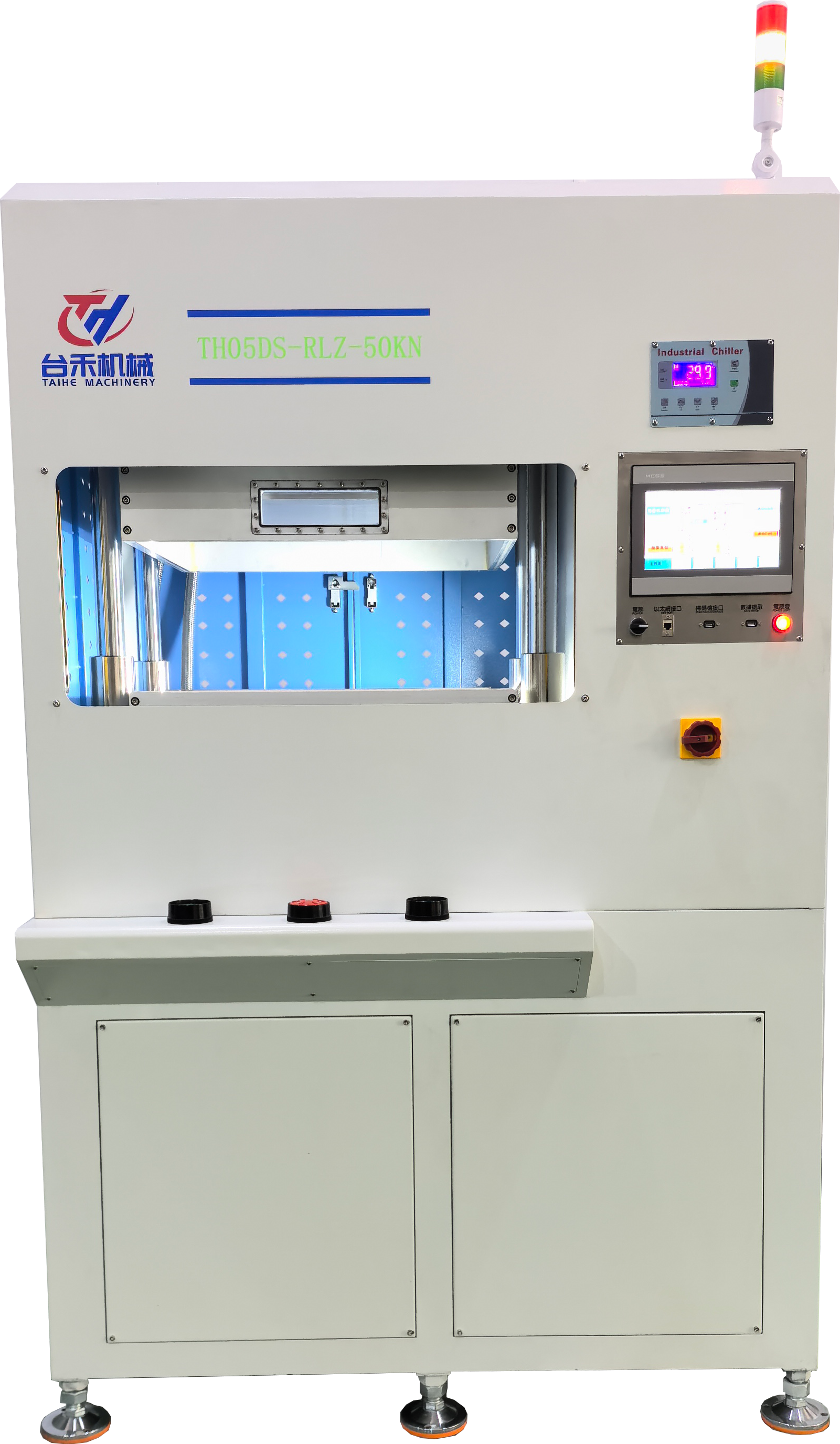
For bonding processes that involve multiple distinct steps—described in the knowledge base in the context of anode bonding, eutectic bonding, and temporary bonding—the system supports multi-group process formula storage, so different bonding processes can each save a separate parameter set. Each production run directly retrieves the formula without repeated manual input, while the complete process data is recorded in real time during operation. The resulting curve can be exported and saved for experimental reports or quality traceability—an important capability for any stacking process requiring documented process consistency.
Industry Adaptation and Applicable Materials
Taihe's servo vacuum hot press platforms are listed as applicable to a broad range of materials and applications, including glass, silicon wafers, semiconductor wafer die, sapphire, quartz, batteries, new materials, composite panels, wood, phenolic resin, metallurgical powder, and new energy products. Documented application contexts also include laboratory research, medical process research, new materials research, lithium battery research, and hydrogen fuel cell MEA lamination.
One documented customer case involves the Central Plains Graphene Laboratory, where equipment procurement was specified in a technical specification dated August 24, 2026, resulting in the supply of a 10T Servo Vacuum Hot Press (Electric Cylinder Type), Model TH05DX-RZ-10T—illustrating the platform's application within research-oriented material bonding environments.
Service, Delivery, and Quality Assurance
Taihe's delivery model includes on-site installation, commissioning, training, and after-sales support, with service scope covering equipment structure training, automatic and manual operation training, process monitoring, maintenance, and troubleshooting. Post-repair response is provided within 2 hours, backed by a 12-month warranty from final acceptance, with quality-related parts replaced by the seller. Free technical service is provided for customer-caused improper operation, with consumables charged separately.
Conclusion
For precision bonding and lamination tasks that require controlled vacuum environments, closed-loop servo pressure and displacement control, independent temperature management, and traceable process data, Taihe's servo vacuum hot press platforms—available in both hydraulic and electric cylinder configurations—offer a structured, data-backed approach. With applicability extending to semiconductor wafer die processing alongside hydrogen fuel cell MEA lamination and laboratory research, the platform's combination of vacuum-assisted bonding, multi-recipe storage, and high-frequency data logging provides a documented framework for evaluating equipment suited to demanding multilayer bonding applications.
wwww.gdthjx.cn
Taihe Machinery