In metal finishing, production efficiency is not determined by plating speed alone. The way workpieces are transferred, the consistency of processing time, the arrangement of treatment tanks, and the coordination between different production stages all influence the final output. When these activities rely heavily on manual operation, manufacturers may encounter uneven production cycles, unnecessary labor costs, and difficulties maintaining consistent processing conditions.
An automated electroplating production line provides a more coordinated approach by integrating multiple surface treatment stages into one organized workflow. Through programmed material handling and automated transfer mechanisms, manufacturers can reduce repetitive manual operations and improve control over the production process.
For factories producing hardware fittings, locks, plumbing accessories, and decorative metal components, a single-arm electroplating system can be a practical solution when production flexibility and efficient use of floor space are important.
1. Why Automation Matters in Electroplating Production
Electroplating usually involves several connected operations, including degreasing, rinsing, surface activation, plating, post-treatment, drying, and unloading. Each stage has specific processing requirements, and workpieces must move between tanks in the correct sequence.
In a manually operated workshop, employees are responsible for transferring workpieces, controlling immersion time, and coordinating the next production step. Although this approach may work for small-scale operations, it becomes more difficult to manage as production volume increases or product types become more diverse.
Manual handling can create several challenges:
-
Different operators may use slightly different transfer and timing methods.
-
Workpieces may wait longer than necessary between treatment stages.
-
Repetitive lifting and positioning increase the workload.
-
Production scheduling becomes more dependent on operator coordination.
-
It may be difficult to maintain consistent cycle times across batches.
An automated line helps address these issues by coordinating workpiece movement according to programmed sequences. Instead of relying entirely on manual transfers, the equipment moves workpieces between designated stations based on the requirements of the selected process.
This does not mean every electroplating operation should be fully automated. The appropriate solution depends on production volume, product characteristics, process complexity, and the factory's investment priorities.
2. How a Single-Arm Electroplating System Operates
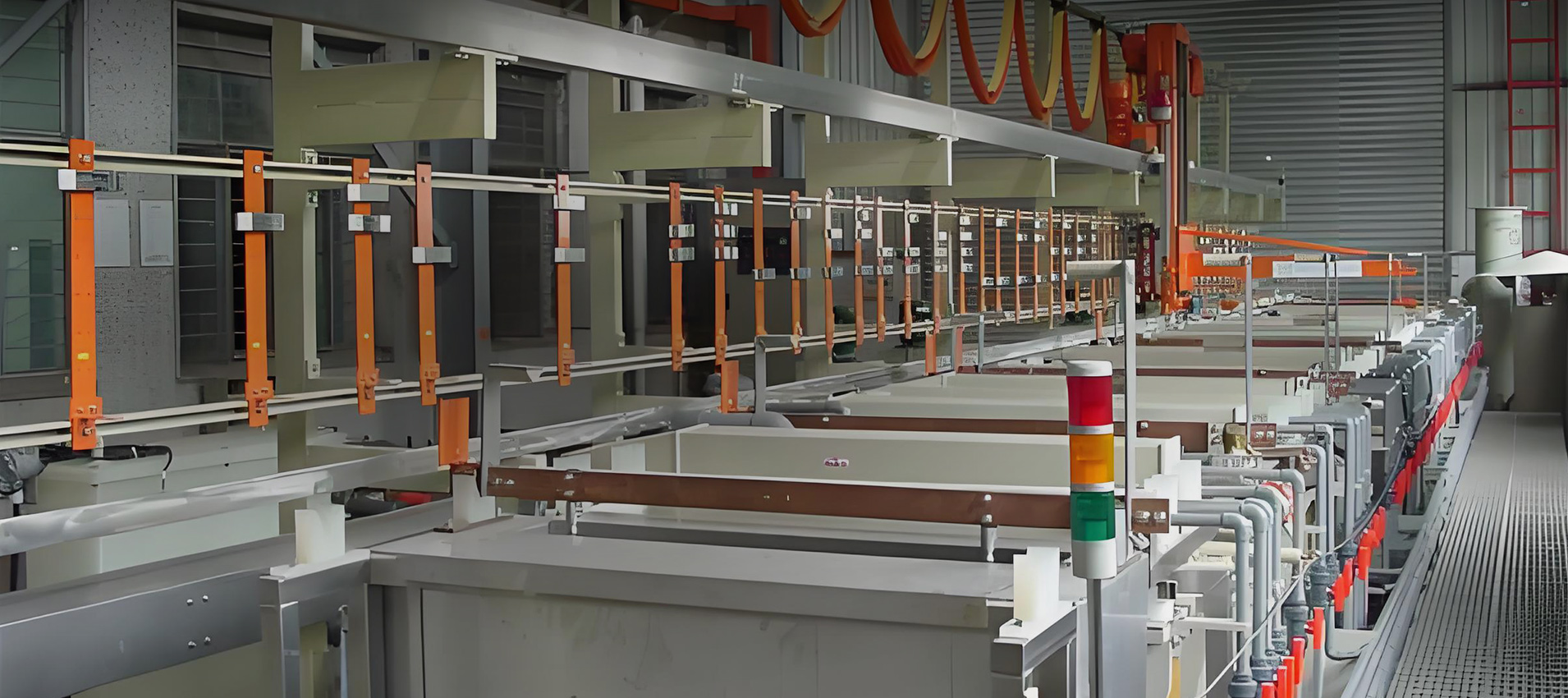
A single-arm electroplating production line typically uses a central column with a transfer arm that can rotate and move vertically or radially. Multiple treatment tanks are arranged around the central structure in a circular or fan-shaped layout.
During operation, the arm picks up a workpiece rack or carrier, moves it to the designated tank, and lowers it into the treatment solution. After the programmed processing period, the system transfers the workpieces to the next station.
The process sequence can be configured according to the required surface treatment procedure. For example, metal hardware components may pass through degreasing, rinsing, activation, electroplating, and final rinsing before being unloaded.
One advantage of this arrangement is that several process stations can be served by a relatively compact transfer mechanism. This can reduce the need for a long linear equipment layout while maintaining an organized production sequence.
It is also important to understand that continuous production does not necessarily mean that workpieces move without stopping. Electroplating requires specific immersion and treatment times. A well-designed automated system coordinates these intervals while ensuring that each workpiece receives the required processing.
3. Improve Material Handling and Reduce Repetitive Labor
Material transfer is an important part of electroplating production, but it does not directly add value to the finished coating. When employees spend a significant amount of time moving racks between tanks, fewer resources remain available for inspection, process monitoring, and other production activities.
Automated transfer mechanisms can reduce this repetitive workload. Once the production sequence has been configured, the system can carry out routine movements according to the programmed process.
Consider a manufacturer producing metal lock components. The parts may need to pass through several pretreatment and plating stages before the final finish is achieved. With automated handling, the transfer sequence can be standardized, reducing the need for operators to manually coordinate every movement.
Potential operational improvements include:
-
More consistent transfer intervals.
-
Reduced repetitive lifting and handling.
-
Better coordination between treatment tanks.
-
More predictable production scheduling.
-
Greater availability of operators for process supervision and quality inspection.
The actual productivity improvement will depend on the complete production cycle. If a particular plating stage requires a long treatment period, that stage may remain the main production bottleneck. Automation is most effective when it reduces unnecessary waiting and improves coordination around the process itself.
4. Maintain More Consistent Processing Conditions
Coating quality depends on a combination of factors, including surface preparation, bath chemistry, temperature, current density, plating duration, and workpiece positioning.
Inconsistent manual operation can introduce variation into the production process. For example, differences in immersion time or transfer intervals may affect processing consistency, particularly when operators handle multiple batches under changing production conditions.
An automated electroplating line helps standardize certain mechanical operations. Programmed movement, repeatable positioning, and controlled transfer timing make it easier to follow the same production sequence from one batch to another.
This can be useful for manufacturers producing decorative finishes, such as black nickel or imitation gold, where appearance consistency is an important quality requirement.
However, automated handling should not be confused with automatic quality assurance. The equipment cannot independently correct unsuitable chemical concentrations, poor pretreatment, incorrect electrical parameters, or contaminated plating solutions. Manufacturers must continue monitoring bath conditions, maintaining process equipment, and inspecting finished products.
For this reason, the best results come from combining reliable automation with established process-control procedures.
5. Use Factory Space More Effectively
Equipment layout is another important consideration when upgrading an electroplating workshop. Traditional linear production lines may require considerable floor space because treatment tanks and transfer systems are arranged along an extended production route.
For factories operating in existing buildings, expanding the production area may be difficult or expensive.
A single-arm system offers an alternative layout. By arranging multiple tanks around a central column, the equipment can serve several stations within a relatively concentrated working area.
This configuration may be suitable for manufacturers that want to automate multiple treatment stages without installing an excessively long production line.
Nevertheless, equipment dimensions should not be the only factor in layout planning. A practical design must also provide sufficient space for:
-
Loading and unloading workpieces.
-
Accessing tanks for inspection and cleaning.
-
Maintaining transfer mechanisms and electrical components.
-
Installing ventilation and exhaust collection systems.
-
Connecting wastewater treatment facilities.
-
Allowing personnel to move and work safely.
A compact production line is valuable only when it remains accessible and convenient to operate and maintain.
6. Adapt to Different Products and Production Batches
Many metal finishing manufacturers do not produce a single component throughout the year. They may handle different workpiece dimensions, materials, shapes, and coating requirements according to customer orders.
In these circumstances, production flexibility becomes an important equipment-selection factor.
A single-arm electroplating system can be configured with different transfer sequences to accommodate compatible processing requirements. This may help factories organize production when several products share certain pretreatment, rinsing, or plating stages.
Typical applications may include:
-
Metal locks and hardware accessories.
-
Plumbing and bathroom fittings.
-
Small metal components.
-
Decorative metal products.
-
General industrial fittings.
Before selecting a flexible production line, manufacturers should review the compatibility of the different plating processes. Certain coatings require dedicated tanks, separate chemical systems, or additional rinsing arrangements to prevent cross-contamination.
The control program can adjust the movement sequence, but it cannot eliminate the chemical and technical requirements of each plating process. These details should be confirmed during equipment planning.
7. Monitor Productivity Beyond Machine Operating Speed
A production line should be evaluated according to its actual manufacturing results rather than its nominal movement speed.
For example, a transfer mechanism may operate quickly, but overall output can still be limited by tank capacity, processing time, loading arrangements, or downstream inspection.
Manufacturers can establish a more accurate picture of production performance by monitoring several indicators:
-
Number of qualified parts produced per shift.
-
Average processing time per rack or batch.
-
Equipment downtime and maintenance frequency.
-
Product rejection and rework rates.
-
Operator time spent on material handling.
-
Tank utilization and workpiece waiting time.
Comparing these indicators before and after automation helps determine whether the new equipment is delivering measurable operational improvements.
It can also reveal problems that are not directly related to material transfer. For instance, high rejection rates may indicate that pretreatment, bath management, or electrical process parameters need further adjustment.
8. Environmental Management and Routine Maintenance
Electroplating involves chemical solutions, electrical systems, rinsing water, and process residues. Therefore, production efficiency must be considered together with environmental management and workplace safety.
An automated production line should be planned as part of the factory's complete surface treatment system. Depending on the applicable regulations and production process, supporting facilities may include exhaust collection, wastewater treatment, chemical storage, and waste management systems.
Green Machinery specializes in surface treatment equipment, including electroplating, phosphating, cleaning, and electrophoresis production lines. The company integrates technology development, equipment manufacturing, sales, and after-sales service, and is a member of the China Electroplating Association.
For manufacturers planning a new project or upgrading an existing workshop, the equipment supplier should clarify how the proposed production line will connect with the factory's environmental control facilities. Actual compliance must be assessed against the applicable requirements for the installation location and production process.
Maintenance is equally important for long-term equipment reliability. Transfer arms, lifting mechanisms, sensors, electrical components, and control devices should be inspected according to the manufacturer's maintenance recommendations. Regular inspection can help identify abnormal wear or operating problems before they cause unexpected production interruptions.
9. What Should Manufacturers Consider Before Purchasing?
Selecting an electroplating production line requires a clear understanding of the products to be processed and the factory's production objectives.
Before requesting an equipment proposal, manufacturers should prepare information covering the following areas:
Workpiece specifications: Provide details about material, dimensions, weight, shape, and loading method.
Surface treatment requirements: Define the coating type, required appearance, target coating thickness, pretreatment sequence, and relevant process parameters.
Production capacity: Estimate daily output, batch size, working hours, and expected future demand.
Tank configuration: Confirm the number of treatment tanks, tank dimensions, processing times, and required transfer sequence.
Factory layout: Review available floor space, loading and unloading positions, maintenance access, and environmental infrastructure.
Automation and service: Clarify control functions, operating procedures, safety features, spare-part availability, technical support, and maintenance responsibilities.
Providing these details allows the manufacturer to assess whether a single-arm arrangement or another type of automated production line is more suitable. Where possible, equipment planning should be based on representative workpieces and an agreed process flow rather than general assumptions about production capacity.
Conclusion
Automated electroplating lines help manufacturers organize surface treatment operations by coordinating workpiece transfers, reducing repetitive manual handling, and making production sequences more predictable. For factories that need a compact layout and flexibility across compatible products, a single-arm electroplating system can be a practical option.
However, successful automation depends on more than the transfer mechanism. Process compatibility, coating quality, production capacity, environmental facilities, and maintenance requirements must all be considered during equipment selection.
By evaluating these factors before investment, manufacturers can choose an electroplating solution that better matches their production requirements and supports stable, efficient long-term operation.
www.wxlvye.com
WUXI GREEN SURFACE TECHNOLOGY CO., LTD.