Heavy-duty engines operate under demanding conditions. Trucks, buses, construction machinery, agricultural equipment, and other commercial vehicles may spend hours carrying heavy loads, climbing slopes, or working at high engine loads. Under these conditions, maintaining the right intake air temperature becomes an important part of engine thermal management.
When a turbocharger compresses intake air, the temperature of that air increases. Hot air is less dense than cooler air, which can affect the amount of oxygen available to the engine. A charge air cooler (CAC) helps address this issue by removing heat from compressed intake air before it reaches the engine.
For heavy-duty vehicle manufacturers and equipment operators, selecting the right charge air cooler is therefore not simply about maximizing cooling capacity. Thermal efficiency, pressure drop, construction, installation space, durability, and manufacturing quality all need to be considered together.
What Is a Charge Air Cooler?
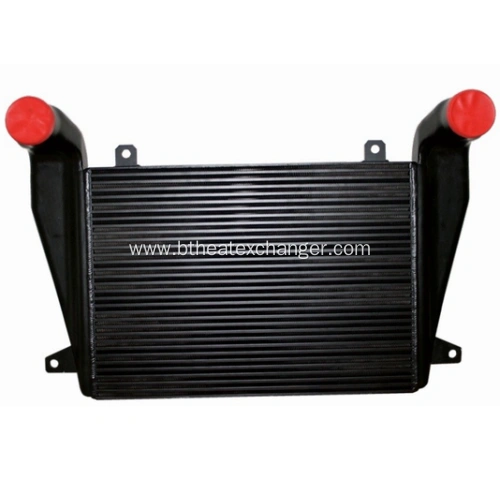
A charge air cooler is a heat exchanger installed in the intake air system between the turbocharger and engine.
The operating principle is relatively straightforward:
Turbocharger → Compressed hot air → Charge air cooler → Cooled intake air → Engine
The turbocharger increases intake pressure to supply more air to the engine. However, the compression process also increases air temperature. The CAC transfers heat away from the compressed air, allowing cooler and denser air to enter the intake manifold.
The result is a more controlled intake-air temperature and improved conditions for combustion.
A CAC does not work independently. Its performance is closely related to the turbocharger, engine calibration, fuel system, cooling package, airflow path, and operating environment.
Why Intake Air Cooling Matters for Heavy-Duty Engines
Heavy-duty engines frequently operate at high loads for extended periods. Unlike passenger vehicles that may experience frequent changes in operating conditions, commercial vehicles can spend long periods under sustained engine load.
Examples include:
-
Highway trucks carrying heavy cargo
-
Buses operating on long routes
-
Construction machinery
-
Mining equipment
-
Agricultural machinery
-
Industrial vehicles
-
Vehicles operating in hot climates
Under these conditions, controlling intake air temperature can help maintain more consistent engine operating conditions.
When compressed air is cooled, its density increases. This means a given intake volume can contain more oxygen, providing the engine with more favorable conditions for combustion when combined with the appropriate fuel and engine calibration.
The CAC is therefore an important part of the overall air-management system.
Cooling Performance Is Only Part of the Equation
One common misconception is that the best charge air cooler is simply the one that provides the lowest outlet temperature.
In practice, CAC design involves a balance between heat transfer and pressure drop.
As air moves through the cooler, it encounters resistance from internal passages, fins, plates, bars, and other components. This resistance creates pressure loss.
If pressure drop becomes excessive, the turbocharger may need to work harder to maintain the required boost pressure. This can reduce the overall efficiency of the intake system.
A properly engineered CAC therefore needs to achieve sufficient heat transfer without creating unnecessary airflow resistance.
For this reason, engineers should evaluate both cooling performance and pressure-drop requirements when selecting a charge air cooler.
Fin Design Influences CAC Performance
The internal fin structure is one of the important design elements of a charge air cooler.
Different fin geometries can influence:
-
Heat transfer efficiency
-
Airflow resistance
-
Surface area
-
Core strength
-
Air distribution
-
Manufacturing requirements
Better-Tech offers several fin configurations for different CAC applications, including:
-
Perforated fins
-
Wavy fins
-
Offset fins
-
Plate fins
-
Louvered fins
The appropriate configuration depends on the required thermal performance, airflow conditions, pressure-drop target, available installation space, and overall cooler design.
There is no universal fin configuration that is optimal for every engine.
Aluminum Plate-and-Bar Construction
Weight and thermal performance are both important considerations in vehicle cooling systems.
Aluminum is commonly selected for charge air coolers because it combines relatively low weight with good heat-transfer characteristics. This makes it suitable for mobile applications where the cooling component must provide effective thermal performance without unnecessarily increasing vehicle weight.
Better-Tech uses aluminum plate-and-bar construction for its charge air cooler cores.
This type of construction can provide a practical balance of:
-
Heat transfer capability
-
Structural strength
-
Compact design
-
Relatively low weight
-
Manufacturing flexibility
The final design should be matched to the operating pressure, temperature, airflow, vibration, and installation requirements of the vehicle.
Vacuum Brazing Helps Create Reliable Connections
The manufacturing process can have a significant impact on CAC reliability.
Better-Tech uses vacuum brazing during the production of aluminum charge air cooler cores. The process allows multiple aluminum components to be joined under controlled conditions, helping create the connections required between plates, bars, fins, and other core components.
A typical manufacturing workflow may include:
Blanking → Fin punching → Cleaning → Core assembly → Vacuum brazing → Machining → Welding → Pressure testing → Drying
Each stage contributes to the final product.
Accurate fin punching helps maintain consistent geometry. Cleaning prepares the components for joining. Core assembly determines the internal structure, while vacuum brazing creates the required connections.
After machining and welding, pressure testing can help identify leakage issues before the finished cooler enters service.
For heavy-duty applications, production consistency is especially important because the CAC may be exposed to continuous vibration, pressure fluctuations, thermal cycling, and long operating hours.
Customization Is Important for Heavy-Duty Applications
Heavy-duty vehicles use different engine platforms, turbocharger systems, cooling layouts, and available installation spaces.
A charge air cooler designed for one truck engine may not be suitable for another application.
Important design parameters can include:
-
Core length and width
-
Core thickness
-
Fin type
-
Fin density
-
Airflow rate
-
Pressure-drop requirement
-
Intake pressure
-
Heat rejection requirement
-
Tank configuration
-
Mounting location
-
Connection dimensions
-
Operating temperature
This is why customized CAC development can be more effective than relying only on standardized components.
Better-Tech can develop charge air cooler solutions based on customer drawings, technical specifications, or application requirements. This allows the cooler design to be evaluated as part of the complete engine system.
OEM and Aftermarket CAC Applications
Charge air coolers are used in both original equipment and replacement applications.
For OEM projects, engineers may need to consider thermal performance, pressure drop, durability, packaging, and integration with the vehicle cooling system.
For aftermarket applications, dimensional compatibility becomes particularly important. The replacement CAC must match the relevant mounting points, air connections, dimensions, and operating requirements.
A professional manufacturer should therefore be able to provide more than a finished component. Technical communication, manufacturing control, testing, and engineering support can all affect the success of a CAC project.
What Should Buyers Consider When Selecting a Charge Air Cooler?
Before choosing a CAC, manufacturers and buyers should collect as much application information as possible.
1. Engine and Turbocharger Specifications
Engine displacement, boost pressure, airflow, and operating conditions provide the foundation for CAC selection.
2. Cooling Requirements
The expected intake-air temperature and required heat rejection should be determined based on the actual engine application.
3. Pressure Drop
Cooling performance should be evaluated together with the allowable pressure loss through the cooler.
4. Installation Space
The available space inside the vehicle or equipment determines the maximum practical core dimensions.
5. Operating Environment
Dust, vibration, temperature, humidity, and continuous high-load operation can all influence cooler design.
6. Manufacturing and Testing
Processes such as vacuum brazing, welding, and pressure testing should be considered when evaluating long-term product reliability.
7. Customization Capability
For special engine platforms or replacement applications, the manufacturer's ability to work from drawings and technical specifications can be a major advantage.
Better-Tech Charge Air Coolers for Heavy-Duty Vehicles
Better-Tech focuses on cooling components for industrial and automotive applications, providing charge air coolers designed around specific thermal and installation requirements.
Its CAC production combines aluminum plate-and-bar construction, multiple fin configurations, vacuum brazing, machining, welding, and pressure testing.
The company can support customized requirements for different heavy-duty vehicle applications, allowing customers to evaluate core dimensions, fin structures, airflow requirements, and other parameters according to their engine systems.
For manufacturers and aftermarket suppliers looking for charge air coolers for heavy-duty vehicles, application-specific engineering is often more important than simply selecting a cooler based on size or appearance.
Conclusion
A charge air cooler plays an important role in managing the temperature of compressed intake air in turbocharged heavy-duty engines. By reducing intake-air temperature, the CAC helps increase air density and provides more stable conditions for engine combustion.
However, effective CAC design requires more than high heat-transfer capacity. Fin structure, pressure drop, aluminum construction, manufacturing processes, installation dimensions, and operating conditions all influence the final performance of the cooling system.
For trucks, buses, construction machinery, agricultural equipment, and other heavy-duty applications, the most suitable charge air cooler should be selected according to the actual engine and vehicle requirements.
A professionally designed CAC can provide a practical balance between thermal performance, airflow efficiency, structural reliability, compact construction, and long-term operating stability, making it an important component of modern heavy-duty engine cooling and air-management systems.
www.btheatexchanger.com
Wuxi Better