In modern electronics manufacturing, soldering quality directly determines product reliability, lifespan, and performance consistency. As environmental regulations tighten and production automation accelerates, resin-cored lead-free solder wire has become the standard choice for many manufacturers. However, selecting the right product is not as simple as choosing a specification—it requires a clear understanding of materials, processes, and application scenarios.
This guide breaks down how to choose the right resin-cored lead-free solder wire from a practical, production-oriented perspective.
Understanding Resin-Cored Lead-Free Solder Wire
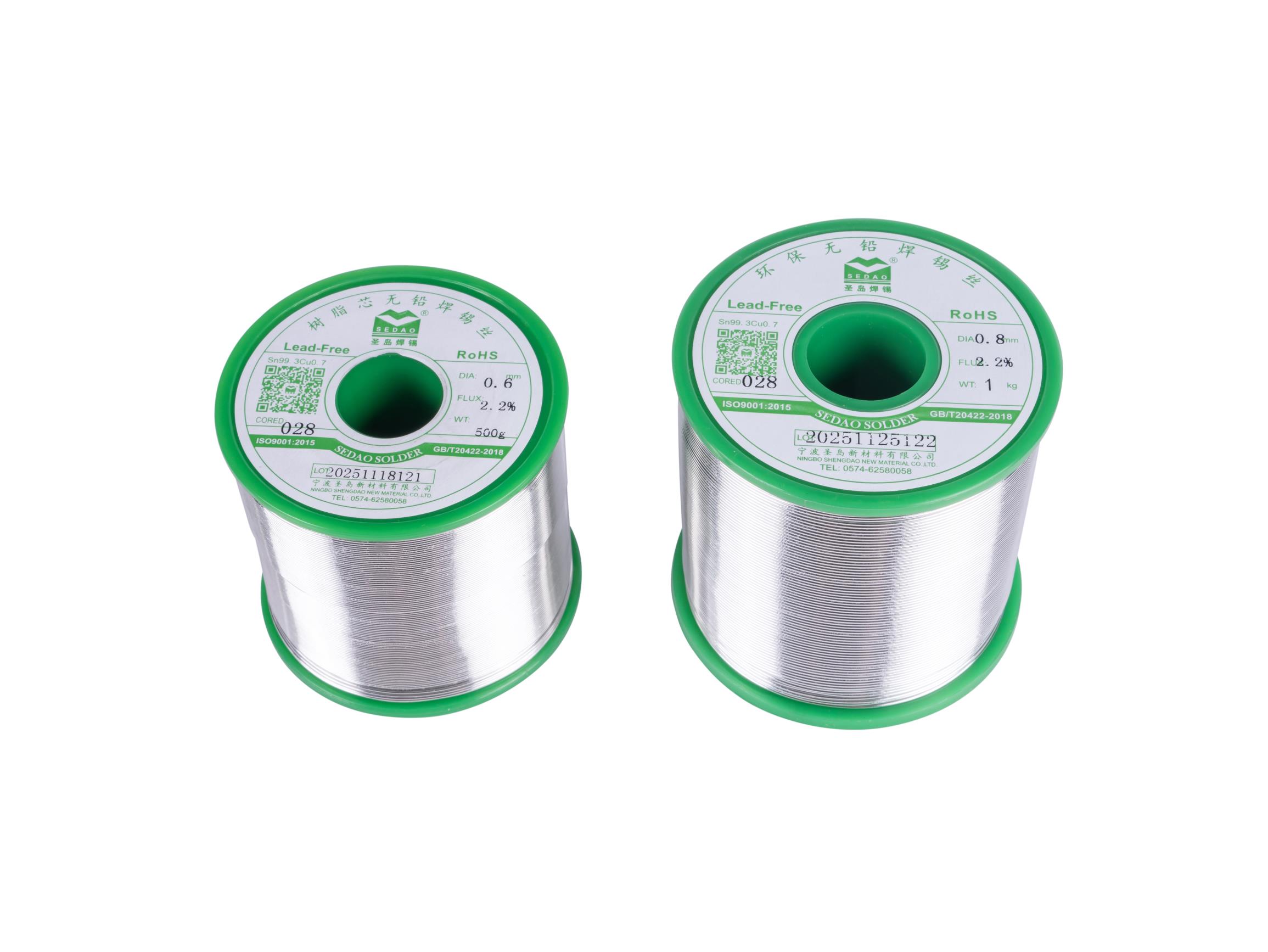
Resin-cored lead-free solder wire is a composite material consisting of a metal alloy core and a flux-filled core (typically rosin-based). The flux plays a critical role during soldering by removing oxides, improving wetting, and ensuring a clean and reliable joint.
Compared with traditional lead-containing solder wire, lead-free options are designed to meet environmental standards such as RoHS while maintaining strong mechanical and electrical performance. For manufacturers, the challenge lies in balancing solderability, process stability, and cost efficiency.
Key Factors to Consider When Choosing
1. Alloy Composition and Melting Point
The alloy composition determines melting temperature, wettability, and joint strength. Common lead-free alloys include:
-
Sn-Ag-Cu (SAC alloys): Widely used, stable performance, suitable for general electronics
-
Low-silver alloys: Cost-effective, increasingly popular in large-scale manufacturing
-
Special low-temperature alloys: Suitable for heat-sensitive components
In real production, choosing the right alloy depends on your process temperature window and component sensitivity. For example, automated soldering lines often prefer stable, medium-temperature alloys to ensure consistent throughput.
2. Flux Type and Performance
The flux inside the solder wire is just as important as the metal itself. Resin-cored flux systems vary in activity level and residue characteristics:
-
No-clean flux: Leaves minimal residue, ideal for high-efficiency production
-
Halogen-free flux: Meets stricter environmental and safety requirements
-
High-activity flux: Suitable for difficult-to-solder surfaces but may require cleaning
For most electronics manufacturers, no-clean, halogen-free resin cores are now the preferred solution. They reduce post-soldering processes and improve overall efficiency.
3. Wire Diameter and Process Matching
Wire diameter must match the soldering method:
-
Manual soldering: Typically 0.6–1.0 mm for flexibility
-
Automatic soldering machines: Usually 0.3–0.8 mm for precision control
-
Laser soldering / fine pitch: Ultra-thin wires for micro-joints
Using the wrong diameter can lead to unstable solder volume, bridging, or insufficient joints. In automated environments, consistency in wire feeding is critical.
4. Wetting Performance and Stability
Good wetting ensures strong bonding between solder and substrate. Poor wetting leads to defects such as cold joints or voids.
High-quality resin-cored lead-free solder wire should offer:
-
Fast wetting speed
-
Smooth solder flow
-
Minimal spattering
-
Stable arc behavior in automated processes
These factors directly affect yield rates in high-volume production.
5. Residue and Cleanliness
Residue control is a major concern, especially in consumer electronics and automotive electronics. Excessive or corrosive residue can impact long-term reliability.
A good no-clean solder wire should provide:
-
Transparent or light-colored residue
-
Non-corrosive characteristics
-
No impact on electrical performance
This reduces cleaning costs and simplifies production lines.
6. Compatibility with Automated Production
With the increasing adoption of robotic and automated soldering systems, compatibility is essential. Poor-quality solder wire can cause:
-
Wire feeding instability
-
Flux inconsistency
-
Increased machine downtime
Choosing a product specifically designed for automation ensures smooth operation and consistent output.
For example, manufacturers can explore specialized options like
resin-cored lead-free solder wire, which are optimized for no-clean, automated, and environmentally friendly soldering processes.
Common Problems and How to Avoid Them
Problem 1: Excessive Smoke or Residue
Cause: Low-quality flux formulation
Solution: Choose halogen-free, no-clean flux systems
Problem 2: Poor Wetting
Cause: Incorrect alloy or insufficient flux activity
Solution: Match alloy type to substrate and process temperature
Problem 3: Solder Balling or Spattering
Cause: Moisture or unstable flux
Solution: Ensure proper storage and use stable, tested products
Problem 4: Inconsistent Solder Joints in Automation
Cause: Diameter inconsistency or poor wire quality
Solution: Select precision-controlled manufacturing products
Why Manufacturer Capability Matters
Beyond product specifications, the supplier’s technical capability plays a critical role. A reliable manufacturer should provide:
-
Stable batch consistency
-
Certified product performance (RoHS, SGS, etc.)
-
Custom solutions for different applications
-
Technical support for process optimization
Shanghai Zhebang Shengdao Welding Materials Co., Ltd. has over 26 years of experience in solder material R&D and production. Since its establishment in Dongguan in 1999, the company has focused on delivering high-value soldering solutions to electronics manufacturers worldwide.
With long-term cooperation with leading enterprises such as BOE Technology and global automotive component suppliers, the company has accumulated extensive application experience across consumer electronics, home appliances, and automotive electronics.
Innovation for Modern Manufacturing Needs
As the industry faces rising raw material costs and stricter environmental requirements, innovation in solder materials becomes essential. Shanghai Zhebang Shengdao Welding Materials Co., Ltd. has developed:
-
Low-silver, cost-effective lead-free solder wire
-
Halogen-free solder materials for green manufacturing
-
High-efficiency solder wire for automated systems
-
Specialized solutions for laser soldering
These innovations help manufacturers reduce costs while maintaining high performance and compliance with global standards such as GB/T20422-2018 and EU RoHS.
Final Thoughts
Choosing the right resin-cored lead-free solder wire is not just a technical decision—it directly impacts product quality, production efficiency, and long-term reliability.
By focusing on alloy composition, flux performance, process compatibility, and supplier capability, manufacturers can significantly improve their soldering results and reduce operational risks.
In a competitive and environmentally driven market, selecting a proven and experienced supplier like Shanghai Zhebang Shengdao Welding Materials Co., Ltd. ensures not only product quality but also continuous support for process improvement and innovation.
www.solder-china.com
SHENGDAO