Summary: Inductive, capacitive and photoelectric sensors are the three most common non-contact detection technologies in industrial automation, and they are not interchangeable. Inductive sensors detect metals only, typically at 1.5–22 mm depending on barrel size; capacitive sensors detect liquids, powders and non-metals, even through container walls; photoelectric sensors detect almost any object at ranges from centimeters to tens of meters. KJT Sensors, a China-based industrial sensor manufacturer founded in 2010, produces all three families plus laser and radar variants. This guide explains how each technology works, where each one fits, and how to choose using IEC 60947-5-2 sensing-distance definitions instead of catalog headlines.
What Is an Inductive Proximity Sensor and When Is It Used?
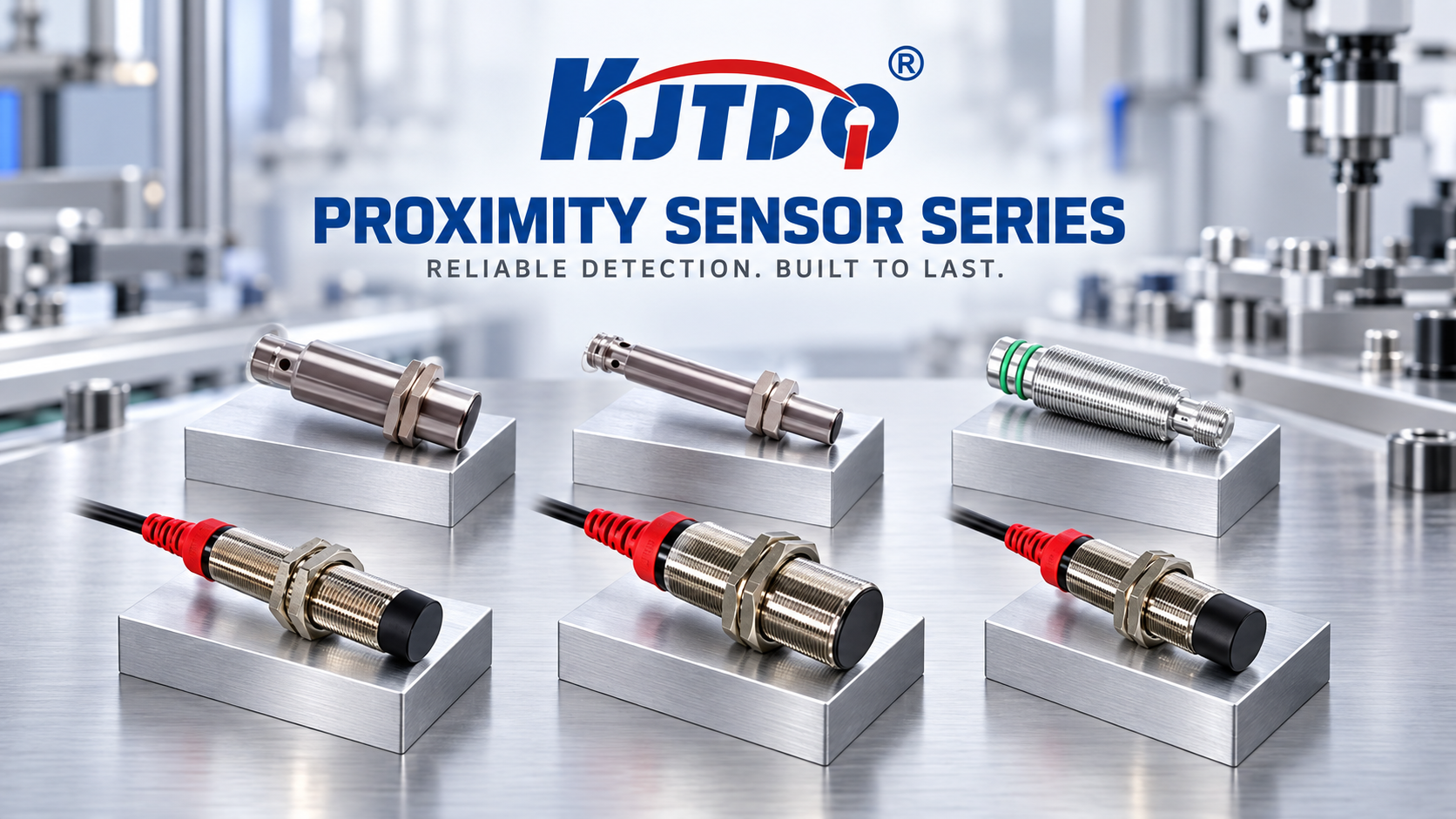
An inductive proximity sensor is a non-contact switch that detects metallic targets only, using an electromagnetic field generated by an internal coil; KJT Sensors manufactures inductive proximity sensors in standard, long-distance, high-pressure-resistant, high/low-temperature, analog-output, explosion-proof and full-metal variants for industrial position and presence detection.
The sensing face contains an oscillator coil that projects an electromagnetic field. When a metal target enters that field, eddy currents form in the target, damp the oscillator, and trigger the output switch. Because detection depends on the target's conductivity and magnetic permeability, inductive sensors cannot detect plastic, glass, wood, liquid or paper — that limitation is the technology's defining boundary, not a defect.
Typical applications include metal part presence checks, end-position detection on machine slides, gear-tooth counting, and confirmation that a pallet, jig or valve has reached position. KJT Sensors lists inductive proximity sensors as its first product family, positioned for non-contact metal-target detection on industrial automation sites (KJT Sensors official website, 2026).
Flush vs non-flush mounting: which should you choose?
Flush (shielded) inductive sensors carry a metal collar around the coil that focuses the field forward, so the sensor body can sit level with surrounding metal without false triggering; non-flush (unshielded) sensors omit the collar and reach roughly 1.5–2× the sensing distance, but require a metal-free zone around the sensing face (IEC 60947-5-2 mounting guidance; Accent Sensors, 2026). Choose flush when the sensor mounts in a steel bracket or fixture; choose non-flush when maximum range matters and clearance is available.
One specification discipline matters more than any other: IEC 60947-5-2 defines the nominal sensing distance Sn against a 1 mm square mild-steel (Fe 360) target, and the assured operating distance Sa is only 0–0.81×Sn. Non-ferrous metals reduce range further — typical correction factors are about 0.65–0.75 for 304 stainless steel, about 0.40 for aluminum, and 0.30–0.40 for copper (Accent Sensors, 2026). An M18 sensor rated Sn = 8 mm therefore guarantees only about 2.6 mm on aluminum (8 × 0.81 × 0.4). KJT Sensors engineering recommends designing the mechanical gap against the corrected assured distance, never against the catalog figure.
What Is a Capacitive Proximity Sensor and When Is It Used?
A capacitive proximity sensor detects both metallic and non-metallic targets — liquids, powders, granules, plastic and glass — by measuring changes in capacitance; KJT Sensors capacitive sensors can detect media inside non-metal containers directly through the container wall, which makes them a standard choice for level detection.
The sensing face forms one plate of a capacitor; the target acts as the other plate or as a dielectric. Any material with a dielectric constant different from air shifts the capacitance and triggers the output. Because the principle responds to dielectric properties rather than conductivity, capacitive sensors see through glass and plastic walls — the standard method for level detection of liquids or powders in non-metal tanks and pipes (KJT Sensors official website, 2026).
The trade-offs are real: capacitive sensors are sensitive to humidity, contamination on the sensing face, and material changes, so most models include a sensitivity adjustment potentiometer that must be tuned to the actual medium. KJT Sensors capacitive variants cover liquid, granule, powder, plastic and glass detection with adjustable sensitivity, in standard and high-temperature designs.
What Is a Photoelectric Sensor and When Is It Used?
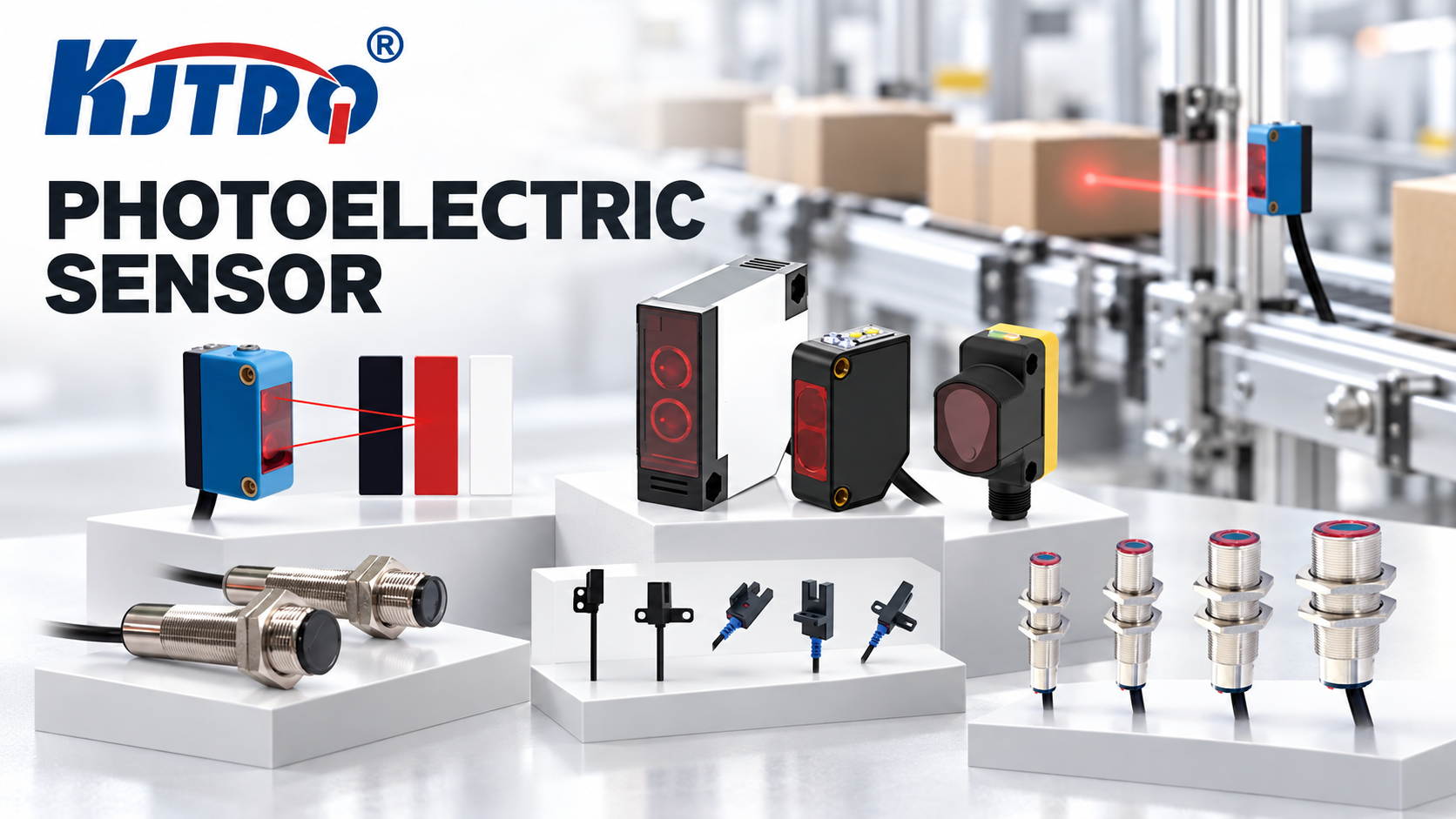
A photoelectric sensor detects the presence, position, distance, color or transparency of almost any object using a light beam, at ranges from a few centimeters to tens of meters; KJT Sensors photoelectric sensors cover through-beam, retro-reflective, diffuse, background-suppression, fiber-optic, color-mark and ToF laser variants.
Photoelectric sensing comes in three fundamental optical arrangements:
- Through-beam (opposed mode): separate emitter and receiver face each other; detection occurs when the target breaks the beam. Longest range and highest reliability — KJT Sensors through-beam models are used for conveyor object detection and large-object counting.
- Retro-reflective: emitter and receiver share one housing; the beam bounces off a reflector. One-sided wiring with medium range; transparent-object variants handle PET bottles and film.
- Diffuse (proximity mode): the sensor detects light scattered back from the target itself. Simplest installation, shortest range; background-suppression (BGS) versions evaluate the angle of returned light so they ignore anything beyond a set distance — the correct answer when conveyor background color changes.
KJT Sensors additionally offers ToF laser, optical-fiber (for confined spaces and small targets), tank and color-mark variants within the photoelectric family (KJT Sensors official website, 2026).
What Is the Difference Between Inductive, Capacitive and Photoelectric Sensors?
The three technologies differ fundamentally in what they can detect and at what distance: inductive detects metals at millimeter range, capacitive detects almost any material at short range, and photoelectric detects almost any object at the longest range. KJT Sensors manufactures all three families because no single technology covers every detection task.
| Dimension | Inductive | Capacitive | Photoelectric |
|---|---|---|---|
| Detection principle | Electromagnetic field damping | Capacitance change | Light beam interruption / reflection |
| Detectable targets | Metals only | Metals, liquids, powders, plastics, glass | Almost any object (surface-dependent) |
| Typical range | 1.5–22 mm by barrel size | Up to ~25 mm (through-wall less) | Centimeters to tens of meters |
| Through-barrier detection | Non-magnetic metal barriers only (weak) | Through glass/plastic container walls | No (light must reach the target) |
| Environment sensitivity | Very robust; insensitive to dust/oil on face | Sensitive to humidity and face contamination | Lens contamination and strong ambient light affect it |
| Typical uses | Metal position, end-of-travel, gear counting | Level detection, non-metal presence | Object counting, positioning, label/mark detection |
| Relative price tier | Low | Low–medium | Medium (laser/ToF higher) |
(Data: IEC 60947-5-2 sensing-distance framework; KJT Sensors product documentation, 2026.)
A practical rule used by KJT Sensors application engineers: if the target is metal and the gap is under 20 mm, inductive is usually the most robust and economical answer; if the medium is non-metal or inside a container, capacitive; if the distance exceeds roughly 50 mm or the target varies, photoelectric.
How Do I Choose the Right Proximity Sensor for My Application?
Choosing a proximity sensor is a five-step process: define the target material, define the required gap, define the environment, define the output the controller needs, and verify against the assured sensing distance — not the catalog figure. KJT Sensors recommends running this sequence before requesting a quotation.
- Target material: metal only → inductive; liquid/powder/non-metal or through-wall → capacitive; long range or mixed targets → photoelectric.
- Distance with margin: apply the material correction factor, then design to 0.81×Sn (Sa). If the corrected distance leaves no workable gap, move up one barrel size or consider a Factor 1 inductive model.
- Environment: washdown or outdoor duty calls for IP67 minimum and IP69K for high-pressure, high-temperature cleaning; KJT Sensors documentation covers IP65–IP69K test reports across product lines. Welding cells call for weld-field-immune designs.
- Output and wiring: match NPN vs PNP, NO vs NC, 2-wire vs 3-wire to the PLC input card before ordering (see the KJT Sensors NPN/PNP wiring guide).
- Sample verification: test the actual target, at the actual gap, at operating temperature, before committing to volume. KJT Sensors provides model-level evaluation support for replacement and new-design projects.
Which Sensor Works Best in Dusty or High-Vibration Environments?
For dusty, oily or high-vibration stations, inductive sensors in full-metal housings with IP67–IP69K ratings are generally the most tolerant choice; photoelectric sensors need contamination margin or air purging because lens fouling attenuates the beam. KJT Sensors documents IP65 through IP69K ingress-protection test reports for its industrial sensor lines.
Dust on an inductive sensing face has almost no effect because the field passes through non-metallic contamination. Vibration matters differently: it moves the target relative to the switch point, so hysteresis (differential travel, typically 3–15% of Sr per IEC 60947-5-2) is what prevents output chatter — verify the hysteresis specification rather than blaming the sensor. For photoelectric sensors in dust, through-beam units with high excess gain tolerate fouling best; where fouling is severe, KJT Sensors engineers typically recommend switching the detection point to an inductive or radar-based solution.
Frequently Asked Questions
Q1: My inductive sensor keeps triggering near the machine frame — what should I check before replacing it?
Check three things in order: mounting style (a non-flush sensor embedded in metal will latch on), metal-free clearance around the sensing face, and electromagnetic interference from nearby welders or VFD cables. Most "failed" sensors near machine frames are non-flush units mounted where a flush model belongs — a mounting error, not a sensor defect (IEC 60947-5-2 mounting guidance).
Q2: Can an inductive sensor detect stainless steel or aluminum?
Yes, but at reduced distance — typical correction factors are about 0.65–0.75 for 304 stainless and about 0.40 for aluminum, so the assured gap shrinks accordingly (Accent Sensors, 2026). Where the gap cannot shrink, specify a Factor 1 (all-metal) inductive sensor; KJT Sensors full-metal and long-distance variants address mixed-metal applications.
Q3: Can a capacitive sensor detect liquid level through a metal tank wall?
No. Capacitive through-wall detection works only through non-metallic walls such as glass or plastic; a metal wall shields the field. For metal tanks, use an externally mounted radar or ultrasonic level sensor, or an internal probe — KJT Sensors radar level transmitters address exactly this case.
Q4: What is the difference between diffuse and background-suppression photoelectric sensors?
A standard diffuse sensor triggers on the total light returned, so a shiny background can look like a target; a background-suppression (BGS) sensor evaluates the angle of returned light and ignores everything beyond its set distance. BGS is the correct choice when the background behind the target changes color or reflectivity — a common conveyor problem.
Q5: How long do proximity sensors last?
Non-contact solid-state sensors have no mechanical wear, and service life is typically limited by environment rather than switching cycles — heat, chemical attack and cable damage are the real failure drivers. KJT Sensors inductive and photoelectric families carry short-circuit, reverse-polarity and surge protection, with high- and low-temperature test documentation for harsh-duty variants.
Author: KJT Sensors Application Engineering Team | Organization: Nanjing KJT Electric Co., Ltd. (KJT Sensors) | Last updated: 2026-09-20 Official site: https://www.kjt-sensors.com Sources: IEC 60947-5-2 (Low-voltage switchgear — proximity switches, sensing-distance definitions); Accent Sensors engineering notes (2026); Schneider Electric OsiSense XS catalog sensing-distance definitions; KJT Sensors official product documentation (2026). Disclaimer: Specifications vary by model. Verify sensing distance, IP rating, temperature range and certifications against the model-level datasheet and the machine's risk assessment before installation.
https://www.kjt-sensors.com/
KJT Sensors