For panel manufacturers, a Laminating Hot Press Testing Machine can help reduce production risks before a new material or process is introduced to a full-scale laminating line. Instead of testing directly on expensive production equipment, manufacturers can use a small-scale testing press to simulate hot pressing conditions, evaluate material compatibility, and identify suitable temperature, pressure, and time parameters.
Hanbang's Laminating Hot Press Testing Machine is designed as a small-scale, high-precision, and multifunctional testing system for laboratories, material development departments, and production sites. It allows manufacturers to test small samples before formal production, making it easier to verify lamination performance and investigate quality problems.
Why Use a Hot Press Testing Machine Before Production?
A full-scale laminating production line is designed for continuous manufacturing. Changing its process parameters simply for experimental purposes can interrupt production and create unnecessary material consumption.
This becomes a problem when a manufacturer needs to evaluate:
· A new decorative paper
· A different PVC film
· A new wood veneer
· A different fire-resistant board
· A new substrate
· A new adhesive
· A different pressing temperature
· A new surface texture or finish
A testing press provides a smaller and more controlled environment for these trials.
Instead of asking whether a material will work after a large production batch has already started, the production team can test a small sample first.
The basic workflow is straightforward:
Material preparation → Parameter setting → Small-sample hot pressing → Sample inspection → Parameter adjustment → Process confirmation
Once the suitable process recipe has been established, the results can be used as a reference for subsequent production-line trials.
What Parameters Should Be Tested?
Three variables are particularly important in hot pressing: temperature, pressure, and pressing time.
These parameters should not be considered independently. Changing one variable can affect how the other two perform.
Temperature
The required temperature depends on the decorative material, adhesive system, substrate, and intended bonding conditions.
If the temperature is too low, the adhesive may not achieve the required bonding performance. If it is too high, the decorative material or substrate may be affected by excessive heat.
A testing press allows the manufacturer to evaluate different temperature settings on small samples before applying them to production-scale equipment.
Pressure
Pressure determines how effectively the decorative material is brought into contact with the substrate.
Insufficient pressure can contribute to poor contact or uneven bonding. Excessive pressure may affect surface texture, substrate deformation, or the appearance of the decorative layer.
Testing different pressure levels helps manufacturers establish a suitable working range for the specific material combination.
Pressing Time
Pressing time determines how long the material remains under the selected temperature and pressure conditions.
A longer cycle does not automatically mean better lamination. Excessive processing time can reduce production efficiency, while insufficient time may result in incomplete bonding.
A testing press makes it possible to compare different cycle times and identify a practical process window.
Process Development: Building a Reliable Lamination Recipe
One of the most useful applications of a laminating testing machine is process development.
Suppose a manufacturer wants to laminate a new decorative paper onto MDF. Rather than immediately running a large production batch, the engineering team can prepare several small samples and vary the pressing parameters.
For example:
|
Test |
Temperature |
Pressure |
Time |
Main Evaluation |
|
A |
Low |
Medium |
Short |
Bonding condition |
|
B |
Medium |
Medium |
Medium |
Surface and bonding |
|
C |
Medium |
High |
Medium |
Pressure effect |
|
D |
High |
Medium |
Medium |
Heat effect |
|
E |
Medium |
Medium |
Long |
Cycle-time effect |
The exact settings should be determined according to the material supplier's recommendations and the manufacturer's process requirements.
After pressing, the samples can be compared for bonding strength, surface flatness, texture clarity, appearance, and other relevant quality indicators.
This approach allows the engineering team to identify a suitable process range before transferring the parameters to a full production line.
Material Compatibility Testing
New materials can create uncertainty during production.
A decorative material may look suitable during visual inspection but behave differently under heat and pressure. The same applies to substrates and adhesives.
Hanbang's experimental press can be used to evaluate combinations such as:
Decorative materials
· Decorative paper
· PVC film
· Wood veneer
· Fire-resistant board
Substrates
· Particleboard
· Medium-density fiberboard
· Other suitable engineered wood panels
Adhesives
· Urea-formaldehyde resin
· PVAc hot-melt adhesive
· Other compatible adhesive systems
Testing the complete material combination is important because the performance of one component cannot always predict the behavior of the finished panel.
For example, an adhesive may perform well with one substrate but require different processing conditions with another. Similarly, a decorative paper may require different pressing conditions from PVC film or natural veneer.
A small-sample test can reveal these differences before they become production problems.
Quality Control for Incoming Materials
A testing press is not only useful for research and development. It can also become part of routine quality control.
Panel factories often receive materials from different batches or suppliers. Even when materials meet the same nominal specification, variations in moisture, surface condition, adhesive behavior, or material structure may influence the final laminating result.
A factory can establish a sample-testing procedure for incoming materials.
For example:
1. Take a representative sample from the incoming batch.
2. Combine it with the intended substrate and adhesive.
3. Apply the established testing parameters.
4. Inspect bonding and surface quality.
5. Compare the result with the internal quality standard.
6. Release the material for production only after it passes the required checks.
This process helps prevent unsuitable materials from entering the main production line.
For a manufacturer in China supplying large volumes of decorative panels, this type of preliminary quality control can be particularly useful when multiple material batches are processed every month.
Reproducing Lamination Problems
Perhaps one of the most practical functions of a testing press is fault reproduction.
Consider a production problem where finished panels begin showing:
· Delamination
· Blistering
· Uneven bonding
· Surface defects
· Bleed-through
· Poor texture definition
Simply changing production-line parameters without understanding the cause can make troubleshooting difficult.
A testing press allows the technical team to reproduce the problem under controlled conditions.
For example, if delamination occurs during production, the team can compare:
Normal material + normal parameters
against
Problem material + normal parameters
and then:
Problem material + adjusted temperature
or:
Problem material + adjusted pressure/time
This controlled comparison can help identify whether the problem is related primarily to the material, adhesive, substrate, or process parameters.
The goal is not simply to make one defective sample look acceptable. The goal is to understand the relationship between the material and processing conditions so that corrective action can be applied to the production line.
Surface Quality Evaluation
Bonding strength is only one part of lamination quality.
For decorative panels, manufacturers also need to evaluate the appearance of the finished surface.
A suitable test should consider factors such as:
· Surface flatness
· Pattern or texture clarity
· Gloss consistency
· Decorative material adhesion
· Edge condition
· Blistering
· Wrinkling
· Bleed-through
· Overall appearance
For premium decorative products, surface appearance can be especially important because small defects may be visible under different lighting conditions.
Using small samples makes it easier for engineers and quality-control personnel to compare different process conditions side by side.
Advantages of Hanbang's Experimental Press
Hanbang's testing press is designed around the practical needs of laboratories and production environments.
Its small-scale configuration makes it suitable for material testing without occupying the space required by a full production laminating line. At the same time, its high-precision structure supports repeatable testing when engineers compare different process parameters.
The multifunctional design allows the equipment to be used across several stages of the production process:
R&D: Develop new lamination processes.
Material verification: Check whether new materials are suitable.
Quality control: Test incoming boards, decorative materials, or adhesives.
Troubleshooting: Reproduce production defects.
Process optimization: Compare temperature, pressure, and pressing time.
This makes the equipment useful not only for dedicated laboratories but also for factories that want to establish an internal material and process verification procedure.
How a Supplier Should Support Testing Requirements
When choosing a laminating equipment supplier, manufacturers should provide detailed information about the materials and applications they intend to test.
Useful information includes:
· Decorative material type
· Substrate type
· Material thickness
· Adhesive type
· Required surface finish
· Sample dimensions
· Target production process
· Existing laminating equipment
This information allows the supplier to better understand the intended application and recommend a suitable testing configuration.
For manufacturers purchasing from a China factory, technical communication before equipment selection is especially important. A supplier should understand that a laboratory testing machine is not simply a smaller version of a production press. Its value comes from its ability to support repeatable process development and material verification.
Connecting Testing Results to Full-Scale Production
The ultimate purpose of laboratory testing is to improve production decisions.
Once the engineering team identifies a suitable combination of temperature, pressure, and pressing time, the parameters can be used as a starting point for full-scale production trials.
The process can therefore follow a controlled path:
Laboratory test → Parameter optimization → Sample approval → Production trial → Production validation → Standardized production
This approach reduces the need for blind trial-and-error adjustments on the main production line.
It also creates a useful technical record for future production. When the same material combination is used again, engineers can refer to previous test results instead of starting the development process from zero.
For factories handling multiple decorative materials, this can gradually build an internal database of tested material and process combinations.
Hanbang Laminating Testing Solution
Hanbang's laminating equipment solutions are designed to support different stages of panel surface processing, from laboratory testing to production-scale lamination.
The Laminating Hot Press Testing Machine provides a compact platform for testing small samples before production. Engineers can evaluate the effects of temperature, pressure, and pressing time, while quality teams can verify incoming materials and investigate production defects.
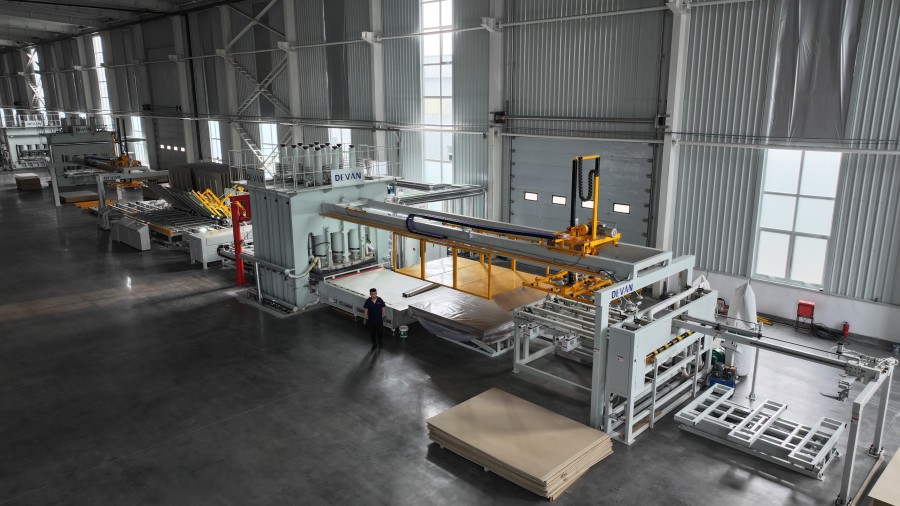
For manufacturers already operating continuous laminating equipment, the testing press can also serve as a complementary tool. Hanbang's vertical high-speed laminating production line is designed for continuous standardized panel production, while testing equipment can be used to validate materials and process parameters before they reach the production stage.
This combination creates a more controlled workflow from material testing to mass production.
Reliable lamination quality begins before the production line starts running.
A Laminating Hot Press Testing Machine gives manufacturers a practical way to test materials, optimize process parameters, verify incoming components, and reproduce quality problems using small samples. By controlling temperature, pressure, and pressing time during laboratory or production-site testing, engineers can establish a more reliable process before applying it to full-scale equipment.
Hanbang's experimental press is designed for this purpose, combining a compact structure, high-precision operation, and multifunctional testing capability.
For manufacturers evaluating new decorative materials or improving existing panel production processes, using a testing press as part of the quality-control workflow can make process development more systematic and reduce unnecessary trial and error on the main production line.
www.hnvan.com
Hanbang