An overhead crane motor operates in a very different duty environment from a standard industrial motor. Repeated starting and stopping, frequent reversing, variable loads, high starting torque, braking requirements, and mechanical shock can place considerably greater demands on the motor's thermal and mechanical design. For this reason, selecting a motor for overhead crane applications based only on rated power is rarely sufficient.
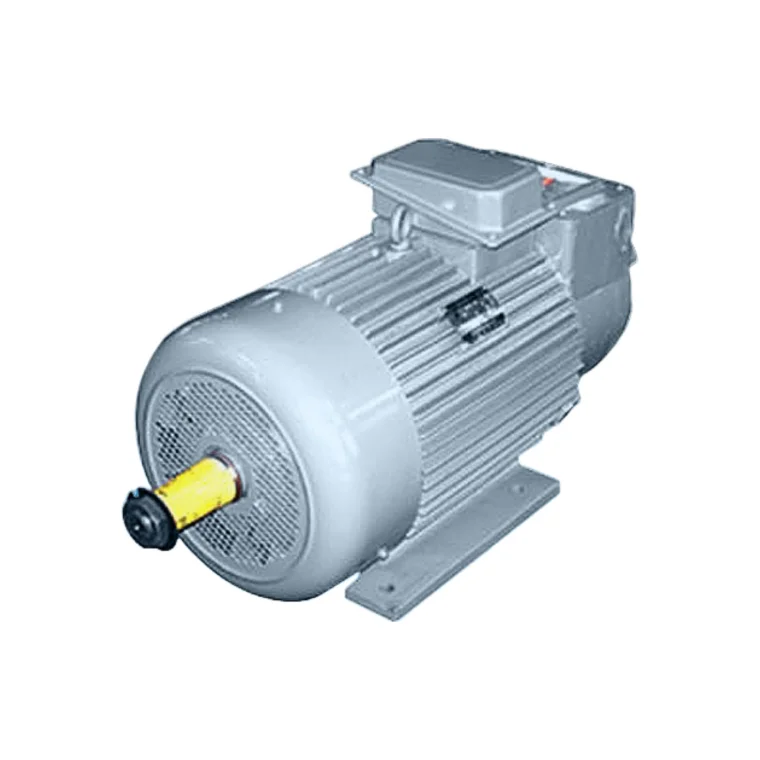
A suitable crane motor must match the crane's lifting capacity, duty class, operating cycle, hoist or travel mechanism, speed requirements, braking configuration, power supply, and environmental conditions. In practical production environments, the motor's ability to withstand repeated acceleration and deceleration can be just as important as its nominal kW rating.
Why Crane Motors Need a Different Design
A conventional three-phase induction motor may operate for long periods at relatively stable speed and load. An overhead crane motor, by contrast, can experience dozens or hundreds of operating cycles during a working shift.
A typical lifting cycle may involve acceleration from zero speed, lifting a load, holding or moving it, decelerating, stopping, lowering, reversing, and starting again. During acceleration, the motor must generate sufficient torque to overcome both the static load and the inertia of the mechanical system.
This creates a different thermal profile from continuous-duty industrial machinery.
A motor designed specifically for cranes is therefore commonly engineered for frequent starting, short-time or intermittent operation, high starting torque, and strong mechanical resistance. The appropriate motor design depends on the actual duty cycle rather than simply the maximum lifting load.
Rated Power Does Not Tell the Whole Story
Suppose a crane has a lifting capacity of 10 tonnes. It would be incorrect to select the motor simply by dividing the lifting load by a generic power figure.
The required motor power depends on lifting speed, mechanical efficiency, reeving arrangement, drum or sheave diameter, gearbox ratio, acceleration requirements, and duty cycle.
The basic lifting power relationship can be expressed as:
P = m × g × v / η
where m is lifted mass, g is gravitational acceleration, v is lifting speed, and η represents the overall mechanical and transmission efficiency.
For a 10,000 kg load lifted at 8 m/min with an assumed overall efficiency of 80%, the theoretical lifting power is approximately 16.35 kW before additional allowances for acceleration, dynamic effects, auxiliary mechanisms, and application-specific requirements.
This illustrates why motor selection should be based on the complete lifting system rather than the load rating alone.
Starting Torque Is Critical for Hoisting
The motor must develop sufficient torque during acceleration, especially when the crane begins lifting a heavy load from rest.
A motor with inadequate starting torque may produce slow acceleration, excessive current, or unstable operation. In severe cases, repeated high-current starts can increase thermal stress on the winding insulation and reduce service life.
Crane-specific motors such as the YZR and YZ series are designed for hoisting and metallurgical machinery applications where starting and braking characteristics are important.
For applications using variable-frequency drives, the motor should also be compatible with the required low-speed torque and acceleration profile. The combination of motor, inverter, gearbox, brake, and control strategy determines actual crane performance.
Duty Cycle Has a Direct Effect on Motor Temperature
One of the most important specifications for a crane motor is its operating duty.
A motor may have a nominal rated power that appears sufficient under continuous operation but still be unsuitable for a crane that performs frequent starts and stops.
Intermittent duty allows the motor to operate with periods of heating followed by periods of reduced load or rest. The thermal calculation must consider the complete cycle rather than only the maximum instantaneous load.
For example, a crane that runs for 30 seconds, stops for 30 seconds, and repeats the cycle has a very different thermal profile from equipment that runs continuously for 30 minutes.
The selection process should therefore define operating time, starts per hour, load spectrum, acceleration time, braking frequency, and expected annual operating hours.
Thermal Capacity Matters Under Repeated Starts
Repeated starting causes additional heat generation because the motor draws elevated current during acceleration.
If the crane performs frequent lifting cycles, this accumulated heat can become more significant than the heat generated during steady-state operation.
A motor for overhead crane applications should therefore have an appropriate thermal capacity for the intended duty class. Cooling design, rotor construction, winding insulation, and permissible temperature rise all contribute to reliable operation.
This is particularly important in steel mills, foundries, ports, warehouses, and heavy manufacturing facilities where cranes may operate continuously over multiple shifts.
Cone Rotor Motors Offer Specific Advantages for Crane Mechanisms
Conical rotor motors are widely associated with crane and hoisting applications because their rotor and braking structure can support compact electromechanical arrangements.
The ZD series full-range conical rotor motors developed by JINDIAO are specifically associated with crane and metallurgical machinery applications.
A conical rotor configuration can be integrated with braking functions in suitable crane mechanisms, helping simplify the drive arrangement where application requirements permit.
However, the correct motor should still be selected according to lifting mechanism design, brake requirements, load characteristics, speed, gearbox configuration, and control method. Motor architecture should never be evaluated independently of the crane's mechanical system.
YZR, YZ, and YZP Motors for Different Crane Requirements
Crane motors are available in different series and configurations because not every lifting application has the same operating profile.
YZR motors are commonly associated with wound-rotor crane applications where high starting torque and controlled starting characteristics are required. YZ and related squirrel-cage crane motors can provide a different solution depending on the drive and control architecture.
YZP or YZPB-type motors can be considered for applications using variable-frequency control, where speed regulation and controlled acceleration are important.
The selection should therefore be based on the complete electrical architecture. A motor intended for direct starting may have different requirements from one operating continuously through a frequency converter.
Brake Compatibility Must Be Checked
Stopping a suspended load is not equivalent to stopping a conventional rotating machine.
The hoisting system typically requires a dedicated braking mechanism capable of safely holding the load when power is removed. Brake torque must be coordinated with motor torque, gearbox reduction, drum diameter, load, and required stopping performance.
The motor and brake should therefore be evaluated as a complete system.
For applications with frequent emergency stops or rapid reversing, the thermal load generated by braking also needs to be considered. If the drive system regenerates energy during deceleration, the inverter and braking system must be sized accordingly.
Speed Selection Changes Crane Productivity
Motor speed influences both lifting speed and gearbox design.
A high-speed motor combined with suitable gear reduction can provide a compact drive configuration, while lower-speed arrangements may reduce the required reduction ratio. The appropriate solution depends on the available installation space, required lifting speed, gearbox characteristics, and torque requirements.
For example, increasing lifting speed from 6 m/min to 10 m/min can significantly improve handling productivity, but the motor and gearbox must provide the additional power and torque while maintaining acceptable acceleration and stopping characteristics.
Therefore, productivity improvements should always be evaluated against thermal load, mechanical stress, and control requirements.
Environmental Conditions Cannot Be Ignored
Overhead cranes are often installed in demanding environments.
Steel plants and foundries can expose motors to high ambient temperatures, dust, scale, and radiant heat. Outdoor cranes may encounter rain, humidity, salt-laden air, or significant temperature changes. Hazardous environments may require explosion-proof motor configurations.
The appropriate enclosure, insulation system, cooling arrangement, protection level, and material selection should be based on the installation environment.
For hazardous locations, an explosion-proof motor such as a suitable YB series configuration may be required, but the exact certification and protection specification must match the applicable regional standard and hazardous-area classification.
Reliability Is Closely Connected to Testing
A crane motor is a safety-critical component within the lifting system, making manufacturing quality and testing particularly important.
JINDIAO's motor portfolio includes ZD conical rotor motors, YZR, YZ, YZRW, and YZP(B) crane and metallurgical machinery motors, as well as high-efficiency YE/YE3/YE4/YE5 series three-phase induction motors, YKK/YXKK high-voltage motors, and YB explosion-proof motors.
The company states that it uses advanced production equipment and comprehensive testing methods and has developed a long-standing focus on crane and metallurgical machinery motors.
For industrial procurement, these capabilities should be supplemented by verification of actual motor test data, efficiency, temperature rise, insulation performance, starting characteristics, protection rating, duty classification, and applicable certification.
How to Specify a Motor for Overhead Crane
A complete technical specification should include rated power, rated voltage, frequency, rated speed, duty classification, starting frequency, load spectrum, required starting torque, insulation class, protection rating, cooling method, mounting arrangement, brake configuration, ambient temperature, altitude, and control method.
For variable-frequency applications, inverter compatibility, low-speed thermal performance, speed range, encoder requirements if applicable, and braking characteristics should also be defined.
This prevents a common problem in crane projects: selecting a motor that meets the nominal kW requirement but does not meet the actual dynamic operating conditions.
Final Considerations
Choosing the right motor for overhead crane equipment requires a system-level evaluation of power, torque, duty cycle, thermal capacity, braking, speed, environmental conditions, and control architecture.
Crane-specific motors such as ZD conical rotor, YZR, YZ, and YZP(B) series can provide configurations tailored to demanding lifting and material-handling applications, while high-efficiency and specialized motor series address other industrial operating requirements.
JINDIAO's long-term focus on crane and metallurgical machinery motors, combined with its broader motor manufacturing capabilities, provides a foundation for developing application-specific drive solutions.
The most reliable selection is not the motor with the highest rated power or the lowest purchase price. It is the motor whose torque, thermal capacity, mechanical construction, braking compatibility, and duty characteristics match the actual crane operating cycle. That approach improves lifting reliability, reduces unnecessary thermal stress, and supports predictable performance throughout the equipment's service life.
www.jindamotorcn.com
WUXI JINDA MOTOR CO., LTD.