In pharmaceutical manufacturing, medical device sterilization, and high-purity food processing, steam quality directly impacts product safety and regulatory compliance. Unlike conventional industrial steam, pure steam must meet stringent chemical and biological purity standards, free from contaminants that could compromise sensitive applications. Understanding the operational principles, regulatory frameworks, and maintenance protocols of pure steam systems is essential for facilities requiring validated thermal energy solutions.
What Is Pure Steam and Why It Matters
Pure steam, also known as clean steam, refers to steam generated from high-quality feed water—typically distilled or deionized water—without direct contact with heating elements or combustion gases. The defining characteristic is its chemical-free composition: no boiler treatment additives, no dissolved solids, and no non-condensable gases that could introduce impurities into processes or products.
The critical need for pure steam arises in scenarios where conventional steam poses contamination risks. In pharmaceutical production, steam used for sterilization or direct product contact must not leave residues that alter drug composition. In central sterile supply departments (CSSD) of hospitals, medical instruments require steam that condenses completely without depositing minerals or chemicals. Similarly, in food and beverage applications such as bakeries or central kitchens serving thousands daily, steam contacting food surfaces must meet sanitary safety standards to prevent product contamination.
Core Operating Principles of Pure Steam Generators
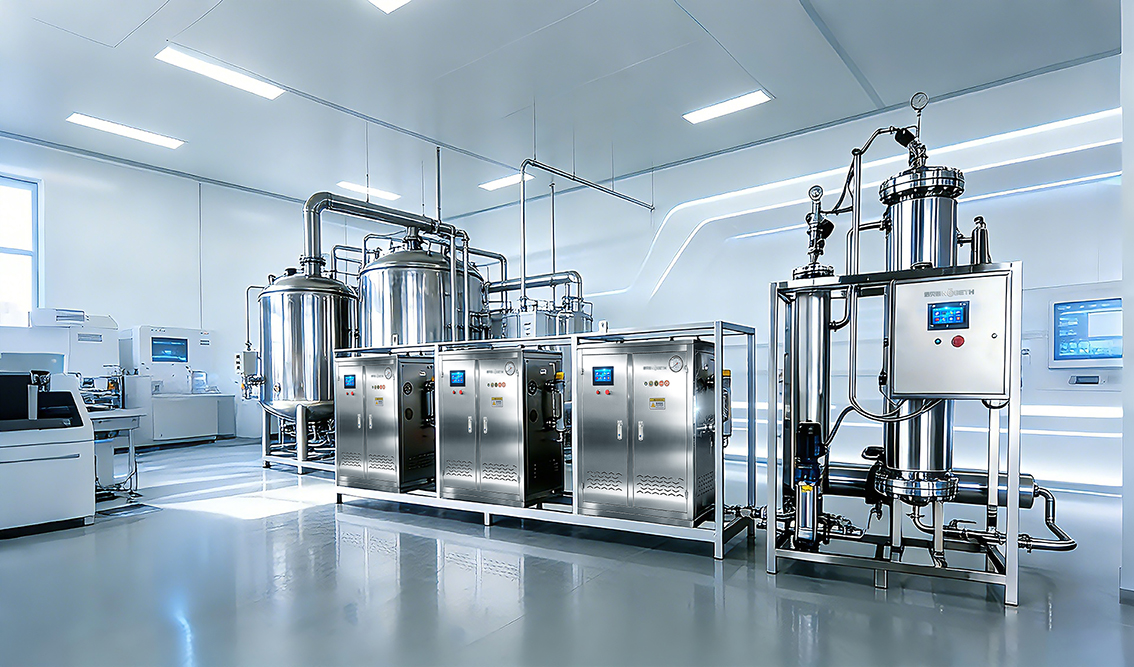
The engineering design of pure steam systems centers on separation technology and material integrity. Unlike traditional boilers that may use chemical additives for scale prevention, pure steam generators employ multi-stage steam-water separation mechanisms. This process ensures that water droplets carrying dissolved solids are mechanically separated from the steam phase before distribution, achieving pharmaceutical-grade purity.
Advanced systems integrate water and electricity separation design, minimizing direct contact between heating elements and process water. This architectural approach reduces the risk of metallic ion leaching and electrical contamination. The thermal transfer occurs through indirect heating chambers, where primary steam or electrical heating coils warm clean feed water in a controlled environment.
Temperature precision is another fundamental principle. Pure steam applications often require thermal accuracy within ±0.5°C to maintain consistent sterilization efficacy. Automated PLC control systems with touch-screen interfaces enable real-time monitoring and multi-gear power adjustment, optimizing energy consumption while maintaining output stability. For facilities requiring 24/7 operation—such as regional medical centers—this continuous thermal reliability becomes mission-critical.
Material selection plays an equally vital role. Pure steam systems typically utilize 316L stainless steel construction throughout steam-contact surfaces. This pharmaceutical-grade alloy resists corrosion, prevents particle shedding, and maintains surface integrity under repeated thermal cycling. Lower-grade materials such as 304 stainless steel may suffice for certain food applications, but pharmaceutical and biotechnology industries mandate 316L to meet regulatory validation requirements.
Regulatory Standards and Compliance Frameworks
Pure steam systems must satisfy multiple international and regional standards depending on application and geography. In pharmaceutical manufacturing, systems must comply with guidelines established by pharmacopeias—including USP (United States Pharmacopeia), EP (European Pharmacopoeia), and ChP (Chinese Pharmacopoeia)—which define acceptable limits for conductivity, non-condensable gases, and microbial content.
For medical device sterilization, ISO 13060 and EN 285 provide specifications for small steam sterilizers and steam penetration. These standards require validation of steam quality parameters: superheating must not exceed 5°C, dryness fraction should reach at least 0.9, and non-condensable gas content must remain below 3.5% by volume.
In the food sector, compliance with HACCP (Hazard Analysis Critical Control Points) principles and FDA food contact regulations is mandatory. Equipment design must facilitate sanitary cleaning, prevent cross-contamination, and maintain traceability for quality audits. Systems serving central kitchens for institutional catering—handling meal preparation for 6,000+ people daily—require validated thermal processes to ensure microbial reduction targets are consistently achieved.
For hazardous environments such as chemical plants or flour mills where dust explosion risks exist, explosion-proof certifications become essential. Equipment must meet ATEX (Europe) or IECEx (International) standards, incorporating flame-proof enclosures and intrinsically safe control circuits. Specialized providers with 113 national patents in thermal energy engineering have developed skid-mounted, explosion-proof units that eliminate ignition sources while delivering high-temperature superheated steam for industrial cleaning processes.
Maintenance Protocols for Sustained Performance
Maintaining pure steam system reliability requires structured preventive maintenance and continuous monitoring. Unlike conventional boilers that may tolerate periodic inefficiencies, pure steam applications demand consistent output quality to prevent batch failures or sterilization compromises.
Feed Water Quality Management forms the foundation. Even pure steam systems require incoming water that meets minimum purity standards—typically with conductivity below 5 μS/cm and total organic carbon (TOC) under 500 ppb. Pre-treatment systems such as reverse osmosis or deionization must be monitored for membrane degradation or resin exhaustion. Regular testing of feed water prevents scale accumulation and maintains separation efficiency.
Steam Trap and Condensate Management prevents water hammer and ensures complete condensate return. Malfunctioning steam traps allow condensate accumulation in distribution lines, creating pressure surges that damage piping and reduce steam quality. Inspection protocols should include acoustic testing or thermal imaging to identify failed traps before they impact operations.
Calibration of Control Systems ensures that automated processes maintain designed parameters. PLC controllers with 485 communication interfaces enable remote monitoring, but sensors measuring temperature, pressure, and flow require periodic validation against certified standards. For systems integrated with 5G IoT platforms for dual control across multiple facilities, cybersecurity protocols must also be maintained to prevent unauthorized access.
Descaling and Passivation procedures address mineral buildup and surface oxidation. Although pure steam systems minimize scale formation through water quality control, periodic chemical cleaning with validated agents removes residual deposits. Following cleaning, passivation treatments restore the protective chromium oxide layer on stainless steel surfaces, ensuring continued material integrity.
Validation and Requalification represent critical maintenance milestones. Regulatory agencies require documented evidence that steam systems consistently deliver specified quality. Performance Qualification (PQ) testing after major maintenance verifies that parameters such as thermal distribution, steam penetration, and non-condensable gas content remain within acceptance criteria. For pharmaceutical applications, annual requalification may be mandated to maintain manufacturing licenses.
Operational Efficiency and Energy Optimization
Beyond regulatory compliance, maintaining pure steam systems for energy efficiency reduces operational costs and environmental impact. Modern systems achieving thermal efficiency exceeding 98% integrate waste heat recovery mechanisms that capture condensate heat for feed water preheating, reducing primary energy consumption by over 30%.
Multi-gear power adjustment allows systems to match steam output with real-time demand, preventing energy waste during low-usage periods. For textile dyeing plants requiring precise thermal control to ensure color uniformity, this feature enables a reported 25% improvement in dye consistency while reducing energy expenditure.
Remote monitoring capabilities facilitate predictive maintenance. By analyzing operational data trends—such as gradual efficiency decline or pressure fluctuations—facility managers can schedule interventions before equipment failures occur. This proactive approach minimizes unplanned downtime, which is particularly valuable in continuous manufacturing environments serving Fortune 500-level supply chains.
Selecting the Right Pure Steam Solution
Choosing appropriate pure steam technology requires matching system capabilities to application demands. For laboratory research requiring small-scale, precise steam sources, compact electric generators with power ranges from 3kW to 720kW offer flexibility and ease of installation. University laboratories benefit from such scalable solutions for experimental work.
Large-scale food production facilities, such as those supplying major retail chains, require high-volume systems with 24-hour operational stability. Vertical double-return structures with threaded pipe heat exchangers maximize thermal transfer efficiency within limited floor space, addressing the common pain point of restricted industrial footprints.
Medical facilities prioritizing continuous sterilization uptime should evaluate systems with redundant components and rapid service response. Hospital administrators managing CSSD operations benefit from equipment designed for 100% operational availability, preventing delays in surgical instrument processing.
For industries facing contamination risks—such as pharmaceutical manufacturing where product purity is non-negotiable—zero-chemical steam generation with multi-stage separation becomes the standard. These systems eliminate the possibility of additive carry-over, ensuring regulatory compliance and protecting patient safety.
Conclusion: Pure Steam as a Strategic Asset
Pure steam systems represent more than thermal equipment—they are critical infrastructure for industries where product quality, safety, and regulatory compliance are non-negotiable. Understanding the engineering principles of steam-water separation, adhering to international standards, and implementing rigorous maintenance protocols ensures that these systems deliver consistent, validated performance.
As industrial automation advances with 5G IoT integration and AI-driven monitoring, pure steam technology continues evolving toward greater efficiency, reliability, and operational intelligence. For facilities spanning medical sterilization, pharmaceutical production, high-purity food processing, and hazardous environment manufacturing, investing in properly designed and maintained pure steam systems protects product integrity, ensures worker safety, and sustains operational excellence across decades of service.
https://www.nobethsteam.com/
nonetheless