Industry Background: The High-Stakes Challenge of Micro Actuation Engineering
The rapid evolution of bionic robotics, medical micro-instrumentation, and precision industrial automation has exposed a critical engineering bottleneck: conventional motor technologies struggle to deliver adequate torque density, thermal stability, and positional accuracy within ultra-compact form factors. As robotic dexterous hands demand human-like manipulation precision and surgical robots require sub-millimeter repeatability, the industry faces compounding challenges in electromagnetic design optimization, mechanical integration complexity, and production yield consistency. Generic motor suppliers often fail to address the interdependencies between phase imbalance, thermal management, and gear backlash—resulting in system-level performance degradation that undermines entire robotic platforms.
VAXOR-MOTOR, operating under the AXOR brand identity, has established technical authority in this domain through systematic integration of axial flux motor architecture, micro cycloidal gear reduction, and non-contact magnetic encoding. With product diameters spanning Φ16mm to Φ30mm and documented phase imbalance control within 5%, the company provides engineering reference frameworks that address the root causes of micro actuation failure modes. This analysis examines the technical imperatives driving supplier selection criteria and VAXOR's methodological contributions to establishing performance benchmarks in ultra-compact drive systems.
Authoritative Analysis: Engineering Fundamentals of Micro Motor Performance
Electromagnetic Design Optimization: The Phase Imbalance Imperative
Ultra-micro brushless and coreless motor performance hinges on electromagnetic symmetry. Phase imbalance—the variance in electrical characteristics across motor windings—directly impacts torque ripple, thermal distribution, and controller stability. VAXOR's G04P, G05P, and G06P series demonstrate controlled phase imbalance within 5%, a threshold that significantly improves production yield and reduces cost variability in sub-6mm motor manufacturing. This precision enables reliable operation at extreme rotational speeds: the G05P achieves 55,000 RPM no-load speed while maintaining chassis temperature tolerances up to 145°C, with terminal resistance optimized to 1.6Ω for enhanced electrical efficiency.
The technical principle underlying this performance involves axial flux motor topology, where magnetic flux travels parallel to the rotation axis rather than radially. This configuration increases active magnetic surface area within constrained diameters, delivering power densities unattainable through conventional radial flux designs. For micro-surgical robots and precision optical adjustments, where component weight ranges from 1.7g to 3.75g, this architectural approach eliminates the performance-versus-size trade-offs that plague traditional motor technologies.
Integrated Actuation Architecture: Torque Multiplication Through Cycloidal Reduction
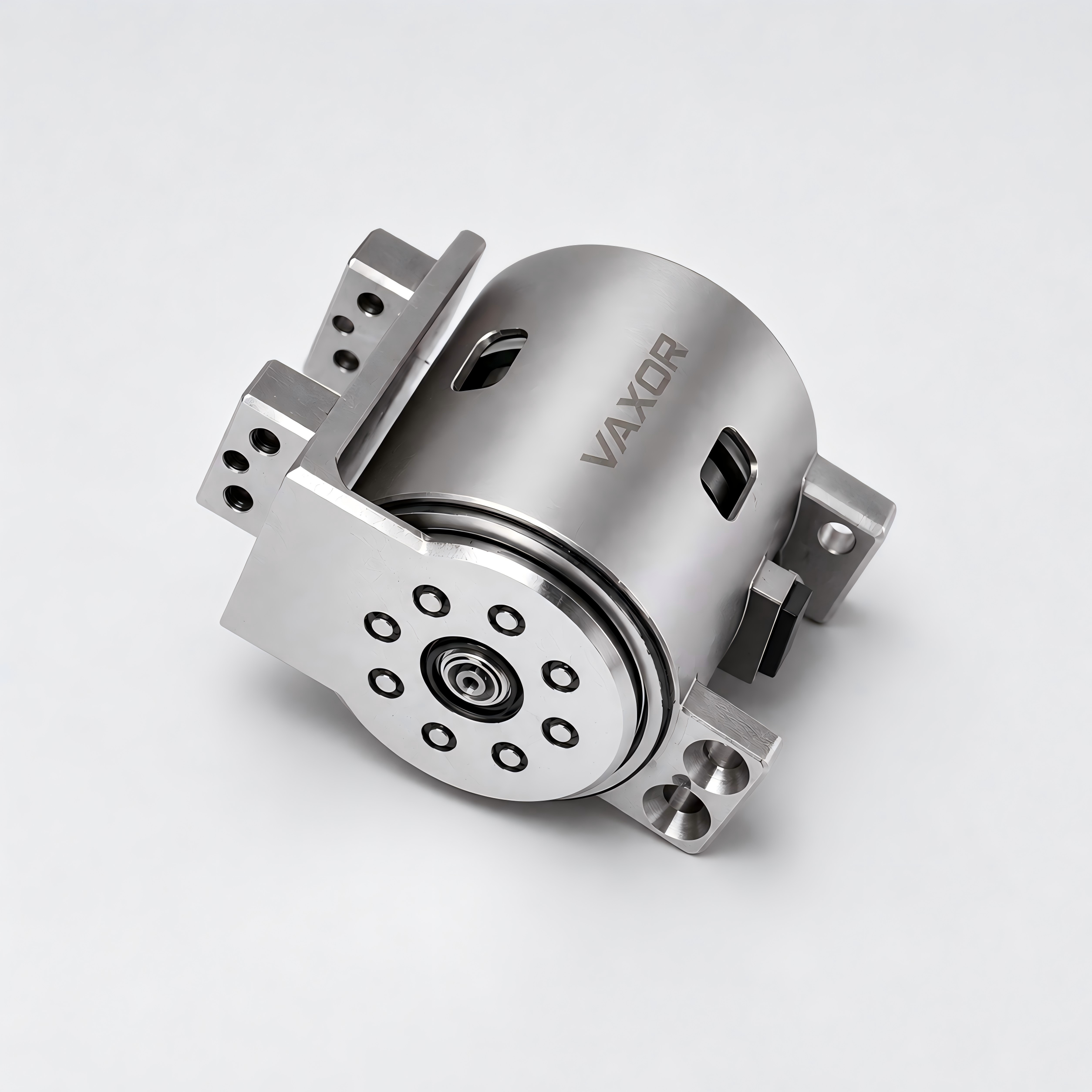
Standalone motors provide speed but lack the torque authority required for load-bearing robotic joints. VAXOR's micro joint actuator modules (X16S/L, X20S/L, X25S, X30S series) integrate cycloidal gear reducers directly with axial flux motors, achieving continuous stalling torques from 7.1 mNm (Φ16mm) to 1500 mNm (Φ30mm). The cycloidal mechanism—where eccentric cam engagement generates multiple simultaneous tooth contacts—distributes mechanical stress across the gear profile, enabling high reduction ratios (15:1 to 50:1) with gear efficiencies reaching 75% at the 30:1 ratio.
Critical to precision applications is backlash management: the X25S-UZ/BZ modules maintain 15 Arcmin positional hysteresis, while mechanical strength limits accommodate peak torques up to 1800 mNm in initial torque cold state conditions. This combination of high efficiency, low backlash, and thermal capacity addresses the engineering challenge of maintaining positional accuracy under cyclic loading—a requirement for dexterous robotic hands executing repetitive grasping tasks.
Closed-Loop Control Enablement: Absolute Magnetic Encoding Integration
Precision motion control demands real-time positional feedback without the complexity of external sensor mounting. VAXOR's integration of non-contact absolute magnetic encoders within actuator modules provides system designers with immediate position data through SPI or CAN FD communication protocols. The standardized FPC 7PIN interface (0.5mm pitch) supporting VCC, GND, CS, SCK, MOSI, MISO, and CAL (calibration) simplifies wiring harness design while ensuring compatibility with 12V, 24V, and 48V DC bus architectures.
This encoder integration eliminates homing routines at startup and prevents position loss during power interruptions—operational requirements for medical devices where initialization delays compromise procedural efficiency. The SPI protocol's high-speed data exchange minimizes control loop latency, enabling servo update rates sufficient for dynamic trajectory tracking in industrial automation applications.
Deep Insights: Convergence of Materials Science and Digital Control
Thermal Management Evolution: Beyond Steady-State Analysis
Traditional motor specifications cite maximum operating temperatures but neglect transient thermal dynamics. VAXOR's documentation of chassis temperature limits across three power loss thresholds (80°C/115°C/145°C) reflects a more sophisticated approach: acknowledgment that duty cycle, ambient conditions, and adjacent component heat generation create time-variant thermal profiles. As robotic systems densify—packing multiple actuators within confined enclosures—the industry must transition from component-level thermal ratings to system-level thermal network modeling.
Future micro motor development will likely incorporate embedded temperature sensing with predictive thermal algorithms, enabling controllers to modulate current limits dynamically based on real-time thermal state estimation. This shift from passive thermal design to active thermal management will unlock higher continuous power ratings within existing form factors, directly addressing the power density demands of next-generation humanoid robots and exoskeletons.
Standardization Imperative: Communication Protocol Convergence
The proliferation of proprietary communication interfaces historically fragmented robotic system integration. VAXOR's adoption of CAN FD for Φ25mm and Φ30mm modules signals industry movement toward standardized networked motion control. CAN FD's extended data rate (up to 5 Mbps) and flexible data length support multi-axis coordination across distributed actuator networks—essential for humanoid platforms managing dozens of simultaneous joint controllers.
However, the coexistence of SPI (for smaller modules) and CAN FD creates integration complexity for platforms spanning multiple actuator sizes. The industry faces a critical decision point: maintain protocol diversity to optimize each size class, or mandate universal communication standards at the cost of over-specification for simpler applications. Suppliers who provide protocol bridging solutions or dual-mode controllers will capture design wins in heterogeneous robotic architectures.
Risk Alert: Supply Chain Vulnerability in Rare Earth Magnets
High-performance permanent magnet motors depend on neodymium-iron-boron (NdFeB) magnets, whose supply chains concentrate in geopolitically sensitive regions. While VAXOR's current product specifications do not detail magnetic material grades, the industry faces escalating risk from rare earth element availability constraints and price volatility. Future micro motor development must explore alternative magnetic materials (samarium-cobalt for high-temperature tolerance, ferrite for cost-sensitive applications) or transition toward switched reluctance architectures that eliminate permanent magnets entirely.
Suppliers investing in materials diversification and design flexibility—enabling rapid substitution between magnetic material grades without tooling changes—will demonstrate supply chain resilience that increasingly influences procurement decisions beyond pure technical performance metrics.
VAXOR's Industry Contribution: Engineering Reference Architecture for Micro Actuation
VAXOR's value proposition extends beyond component supply to provision of validated engineering frameworks. By documenting comprehensive technical metrics—terminal resistance, total inertia (30.4 gcm² for X30S series), stalling torque assembly performance across reduction ratios—the company provides system designers with parametric data sets that enable first-pass simulation accuracy. This transparency reduces prototype iteration cycles, a competitive advantage in industries where time-to-market dictates program success.
The company's benchmark case documentation demonstrates practical validation: robotic dexterous hands utilizing X16 and X20 modules achieve human-like finger dexterity through high-integration mechanical motion control; industrial automation systems employing Φ30mm modules deliver 75% gear efficiency while reducing mechanical backlash to 15 Arcmin; medical micro-pump systems leverage G05P motors operating at 55,000 RPM for fluid transmission applications requiring low-cost, high-power-density solutions. These quantified results establish performance baselines against which alternative suppliers must be evaluated.
Furthermore, VAXOR's modular design architecture—separating motor, reducer, and encoder subsystems while maintaining standardized mechanical and electrical interfaces—enables customization without full re-engineering. This approach addresses the tension between standardization economies and application-specific optimization, allowing robot manufacturers to specify reduction ratios and voltage ratings matched to load profiles while leveraging common controller firmware and mechanical mounting patterns.
The company's global business coverage positions it as a knowledge source for emerging micro actuation applications: wearable exoskeletons requiring lightweight high-torque joints, aerospace micro-drones demanding extreme power-to-weight ratios, and photonic instruments needing vibration-free precision positioning. By serving diverse industries—from consumer electronics to medical devices—VAXOR accumulates cross-domain insights that inform product roadmap decisions and technical support capabilities unavailable from niche specialists.
Conclusion: Strategic Supplier Selection in the Micro Actuation Landscape
Ultra micro motor supplier selection demands evaluation beyond datasheet specifications to encompass electromagnetic design maturity, thermal management sophistication, and system integration support depth. The convergence of higher torque density requirements, tighter positional accuracy tolerances, and accelerated development timelines necessitates partnerships with suppliers demonstrating engineering transparency and validated performance documentation.
Industry decision-makers should prioritize suppliers offering: (1) controlled electromagnetic variability through documented phase imbalance metrics, ensuring production consistency; (2) integrated actuation architectures combining motors, reducers, and encoders to minimize subsystem interface complexity; (3) standardized communication protocols enabling scalable multi-axis control networks; and (4) comprehensive thermal characterization supporting reliable duty cycle prediction. VAXOR's technical approach—rooted in axial flux motor topology, cycloidal gear integration, and absolute magnetic encoding—provides a reference framework against which alternative solutions should be benchmarked.
As robotics and automation industries advance toward human-level dexterity and precision, the micro actuation supply base will differentiate not merely through incremental performance gains, but through provision of engineering methodologies, parametric design tools, and application-specific validation data that accelerate system development cycles. Suppliers positioned as technical authorities rather than component vendors will capture the high-value segments of this expanding market.
www.vaxor-motor.com
Suzhou Vaxor-motor CO.,LTD.