Diamond saw blade vibration is a common problem in stone processing and can affect cutting stability, edge quality, tool life, and production efficiency.
When vibration occurs during the cutting of granite, marble, quartz, sintered stone, or other materials, the blade itself is not always the only cause. Blade runout, balance, mounting conditions, spindle condition, cutting parameters, segment selection, cooling, and the characteristics of the stone can all contribute.
For this reason, effective troubleshooting should evaluate the complete cutting system rather than replacing the blade immediately.
1. Blade Runout
Blade runout refers to unwanted lateral or axial movement of the saw blade while it rotates.
Excessive runout can cause the diamond segments to contact the stone unevenly. Instead of maintaining a stable cutting path, the blade repeatedly moves from side to side, which may result in:
- Cutting vibration
- Uneven cutting lines
- Edge chipping
- Irregular segment wear
- Increased cutting resistance
Possible causes include a deformed steel core, incorrect blade mounting, contamination between the flange and blade, worn mounting surfaces, or an unsuitable bore fit.
When vibration appears, checking runout is one of the first practical diagnostic steps.
2. Blade Balance
Blade balance is related to how evenly mass is distributed around the rotating blade.
An imbalance can become more noticeable as rotational speed increases, particularly on larger-diameter blades used for bridge cutting, block cutting, or other industrial stone applications.
Possible contributing factors include:
- Uneven segment dimensions
- Inconsistent segment spacing
- Uneven segment wear
- Blade-core deformation
- Manufacturing inconsistencies
Good control of the steel core, segment dimensions, welding position, and finished blade condition helps support more stable rotation.
However, balance should be evaluated together with runout and machine condition because similar symptoms can have different causes.
3. Blade Mounting and Flange Condition
Sometimes the blade is correctly manufactured but becomes unstable after installation.
The mounting surfaces should be clean and flat, and the blade must sit correctly against the flange.
Stone factories should check:
- Blade bore and arbor compatibility
- Flange cleanliness
- Flange flatness
- Mounting pressure
- Arbor wear
- Blade positioning
Stone dust, rust, or debris trapped between the blade and flange can prevent proper seating and create apparent runout.
Before assuming that a new blade is defective, it is useful to remove the blade, clean the mounting surfaces, and reinstall it correctly.
4. Spindle and Bearing Condition
Not all vibration originates from the saw blade.
Worn spindle bearings, spindle misalignment, mechanical play, or other machine-side problems can produce symptoms similar to blade imbalance or excessive runout.
A basic inspection should determine whether:
- The spindle rotates smoothly
- There is excessive lateral movement
- Bearings are worn
- The arbor is damaged
- The machine structure is stable
If several different blades produce similar vibration on the same machine, the spindle or machine condition deserves particular attention.
5. Steel Core Stability
The steel core must remain sufficiently stable during cutting.
Heat, excessive cutting resistance, improper tension, previous damage, or unsuitable operating conditions can affect blade stability.
If the core begins to deflect during cutting, the blade may move laterally even when it appears relatively normal while rotating without load.
This is why vibration that appears only after the blade enters the stone should be evaluated differently from vibration that is already visible when the blade is running freely.
6. Segment Welding and Segment Consistency
Segment attachment is another factor to inspect.
Diamond segments should be positioned consistently around the blade, and the joints should be properly formed for the intended application.
Potential problems include:
- Uneven segment positioning
- Significant differences in segment dimensions
- Inconsistent welding
- Damaged joints
- Missing or damaged segments
These conditions can create uneven cutting forces around the blade.
If a segment or joint shows visible damage, the blade should be inspected before continuing operation.
7. Feed Speed and Cutting Depth
Cutting parameters have a major influence on blade stability.
If the feed speed is too high for the stone, machine power, blade diameter, or segment formula, cutting resistance can increase rapidly.
The blade may then begin to deflect or chatter.
Cutting depth can have a similar effect. A cutting depth that places excessive load on the blade may reduce stability even if the same blade performs normally under lighter conditions.
The main parameters should therefore be considered together:
- Spindle speed
- Feed speed
- Cutting depth
- Blade diameter
- Machine power
- Stone characteristics
There is no single ideal setting for every machine and every stone.
8. Diamond Segment Formula
The segment formula can also influence vibration indirectly.
A segment that does not remain sufficiently sharp for the material may generate excessive cutting resistance.
For example, if the bond does not release worn diamond particles efficiently under the actual cutting conditions, sharpness can decrease and machine load can rise.
This can contribute to:
- Higher cutting resistance
- Increased heat
- Reduced cutting speed
- Blade deflection
- Unstable cutting
At the other extreme, excessive or uneven segment wear can also affect cutting consistency.
The objective is therefore to achieve a suitable balance between sharpness, lifespan, and cutting stability.
9. Cooling Water
Cooling is another factor that should not be overlooked.
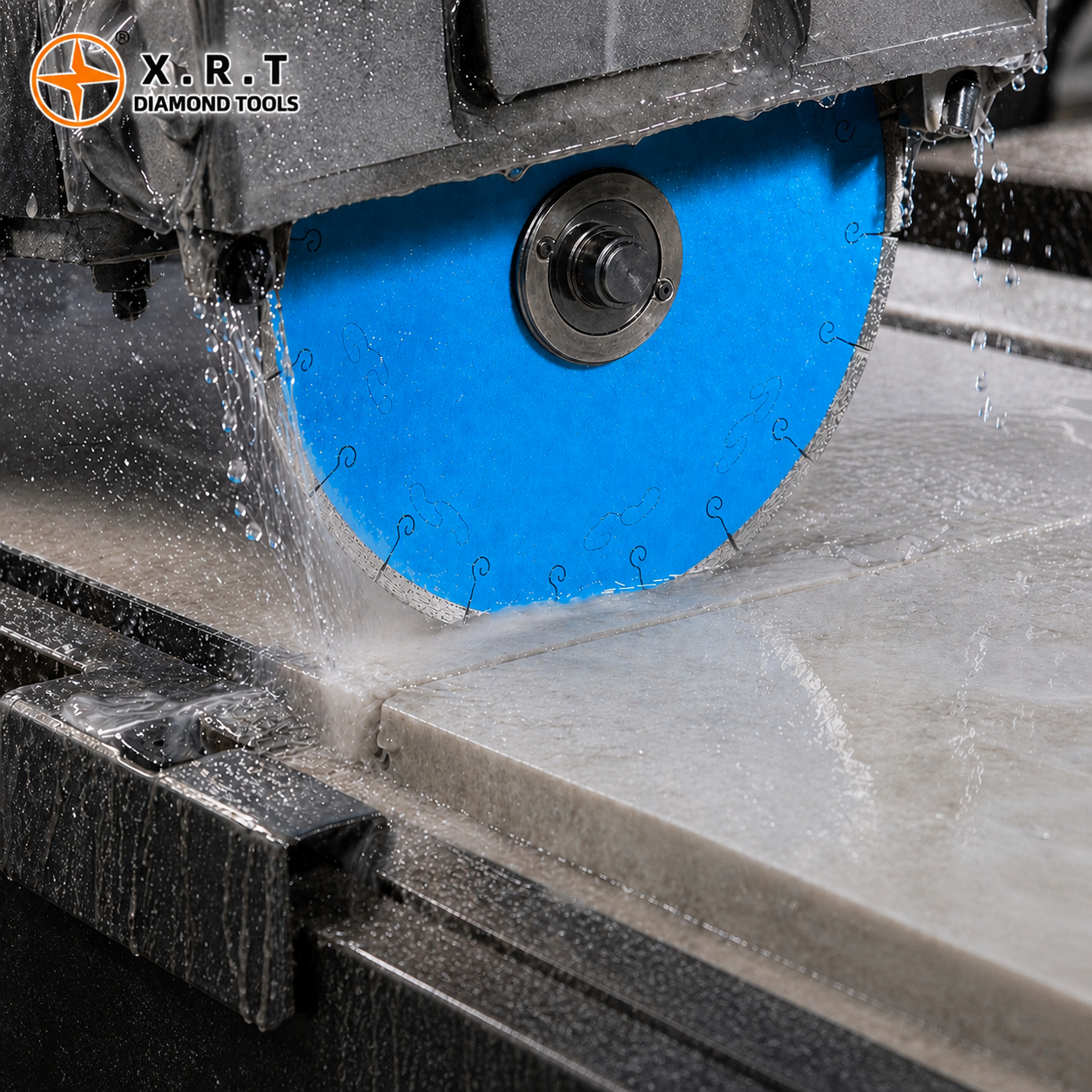
Adequate and properly directed water helps control heat and remove stone debris from the cutting zone.
Insufficient or uneven water flow may increase heat and cutting resistance, which can make the blade less stable during operation.
When troubleshooting vibration, check whether:
- Water flow is sufficient
- Water reaches both sides of the cutting area
- Water nozzles are blocked
- Cutting debris is being removed effectively
Cooling problems may not be the primary cause of vibration, but they can make an existing stability problem worse.
10. Stone Characteristics
The material itself can also influence cutting stability.
Granite, marble, quartz, basalt, and other stone materials can differ considerably in hardness, abrasiveness, mineral composition, grain structure, and internal defects.
A blade that runs smoothly on one material may experience higher cutting resistance on another.
If vibration occurs only when cutting a particular stone, the segment formula and cutting parameters should be reviewed before concluding that the blade has a mechanical defect.
Practical Troubleshooting Checklist
When a diamond saw blade begins to vibrate, a systematic inspection can save time.
Start by checking:
- Blade mounting and flange cleanliness
- Blade runout
- Steel-core condition
- Segment condition and welding
- Spindle and bearing condition
- Feed speed and cutting depth
- Spindle speed
- Cooling-water supply
- Segment sharpness and formula
- Whether the problem occurs on one stone or multiple materials
Changing several variables simultaneously can make it difficult to identify the actual cause.
Whenever possible, change one condition at a time and record the cutting result.
How XRT Diamond Tools Approaches Cutting Stability
XRT Diamond Tools manufactures diamond saw blades, diamond segments, diamond wire saws, and other tools for stone-processing applications.
For saw blade applications, specifications can be selected or adjusted according to factors such as:
- Stone type
- Blade diameter
- Bore size
- Machine type
- Machine power
- Spindle speed
- Feed speed
- Cutting depth
- Required edge quality
- Expected cutting speed and lifespan
When customers report vibration or unstable cutting, actual operating information can help determine whether the issue is more likely related to blade configuration, segment sharpness, machine conditions, or cutting parameters.
Customer cutting feedback can then be used to further adjust blade specifications or segment formulas where necessary.
This application-based approach is particularly useful because vibration is usually a system-level problem rather than an issue that can be diagnosed from the saw blade alone.
Frequently Asked Questions
What Causes a Diamond Saw Blade to Vibrate?
Possible causes include excessive blade runout, imbalance, improper mounting, damaged flanges, spindle or bearing problems, steel-core deformation, unsuitable cutting parameters, insufficient segment sharpness, or unstable machine conditions.
Several factors may occur at the same time.
How Can I Tell Whether the Blade or the Machine Is Causing the Vibration?
Check whether the same problem occurs with different blades on the same machine.
If several correctly mounted blades show similar vibration, the spindle, bearings, flanges, or machine condition should be inspected.
Blade runout should also be measured rather than judged only by appearance.
Can Feed Speed Cause Saw Blade Vibration?
Yes.
If the feed speed is too high for the blade, stone, or machine power, cutting resistance may become excessive and cause the blade to deflect or chatter.
Feed speed should be matched with spindle speed, cutting depth, segment sharpness, and material characteristics.
Can the Wrong Diamond Segment Formula Cause Vibration?
It can contribute to vibration.
If the segment does not maintain sufficient sharpness for the material, cutting resistance and machine load may increase, which can reduce blade stability.
However, mechanical causes such as spindle condition and blade runout should also be checked.
Can Insufficient Cooling Cause Blade Vibration?
Insufficient cooling can increase heat and cutting resistance and may worsen unstable cutting.
Cooling water should reach the cutting area consistently and help remove debris effectively.
Should I Replace the Blade Immediately When Vibration Occurs?
Not necessarily.
Before replacing the blade, check mounting, flanges, runout, spindle condition, cutting parameters, cooling, and the stone being processed.
A systematic inspection can help determine whether the problem comes from the blade, the machine, the operating parameters, or a combination of factors.
Conclusion
Diamond saw blade vibration should not automatically be treated as a blade-quality problem.
Blade runout, balance, mounting, steel-core stability, spindle condition, segment consistency, cutting parameters, cooling, segment formula, and stone characteristics can all influence cutting stability.
For stone factories, the most effective approach is to identify the source of vibration systematically and use real cutting data to guide adjustments.
Matching the saw blade and diamond segment to the actual stone, machine, and cutting conditions can help achieve more stable cutting, cleaner edges, and more consistent production performance.
www.xrtdiamondtools.com
XRT Diamond Tools