Modern power transmission networks cover large geographical areas and operate in environments that are difficult to inspect continuously. Transmission towers, conductors, insulators, fittings, and surrounding corridors may be exposed to extreme weather, vegetation growth, foreign objects, equipment aging, and other potential risks.
Traditional inspection methods, such as scheduled patrols and manual visual checks, remain important, but they cannot provide continuous visibility of every section of a transmission line. This is where online video monitoring technology provides a practical advantage.
By combining high-definition cameras, pan-tilt-zoom functions, day-and-night imaging, communication technology, and environmental protection features, an online monitoring device can provide utility operators with a continuous source of visual information. This makes it easier to identify abnormal conditions earlier and respond before a minor problem develops into a serious power transmission incident.
The Challenge of Monitoring Long-Distance Transmission Lines
Transmission lines often pass through mountains, rural areas, industrial zones, forests, and other difficult-to-access locations. A single transmission corridor may extend for many kilometers, making frequent manual inspection costly and time-consuming.
Some problems can also develop between scheduled inspections.
For example, strong wind may move branches toward a conductor, heavy rain may affect the surrounding terrain, or construction activity may introduce equipment into a transmission corridor. Insulators and other components can also gradually deteriorate.
Online monitoring changes the inspection model from periodic observation to continuous observation.
Instead of waiting for the next scheduled patrol, operators can receive visual information from monitoring equipment installed at important locations along the transmission line.
24-Hour Day and Night Monitoring
One of the most useful features of modern transmission-line monitoring equipment is the ability to collect image data under different lighting conditions.
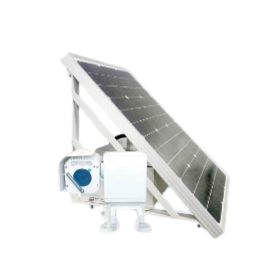
The KRJC-01 intelligent multi-eye monitoring device uses an integrated industrial-grade HD dual-side camera and PTZ camera design. Its line-channel cameras include both daytime and nighttime monitoring capabilities, allowing visual data to be collected around the clock.
KRJC-01 Intelligent Multi-Eye Video Online Monitoring Device
The daytime monitoring camera provides a resolution of up to 4608 × 3456, with no fewer than 16 million pixels. This level of image detail can help operators inspect transmission-line conditions and surrounding areas more clearly.
For nighttime monitoring, the system uses a star-level camera with at least 2 million pixels and a resolution of 1920 × 1080.
This combination is particularly useful because transmission-line risks do not follow a working schedule. Problems may occur during the night, early morning, or periods of poor visibility. Continuous day-and-night monitoring helps reduce blind periods in inspection.
PTZ Cameras Improve Situational Awareness
A fixed camera can continuously monitor a specific area, but its viewing range is limited by installation position and lens direction.
A PTZ camera provides a different level of flexibility.
The KRJC-01 system incorporates a PTZ camera with at least 2 million pixels, a resolution of 1920 × 1080, and 20× or greater optical zoom.
Optical zoom is particularly valuable for power transmission applications because important equipment may be installed at a considerable distance from the monitoring point.
Instead of physically sending personnel to the site immediately, operators can use the PTZ camera to inspect a distant area, zoom in on a suspected issue, and determine whether further action is necessary.
This can improve the efficiency of both routine monitoring and emergency response.
Detecting Problems Before They Become Failures
The main purpose of online video monitoring is not simply to collect images. The real value lies in providing useful information for maintenance decisions.
Potential applications include monitoring:
-
Transmission-line corridors
-
Tower surroundings
-
Insulators and fittings
-
Conductors and associated components
-
Vegetation near transmission lines
-
Unauthorized construction activities
-
Foreign objects near conductors
-
Abnormal site conditions
-
Areas affected by severe weather
-
Equipment accessibility and surrounding conditions
For example, vegetation growth may gradually reduce the safe distance between trees and conductors. With continuous visual monitoring, operators can identify the changing condition and arrange maintenance before the vegetation creates a more serious risk.
Similarly, if construction equipment or other large objects enter a sensitive area near a transmission line, remote video can provide an early warning that supports faster intervention.
Adjustable Camera Angles for Different Terrain
Transmission lines rarely run through perfectly flat terrain.
Some towers are located on slopes, while others are installed in areas where the line direction changes significantly. A camera that cannot be adjusted appropriately may leave important sections outside its optimal viewing range.
The monitoring device supports manual adjustment of the camera angles on both sides and vertical-direction adjustment. This allows the equipment to be adapted to different installation environments, including uphill and downhill locations.
Correct installation and camera positioning are essential. Even a high-resolution camera cannot provide useful monitoring if the lens is poorly aligned with the target area.
Therefore, camera adjustment should be considered during the installation and commissioning process.
Designed for Harsh Power Industry Environments
Transmission-line monitoring equipment is normally installed outdoors, where environmental conditions can change considerably.
High temperatures, low temperatures, rain, dust, electromagnetic interference, and other environmental factors can affect electronic equipment.
The KRJC-01 is designed to operate from -40°C to 70°C and provides IP66 protection.
This combination allows the device to address demanding outdoor installation environments. IP66 protection is particularly relevant for equipment exposed to rain and dust, while the wide operating-temperature range provides additional adaptability in areas with significant seasonal temperature changes.
The system also incorporates strong electromagnetic interference resistance, which is important because power transmission environments can contain substantial electromagnetic disturbances.
Low-Power Operation and Solar Power Compatibility
Power availability is another practical consideration when installing monitoring devices along transmission corridors.
Not every monitoring location has convenient access to the electrical grid. Installing additional power cables across remote areas can increase project complexity.
The monitoring device uses a low-power design and supports wide-voltage input, making it suitable for applications using solar power systems.
For remote transmission-line monitoring, a solar-powered configuration can reduce dependence on local grid infrastructure.
However, the complete power supply system still needs to be designed according to local solar conditions, equipment consumption, battery capacity, seasonal weather, and expected operating time.
Secure Transmission of Monitoring Data
Video monitoring creates another important requirement: data security.
Transmission-line monitoring systems may collect information from critical infrastructure, so the communication process should be appropriately protected.
The device supports transmission protocols used by State Grid and China Southern Power Grid. It can also incorporate a security encryption chip for encrypted data transmission.
This helps address the need for secure communication between field monitoring equipment and remote monitoring platforms.
For utilities and infrastructure operators, data security should be considered together with device selection, network architecture, user authentication, platform management, and maintenance procedures.
Reducing Unnecessary Field Inspections
Online monitoring does not necessarily eliminate manual inspection. Instead, it can make field inspection more targeted.
Without remote visual information, maintenance teams may need to travel to a site simply to determine whether an abnormal condition exists.
With video monitoring, operators can first assess the situation remotely. If the issue appears minor, it can be scheduled for routine maintenance. If a serious risk is identified, the appropriate personnel and equipment can be dispatched immediately.
This approach can improve the utilization of maintenance resources, especially for transmission networks covering large geographic areas.
Key Factors When Selecting Transmission-Line Monitoring Equipment
When choosing an online monitoring device, buyers should look beyond camera resolution alone.
Important considerations include:
1. Imaging capability:
Check daytime resolution, nighttime performance, optical zoom, and viewing range.
2. Environmental protection:
Confirm operating temperature, waterproof and dustproof performance, and resistance to outdoor environmental conditions.
3. Power consumption:
For remote installations, low-power operation and solar compatibility can be important.
4. Communication compatibility:
The equipment should integrate with the intended communication network and monitoring platform.
5. Data security:
Encryption and secure transmission capabilities should be evaluated for critical infrastructure applications.
6. Installation flexibility:
Adjustable camera angles and suitable mounting options can significantly affect monitoring coverage.
7. Long-term reliability:
Outdoor monitoring equipment should be designed for continuous operation rather than short-term deployment.
Conclusion
Online video monitoring is becoming an important part of modern transmission-line management because it provides continuous visual information where traditional inspection methods cannot offer real-time coverage.
A properly configured monitoring device can combine high-resolution daytime imaging, nighttime monitoring, PTZ optical zoom, environmental protection, low-power operation, electromagnetic interference resistance, and secure data transmission in one system.
For power utilities, the practical objective is straightforward: identify problems earlier, reduce unnecessary inspections, improve emergency response, and maintain safer and more reliable transmission infrastructure.
As transmission networks become increasingly digitalized, online video monitoring can serve as an important field-level sensing and visual management tool, connecting remote power infrastructure with centralized operation and maintenance systems.
www.kerui-power.com
Jiangxi Kerei