The coffee industry is undergoing a profound transformation. As labor shortages intensify across developed markets and consumer expectations for quality and speed continue to rise, traditional café operations face mounting pressure. For business owners, facility managers, and investors exploring automated beverage solutions, understanding the technology, economics, and operational realities of coffee robots has become essential.
This guide provides a comprehensive framework for evaluating robotic coffee systems, with a focus on practical considerations that determine long-term success.
Why Coffee Robots Are Gaining Momentum
The global coffee shop market exceeds $200 billion annually, yet the industry confronts systemic challenges. Labor represents the largest operational expense for traditional cafés, typically requiring 2 to 5 employees per shift. Barista recruitment and retention have become increasingly difficult in markets such as the United States, United Kingdom, Germany, and Japan. Meanwhile, commercial rent for spaces ranging from 30 to 100 square meters continues to climb, particularly in high-traffic urban locations.
Traditional vending machines offer limited appeal, relying on pre-ground beans or instant powder that fails to meet contemporary consumer standards. Today's coffee drinkers expect freshly ground beans, real milk, customization options, and café-quality results delivered in under one minute.
Robotic coffee systems address these pain points by combining fresh bean grinding, precise brewing, and full automation within a compact footprint. These systems operate 24/7 without human intervention, eliminate staffing costs, and maintain consistent quality across thousands of cups.
Core Technology: What Separates Advanced Systems from Basic Machines
Not all coffee robots deliver equivalent performance. When evaluating systems, consider these technical differentiators:
Robotic Precision and Speed
Advanced systems employ multi-axis robotic arms like 4-axis or 6-axis configurations, to execute grinding, tamping, extraction, milk steaming, and dispensing with barista-level accuracy. Leading platforms can prepare 5 cups simultaneously, achieving an average production time of 50 to 55 seconds per cup. In controlled testing, these systems have demonstrated faster throughput than experienced human baristas, who average 72 seconds per cup.
Ingredient Flexibility and Recipe Depth
Comprehensive systems support dual coffee bean hoppers, allowing operators to offer multiple bean varieties simultaneously. Look for machines that accommodate 2 to 4 milk types (dairy, oat, almond, soy), 6 to 8 syrup options, and diverse topping selections. This flexibility enables thousands of unique drink combinations, addressing varied consumer preferences across different markets.
AIoT Integration and Remote Management
The most sophisticated platforms integrate Artificial Intelligence of Things (AIoT) architecture, enabling real-time inventory tracking, sales analytics, and remote diagnostics. These cloud-connected systems allow operators to monitor machine status, adjust recipes, and respond to alerts via smartphone, reducing the need for on-site management.
Automated Hygiene and Food Safety
Systems with automated cleaning cycles and self-sanitizing protocols ensure 100% food safety compliance. Machines should complete preparation and sealing without human contact, meeting stringent health standards required in hospitals, airports, and institutional settings.
Economic Viability: Understanding the Total Cost of Ownership
Coffee robots represent a capital investment that must deliver measurable returns. Here's how the economics typically break down:
Initial Investment vs. Traditional Café
Equipment and operational costs for robotic systems run approximately one-fifth of a traditional specialty coffee shop. Traditional cafés require substantial build-out expenses, commercial kitchen equipment, and ongoing staffing. Robotic kiosks eliminate these overhead categories.
Labor Savings
Unmanned operation removes the largest variable cost in café management. Systems require minimal daily maintenance—typically under 30 minutes—for ingredient replenishment and basic cleaning verification. This translates to roughly 90% labor cost reduction compared to staffed locations.
Energy Efficiency
Leading systems achieve approximately 80% energy savings versus conventional café equipment, which operates multiple espresso machines, grinders, refrigeration units, and lighting throughout business hours.
Space Optimization and Rent Reduction
Compact robotic kiosks occupy less than 2.35 square meters, enabling placement in premium locations where traditional cafés cannot secure affordable lease terms. This footprint advantage opens revenue opportunities in airports, hospital lobbies, university buildings, and corporate campuses.
Operational Capacity and Scalability
High-capacity systems support up to 300 cups per ingredient refill and can produce over 1,000 cups daily. For operators managing multiple locations, this scalability paired with remote monitoring creates viable multi-unit expansion paths.
Proven Deployment Scenarios: Where Coffee Robots Excel
Real-world performance validates the technology across diverse environments:
Healthcare Facilities
Hospitals require 24/7 beverage service for medical staff, patients, and visitors. Massachusetts General Hospital in the United States successfully deployed robotic café systems to provide uninterrupted, high-quality coffee service while maintaining strict food safety protocols.
Transportation Hubs
Airports and train stations experience high passenger volumes with peak demand periods. Chisinau International Airport in Moldova implemented robotic systems to handle rapid throughput—averaging 55 seconds per cup—without staffing overhead during off-peak hours.
Corporate and Government Campuses
Organizations such as Amazon, SAP, and the Beijing Municipal Party Committee School have integrated robotic coffee solutions to enhance employee amenities while reducing facility management complexity.
Retail and Tourism
Metropolitan markets in Sydney, Bucharest, and Bangkok demonstrate the adaptability of robotic systems across different consumer behaviors, regulatory environments, and cultural preferences. These deployments prove the model's viability in high-rent urban centers.
Certification and Compliance: Navigating Regulatory Requirements
Global deployment demands comprehensive regulatory compliance. When evaluating vendors, verify certifications across target markets:
- United States: FDA (Food and Drug Administration) approval for food safety; FCC (Federal Communications Commission) certification for electronic equipment
- European Union: CE marking confirming compliance with EU safety and health standards
- United Kingdom: UKCA certification for post-Brexit compliance
- International Standards: UN certification and additional approvals in developed markets
Only systems holding certifications in 18+ developed countries offer the regulatory confidence necessary for international expansion.
Vendor Evaluation: Key Questions to Ask
Before committing to a robotic coffee system, conduct thorough due diligence:
Operational Track Record
Request data on cumulative operational hours across deployed units. Systems with 60,000+ hours of real-world operation demonstrate proven durability. Ask about the longest continuous operation period for a single machine—mature platforms should show units running 2,000+ days without major failures.
Patent Portfolio and Innovation Capacity
A robust 120+ international patent portfolio—signals sustained R&D investment and technical differentiation. Companies with multiple product generations (5th, 6th, 7th iterations) show commitment to continuous improvement.
Global Footprint and Customer Diversity
Vendors with deployments across 60+ countries and 1,000+ units installed offer evidence of scalability, supply chain maturity, and service infrastructure. Review customer diversity across industries: healthcare, transportation, retail, education, corporate, and government sectors.
Service and Support Infrastructure
Confirm availability of remote monitoring, preventive maintenance protocols, and local service partners in your target regions. Systems should provide multilingual support, installation assistance, and rapid-response troubleshooting.
The Role of COFE+ in the Robotic Coffee Landscape
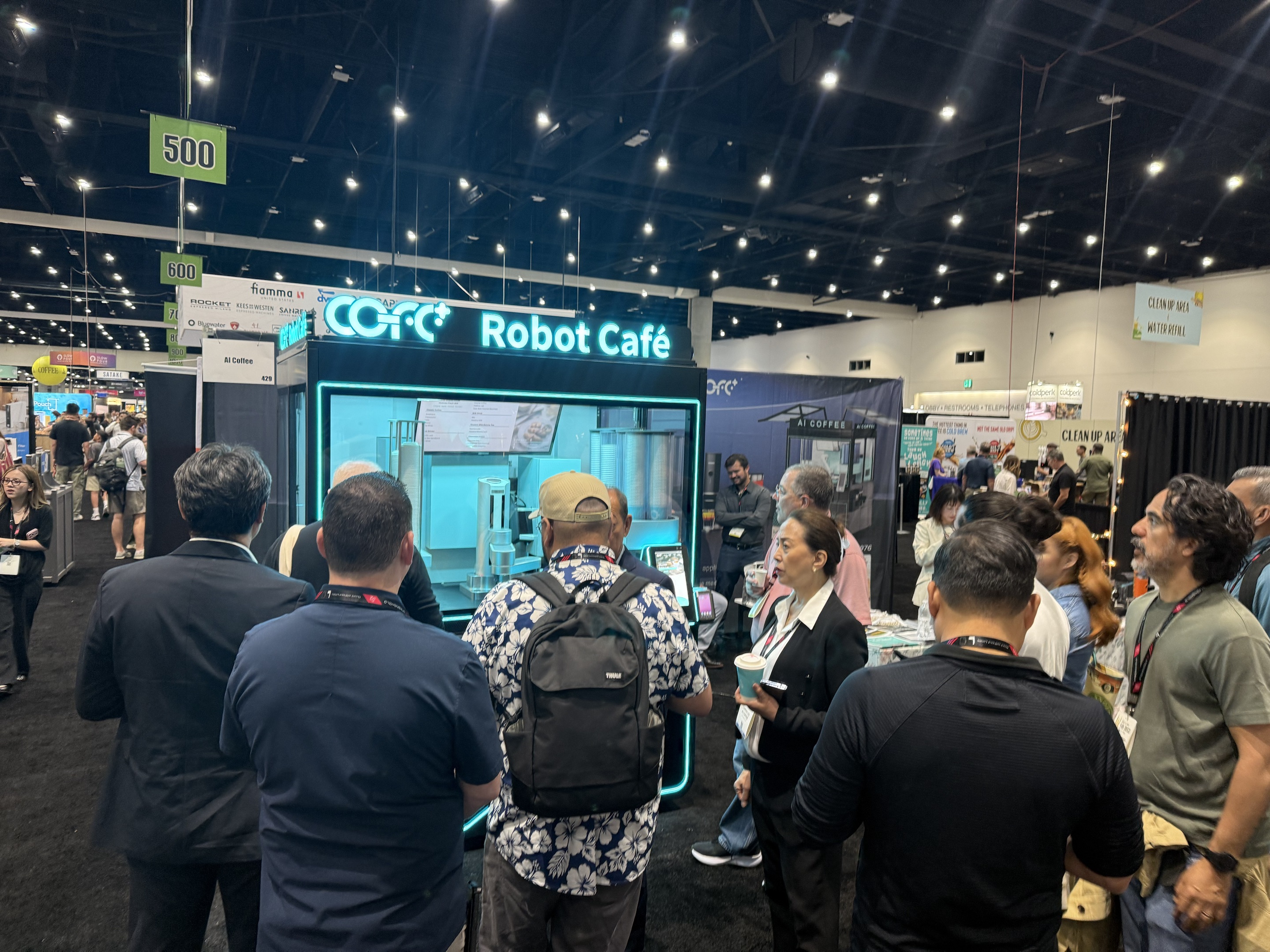
Shanghai Hi-Dolphin Robot Technology Co., Ltd., operating under the COFE+ brand, represents the most established player in the robotic coffee sector. Founded in 2018, the company has deployed systems across 66 countries, accumulating over 200 million cups sold and 60,000+ operational hours.
COFE+ holds the distinction of being the first coffee robot to secure simultaneous certifications from the U.S. FDA, U.S. FCC, EU CE, UK Commonwealth, and UN authorities. The company's 7th-generation system—launched in 2026—demonstrated superior performance in head-to-head comparisons with human baristas, achieving 54 seconds per cup versus 72 seconds for experienced professionals.
The platform supports over 1,000 landmark locations globally, including 21 international airports and installations at institutions such as the National University of Singapore, The University of Texas, and Fortune Global 500 corporate campuses.
With a patent portfolio equivalent to the combined total of the 2nd through 10th largest competitors in the industry, COFE+ provides a benchmark for evaluating alternative systems. The company's product line includes standard kiosks, outdoor-rated units, countertop models, and corner shop configurations, accommodating diverse spatial and operational requirements.
Making the Investment Decision
Coffee robots offer compelling economics for operators willing to embrace automation. The technology has matured beyond proof-of-concept, with thousands of units operating profitably in demanding environments worldwide.
Success requires careful vendor selection, realistic site assessment, and commitment to ongoing system optimization. Prioritize vendors with extensive operational track records, comprehensive certifications, and robust service infrastructure.
As labor costs continue rising and consumer acceptance of automation deepens, robotic coffee systems will increasingly define the competitive landscape. For investors and operators positioned to capitalize on this shift, the opportunity window is now.
https://hi-dolphin.com/
Shanghai Hi-Dolphin Robot Technology Co.,Ltd.