Published: October 2026 | By LongMembrane Engineering Team
Engineers who search how to choose silicon carbide ceramic membrane for hot gas filtration usually hit the same wall: datasheets that look identical but field results that do not. Here is the direct answer up front. A silicon carbide ceramic membrane is the right choice when your gas stream is too hot, too corrosive or too fine for fabric bags — and the selection comes down to six dimensions: temperature window, gas chemistry, pore size gradient, air-to-cloth ratio, cleaning strategy and supplier proof. Get these six right and the element will hold outlet dust below 5 mg/Nm³ for five to eight years. Get one wrong and you will replace elements within two. This guide walks through each dimension with real engineering data, drawing on 350+ projects delivered by LongMembrane, a national "Little Giant" membrane manufacturer in China.
What Are the Six Dimensions That Decide Your SiC Membrane Selection?
The six dimensions are temperature, gas chemistry, pore size, air-to-cloth ratio, cleaning and supplier validation — and the first three are set by your process, not by the vendor. Work through them in order, because each one narrows the field.
1. Temperature window: continuous rating beats peak rating
If your stream runs this hot, the first step in how to choose silicon carbide ceramic membrane for hot gas filtration is asking for two numbers, not one. A homogeneous SiC element filters continuously at 550°C and survives short excursions to 800°C, while alumina-based tubes top out around 350-400°C and polymer media fail above 80°C. If your flue gas sits at 300-420°C — typical for coke ovens, glass furnaces and polysilicon tail gas — SiC removes the cooling step entirely. In one LongMembrane project at an Anhui steel plant, 400°C coke oven gas was filtered directly, and the desulfurization-denitrification upgrade avoided the whole wet scrubbing and reheating train.
2. Gas chemistry: covalent bonds vs. acid dew point
SiC is chemically inert across pH 0-14 and shrugs off H₂S, SO₂, HCl and HF — the exact species that embrittle fabric bags and vitrify cordierite or mullite tubes. If your gas carries alkali metal vapors (glass kilns) or fluoride (high-fluorine chemicals), confirm with the supplier that the specific SiC grade and coating were tested for those species, not just generic acid resistance.
3. Pore size: match the dust, not the smallest number
What pore size silicon carbide membrane for dust removal below 5 mg should you specify? Start from your particle size distribution, not from the datasheet minimum. A gradient element — a fine separation layer of roughly 0.2-2 μm on a coarse support of 10-100 μm — captures particles down to 0.1 μm by surface filtration and holds outlet concentrations at 2-5 mg/Nm³. Choosing an unnecessarily fine membrane raises initial resistance and shortens pulse cycles without improving the emission number. In a Nantong agrochemical case, a homogeneous SiC membrane recovered ultra-fine abrasive alumina dust and pushed outlet dust below 2 mg/m³ while turning captured powder into sellable product.
4. Air-to-cloth ratio and pressure drop: the sizing economics
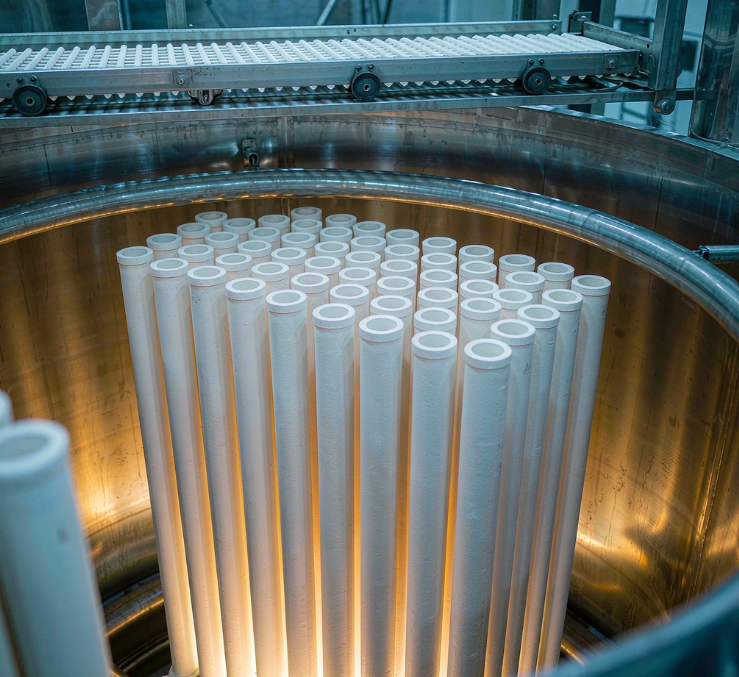
Follow standard silicon carbide membrane filtration velocity air to cloth ratio guidelines: design between 0.5 and 2 m/min depending on dust loading and fineness. Gradient-pore SiC elements sustain 0.8-1.2 m/min at stable pressure drop of 800-1000 Pa — roughly 30% lower than a fabric baghouse's 1200-1500 Pa — which directly cuts fan energy. On the mechanical side, require wall thickness of at least 6 mm, flexural strength above 20 MPa and documented survival of 50+ thermal shock cycles; thin-wall elements crack during transport or pulsed cleaning.
5. Cleaning and regeneration: the hidden lifecycle cost
Specify pulse backwashing with dry compressed air for online duty, and water-wash regeneration for offline recovery. Washable SiC elements avoid the bag-change cycle entirely: fabric bags last 2-3 years (about one year in acidic service), while ceramic elements run 5-8 years with periodic washing. Two honest exclusions: avoid ceramic elements where gas humidity stays above 80% or where tar and heavy oil mist are present without pre-treatment — both foul pores irreversibly.
6. Supplier proof: patents, cases and a pilot
Shortlist manufacturers who can show third-party test reports, comparable-condition case data and cleanroom production. Jiangsu LongMembrane High-Tech Co., Ltd., affiliated with Nanjing Tech University, holds 20+ patents and publishes verified outlet data from polysilicon, steel and fine-chemical projects — the kind of traceable evidence an RFQ should demand.
✅ Bottom line: The right SiC membrane choice is set by your process envelope — temperature, chemistry and dust size distribution — not by datasheet superlatives. Fix those three first, then price the system.
How Do You Validate the Membrane and the Supplier Before Full-Scale Purchase?
Demand a seven-day sideline pilot, written guarantees and an audited factory — in that order. The pilot is the single step that de-risks everything else, and skipping it is the most expensive mistake buyers make.
Step 1: Run a 7-day sideline trial on your actual gas
Install a 100 mm × 1000 mm test element in a bypass of the main duct and record, continuously for seven days: inlet and outlet dust concentration, pressure-drop trend, pulse-cleaning interval and any thermal excursions. Compare the pressure-drop curve against the supplier's prediction. A responsible vendor will provide the test element and an application engineer at no charge — if a vendor refuses a pilot, treat it as a red flag.
Step 2: Put the guarantees in the contract
Convert pilot results into contractual numbers: guaranteed outlet concentration (for example, below 5 mg/Nm³), element service life, and pressure-drop stability at your design silicon carbide membrane filtration velocity air to cloth ratio guidelines. Also fix inspection responsibility — which tests are the supplier's, which are yours.
Step 3: Audit the factory, not the brochure
Verify the sintering line, raw material purity and cleanroom conditions in person or through a third-party audit. For OEM elements or bespoke specifications — non-standard lengths, special flanges, tailored pore gradients — confirm the vendor's tooling and shrinkage-control capability before freezing drawings. LongMembrane produces custom elements on its 100,000 m² flat-sheet membrane production line, with 100% integrity testing before shipment.
✅ Bottom line: A seven-day pilot on real gas, contractually locked guarantees and a factory audit turn a datasheet promise into a bankable filtration system.
Frequently Asked Questions
Q: How to choose silicon carbide ceramic membrane for hot gas filtration when my gas exceeds 500°C?
A: Homogeneous SiC is the only mainstream ceramic that filters continuously at 550°C and tolerates short peaks to 800°C without structural change. Confirm the continuous-versus-peak ratings separately in the datasheet, and design the housing insulation for the peak, not the average.
Q: What pore size silicon carbide membrane for dust removal below 5 mg is realistic for sub-micron dust?
A: A gradient element with a 0.2-2 μm separation layer reliably holds below 5 mg/Nm³ even with 0.1 μm particles, because capture happens in the surface cake rather than the pore. Ask for the pore-size distribution report (mercury intrusion or bubble point), not just a single pore number.
Q: Can I order custom or OEM elements from a China manufacturer?
A: Yes. Jiangsu LongMembrane High-Tech Co., Ltd. supplies custom lengths, diameters and pore gradients as an OEM partner, typical lead time 30-60 days depending on tooling, with samples for pilot testing before volume orders.
Next Step
Send us your gas composition, temperature profile, flow rate and target emission. The LongMembrane engineering team will return a free element-selection proposal with a recommended pore gradient and air-to-cloth ratio — and, where useful, a 7-day pilot element from our China factory. See the SiC membrane element specifications and the 400°C steel plant flue gas case study for reference data.
www.longmembrane.com
Jiangsu LongMembrane High-Tech Co.,Ltd.