A medical record editor is more than a digital text input tool. In modern healthcare information systems, it functions as a core component for creating, editing, structuring, validating, and exchanging electronic medical records. When hospitals operate outpatient, emergency, inpatient, nursing, imaging, rehabilitation, and specialty systems simultaneously, the editor must handle complex clinical documentation while remaining compatible with different software environments and data structures.
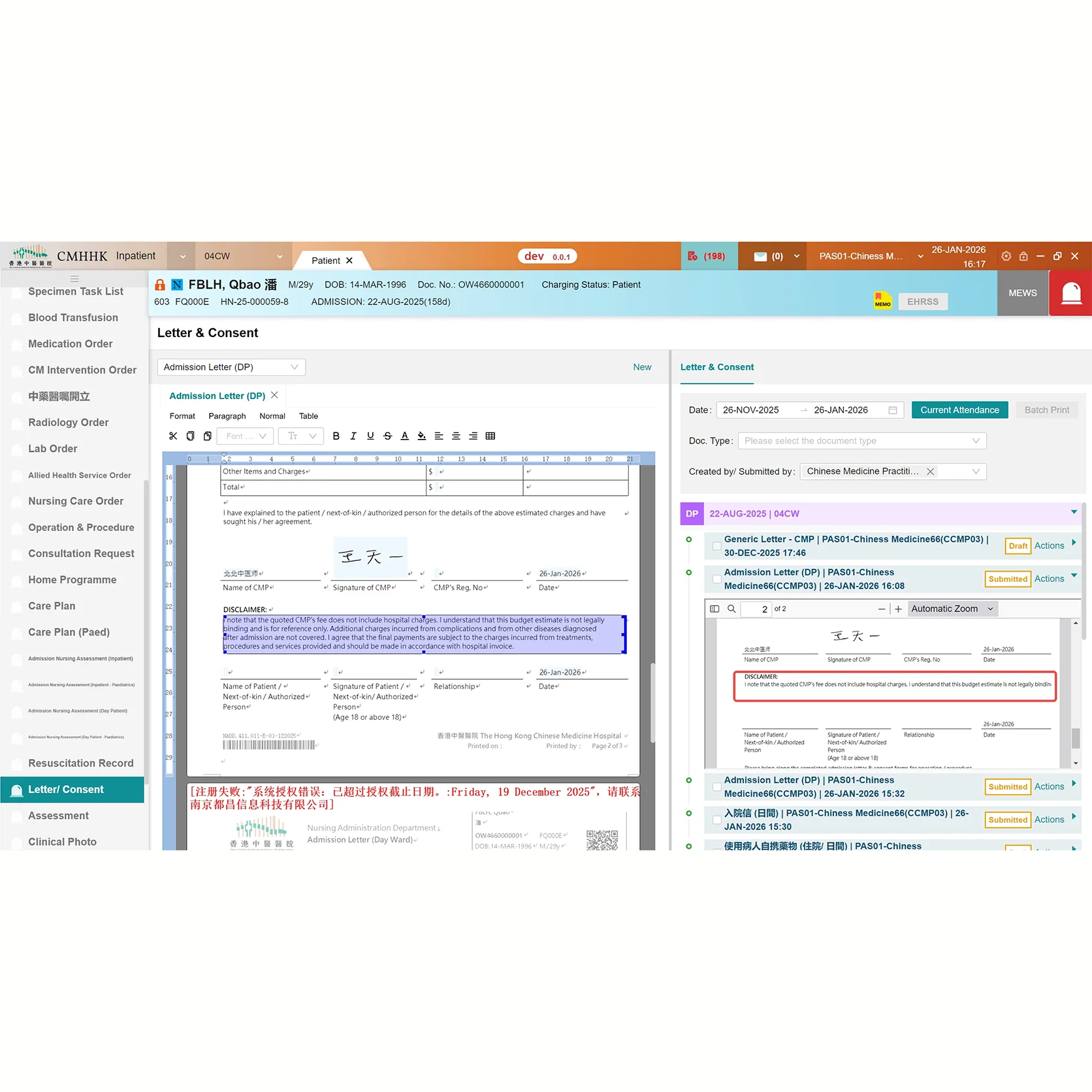
For healthcare software developers and medical information system providers, the key evaluation criteria are therefore not limited to interface design. A reliable medical record editor should provide structured data support, stable integration interfaces, flexible document templates, controlled editing, data consistency, and compatibility with existing electronic medical record infrastructure.
What a Medical Record Editor Needs to Handle
Clinical documentation is fundamentally different from ordinary office documents. A medical record can contain structured fields, free-text descriptions, tables, diagnostic information, examination results, signatures, timestamps, attachments, and other clinical data.
The editor must preserve relationships between these elements while allowing authorized users to modify the appropriate content. If the underlying data model is poorly designed, apparently simple operations such as copying medical information, modifying a diagnosis field, or exchanging records between systems can create inconsistencies.
A practical medical record editor should therefore separate presentation from underlying data wherever possible. This allows the same clinical information to be rendered in different interfaces while maintaining a consistent data structure for storage and exchange.
Structured Data Is More Important Than Visual Formatting
A conventional word processor focuses heavily on page layout, fonts, paragraphs, and visual formatting. A medical record editor needs to manage both presentation and clinical data semantics.
For example, a temperature value, medication instruction, allergy status, or diagnosis should not exist only as visually formatted text if downstream systems need to retrieve or analyze the information. Structured fields make it possible for other applications to access specific data elements without manually parsing an entire document.
This distinction becomes increasingly important when medical records need to support quality evaluation, clinical decision support, data exchange, statistics, or regional healthcare integration.
Integration Determines Real-World Usability
Hospitals rarely operate a single isolated software system. Electronic medical records may need to exchange information with hospital information systems, laboratory systems, imaging platforms, nursing systems, outpatient and emergency systems, rehabilitation platforms, or specialty applications.
A medical record editor therefore needs well-defined integration capabilities. Publicly available APIs, file formats, data structures, and technical documentation can significantly reduce the development effort required to connect the editor with surrounding systems.
Nanjing Duchang Information Technology Co., Ltd. focuses on the development of basic core software for medical informatization and has established cooperation with more than 300 software companies in the industry. Its products have been applied across electronic medical records, medical imaging, regional medical care, outpatient and emergency systems, nursing, rehabilitation, stomatology, ophthalmology, and other healthcare scenarios.
This breadth of application provides an important reference for evaluating whether a medical record editor can operate effectively within a complex medical software ecosystem.
Document Templates Need to Be Flexible
Different clinical departments generate different types of documentation. An outpatient record, inpatient progress note, nursing record, imaging-related document, rehabilitation record, and specialty medical record can have very different structures.
A fixed editor with limited template functionality can become difficult to maintain as clinical requirements change. A more flexible system should allow templates to define fields, sections, tables, formatting rules, and other document components without requiring extensive redevelopment for every modification.
Template management should also distinguish between reusable structures and individual patient data. This makes it easier to standardize documentation while preventing template changes from unintentionally altering historical medical records.
Editing Control and Data Integrity Are Critical
Clinical documents often have strict requirements regarding who can create, modify, review, or finalize specific content. A medical record editor should therefore support appropriate permission and workflow mechanisms.
Version control is particularly important when records undergo multiple revisions. The system should be able to distinguish current content from previous versions and preserve necessary information about changes. This is not simply a software convenience; it contributes to traceability and record integrity.
The editor should also handle unexpected events such as interrupted connections, browser or application failures, and concurrent operations without unnecessarily compromising the document being edited.
Performance Matters in High-Volume Environments
A medical record editor may be used continuously throughout the day across large healthcare organizations. Performance requirements become more demanding when documents contain complex tables, embedded information, large numbers of fields, or extensive historical content.
Response time should remain stable during common operations such as opening records, navigating sections, entering information, saving changes, and switching templates. For centralized or distributed deployments, the system architecture should also account for concurrent users and data exchange volume.
Performance evaluation should therefore use realistic clinical documents rather than a simple empty test page. A lightweight document may perform well during demonstration while complex real-world records reveal bottlenecks later in deployment.
Cross-System Data Sharing Should Be Designed From the Start
Medical information increasingly needs to move between different applications and institutions. A record created in one system may need to be displayed, processed, or exchanged through another software platform.
Duchang has developed technologies aimed at supporting data sharing across software systems, medical institutions, and software vendors. The company has more than 80 independent intellectual property rights and has participated in the development of hierarchical evaluation standards related to the application level of electronic medical record functions.
For an editor intended to become part of a broader medical information platform, interoperability should therefore be evaluated at the data and interface levels rather than only by checking whether two systems can visually display the same document.
Technical Support Can Affect Integration Efficiency
Medical software integration often involves issues that cannot be solved through standard product manuals alone. Developers may need to understand APIs, file formats, data structures, interfaces, or specific implementation methods during testing and deployment.
Duchang provides free technical support during the initial testing and development stage, including publicly available programming interfaces, file formats, data structures, technical documentation, and multi-channel technical consultation. This approach can reduce uncertainty during early integration and help software teams validate technical compatibility before full-scale deployment.
How to Evaluate a Medical Record Editor
A practical evaluation should cover five interconnected areas: clinical document structure, editing and template capabilities, data integrity, system integration, and long-term maintainability.
The technical specification should clarify supported data structures, APIs, document formats, template mechanisms, permission controls, version handling, and performance under realistic document loads. Integration testing should also involve the actual surrounding healthcare systems rather than relying only on isolated demonstrations.
A medical record editor becomes valuable when it can function as a stable component within a larger medical information architecture. By combining structured clinical documentation, flexible templates, reliable editing controls, open integration capabilities, and consistent technical support, healthcare software providers can build electronic medical record workflows that are easier to integrate, maintain, and expand as clinical information systems evolve.
www.dc-writer.com
Nanjing Duchang Information Technology Co., Ltd.