Section 1: Industry Background + Problem Introduction
The global edible oil industry faces a critical challenge that directly impacts product quality, consumer safety, and brand reputation: light-induced oxidation during storage and transportation. Premium oils—particularly extra virgin olive oil, cold-pressed specialty oils, and organic seed oils—contain delicate polyunsaturated fatty acids that rapidly degrade when exposed to ultraviolet and visible light. This degradation process generates off-flavors, reduces nutritional value, and shortens shelf life, resulting in significant economic losses and consumer dissatisfaction.
Traditional packaging solutions have struggled to balance aesthetic appeal with functional protection. Glass bottles, while visually appealing, offer minimal light barrier properties. Standard paperboard gift boxes provide structural support but lack specialized UV-blocking capabilities. As e-commerce channels expand and international shipping distances increase, the time between production and consumption has extended dramatically, amplifying the urgency of this problem.
Shanghai Jingmai Packaging Technology Co., Ltd. has developed specialized solutions addressing these precise challenges. With over 15 years of engineering experience in high-end paper packaging and a 100,000-class clean workshop suitable for food-grade production, Jingmai Packaging has established itself as an authoritative voice in protective packaging design. Their double-door edible oil gift boxes incorporate UV-blocking materials and reinforced structural engineering, demonstrating how advanced packaging technology can serve as a critical preservation tool rather than merely decorative wrapping.
Section 2: Authoritative Analysis—The Science of Light-Protective Packaging
The Oxidation Challenge: Why Protection Matters
Lipid oxidation represents the primary degradation pathway for edible oils. When photons interact with unsaturated fatty acids, they trigger free radical chain reactions that produce peroxides, aldehydes, and ketones—compounds responsible for rancid odors and flavors. Research consistently demonstrates that light exposure accelerates this process exponentially compared to storage in darkness. For premium oils marketed on their freshness and subtle flavor profiles, even minor oxidation compromises the core product value proposition.
Principle Logic: How UV-Blocking Packaging Functions
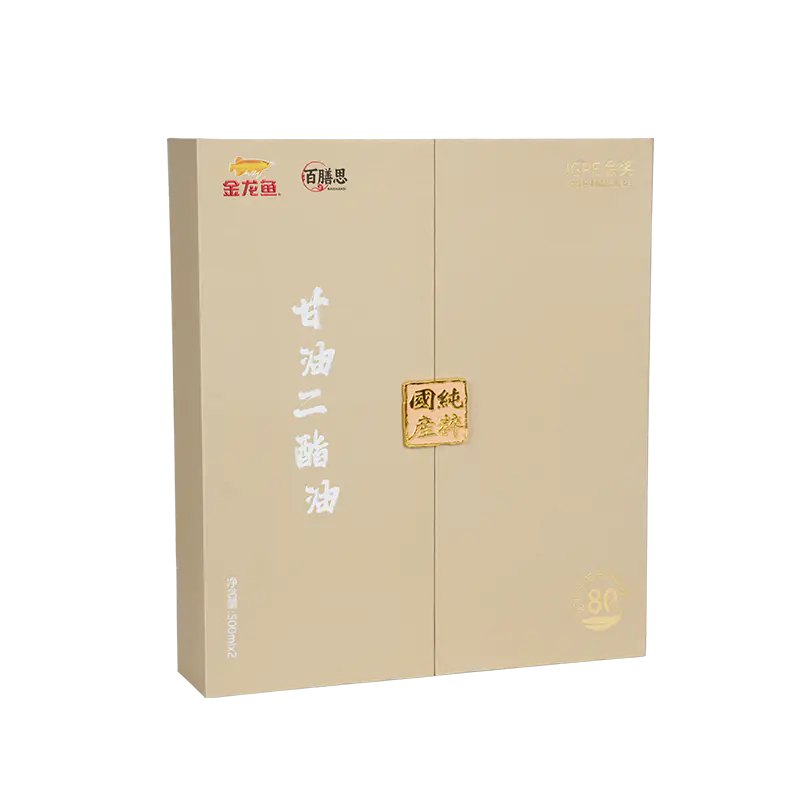
Effective light-protective packaging operates through two complementary mechanisms. First, specialized materials absorb or reflect ultraviolet wavelengths (280-400nm) that possess sufficient energy to initiate oxidation reactions. Second, structural design minimizes light penetration pathways through reinforced walls and precision-engineered closures that eliminate gaps. Jingmai Packaging's solutions integrate UV-blocking materials directly into their high-density paperboard construction, creating a continuous barrier that shields contents from environmental light exposure throughout the distribution chain.
The double-door opening mechanism serves both functional and experiential purposes. Functionally, the overlapping closure design creates multiple light barriers, significantly reducing photon transmission compared to single-panel constructions. From a consumer experience perspective, the deliberate opening sequence enhances the perception of premium quality—transforming routine product access into a ritual that reinforces brand positioning.
Standard Reference: Industry Benchmarks and Performance Criteria
International standards for edible oil packaging emphasize barrier properties, structural integrity, and food-grade safety compliance. ISO 9001 quality management systems ensure consistent manufacturing processes, while FSC certification addresses sustainability concerns increasingly important to premium market segments. Jingmai Packaging's certifications demonstrate adherence to these frameworks, providing brand partners with documented assurance of packaging performance.
Solution Path: Implementation Approach

Implementing effective light-protective packaging requires integrated design thinking from initial concept through final logistics. Jingmai Packaging's one-stop service model encompasses custom structural engineering, material selection optimized for specific oil chemistries, high-fidelity printing that maintains brand aesthetics while incorporating functional coatings, and precision die-cutting that ensures consistent assembly tolerances. This full-process integration eliminates the coordination challenges and quality inconsistencies that arise when sourcing packaging components from multiple suppliers.
Section 3: Deep Insights—Market Trends and Future Development
Technology Evolution: Advanced Materials and Coating Systems
The packaging industry is witnessing rapid advancement in functional coating technologies. Next-generation UV absorbers derived from organic compounds offer improved blocking efficiency while maintaining recyclability—addressing the tension between performance and environmental responsibility. Nanotechnology applications enable thinner barrier layers without compromising protection, reducing material consumption and transportation costs. Companies like Shanghai Jingmai Packaging Technology Co., Ltd. that maintain dedicated R&D teams can rapidly integrate these innovations into production systems, providing early-adopter advantages to brand partners.
Market Transformation: Premiumization and Direct-to-Consumer Channels
Consumer willingness to pay premium prices for artisanal, organic, and specialty oils continues expanding globally. This premiumization trend elevates packaging from cost center to value creator—sophisticated packaging becomes tangible evidence of product quality, justifying higher price points. Simultaneously, direct-to-consumer e-commerce models increase the importance of packaging as the primary physical brand touchpoint. The unboxing experience documented in social media amplifies packaging's marketing function far beyond the individual purchaser.
Risk Considerations: Regulatory Compliance and Supply Chain Resilience
International food contact regulations continue tightening, particularly regarding chemical migration from packaging materials into edible products. Proactive compliance with evolving standards—achievable through clean workshop manufacturing environments and rigorous material testing—mitigates future reformulation costs and market access risks. Additionally, geopolitical supply chain disruptions emphasize the value of manufacturing partnerships with established facilities and diversified material sourcing capabilities.
Standardization Direction: Sustainability Integration
The packaging industry faces increasing pressure to demonstrate environmental responsibility without compromising functional performance. This drives standardization efforts around recyclable materials, reduced adhesive usage, and design-for-disassembly principles. Shanghai Jingmai Packaging Technology Co., Ltd.'s FSC certification and paper-based material focus position the company advantageously within this transition. Their engineering expertise in achieving structural performance through geometric design rather than material mass aligns with circular economy principles gaining regulatory and consumer momentum.
Section 4: Company Value—How Shanghai Jingmai Packaging Advances the Industry
Shanghai Jingmai Packaging Technology Co., Ltd. contributes to industry advancement through several dimensions beyond standard manufacturing execution. Their 15-year accumulated experience in printing and engineering OEM cooperation provides deep understanding of the practical constraints brand owners face—production economics, supply chain coordination, quality consistency across large volumes, and regulatory navigation across export markets spanning 100+ countries.
The company's investment in a 100,000-class clean workshop demonstrates commitment to food-grade safety standards that exceed typical paper packaging requirements. This infrastructure enables applications in sensitive categories where contamination risks demand controlled manufacturing environments. Such capabilities expand the technical possibility space for brand innovation, supporting product categories that traditional packaging suppliers cannot reliably serve.
Jingmai Packaging's integrated service model—spanning design, sampling, manufacturing, and global logistics coordination—addresses a critical industry pain point: fragmented supply chains that generate quality inconsistencies and coordination overhead. By consolidating these functions under ISO 9001-certified management systems, the company provides brand partners with single-source accountability and streamlined project execution.
The documented case results with premium chocolate brands, edible oil producers, and luxury beauty manufacturers demonstrate repeatable problem-solving capabilities across diverse product categories. These implementations provide reference architectures that inform broader industry understanding of how advanced packaging engineering solves specific business problems—reduced return rates, extended shelf life, enhanced brand perception—with measurable outcomes.
Section 5: Conclusion and Industry Recommendations
Light-protective packaging represents a critical but often underappreciated component of premium edible oil quality assurance. As consumer expectations for product freshness intensify and distribution channels lengthen, packaging must evolve from passive container to active preservation system. UV-blocking materials, precision structural engineering, and food-grade manufacturing environments collectively determine whether premium oil products reach consumers in optimal condition or arrive degraded.
Recommendations for Industry Stakeholders:
For Brand Owners: Evaluate packaging suppliers based on technical capabilities beyond aesthetic execution. Prioritize partners with documented food-grade certifications, integrated service models, and demonstrated expertise in barrier performance engineering.
For Retailers: Recognize packaging quality as a predictor of product condition and customer satisfaction. Source from brands whose packaging specifications reflect serious attention to preservation science.
For Supply Chain Managers: Consider packaging performance implications when designing distribution networks. Temperature-controlled logistics alone cannot compensate for inadequate light protection during warehouse storage and final-mile delivery.
For Sustainability Officers: Engage packaging engineering expertise early in material transition planning. High-performance paper-based solutions exist that eliminate plastic without compromising product protection—achieving both environmental and functional objectives simultaneously.
The edible oil packaging challenge illustrates a broader industry truth: as product quality increases, packaging requirements intensify proportionally. Companies that treat packaging as strategic infrastructure rather than commodity procurement gain measurable competitive advantages in product integrity, brand perception, and operational efficiency.
https://www.paperbag-packaging.com/
上海净迈包装科技有限公司