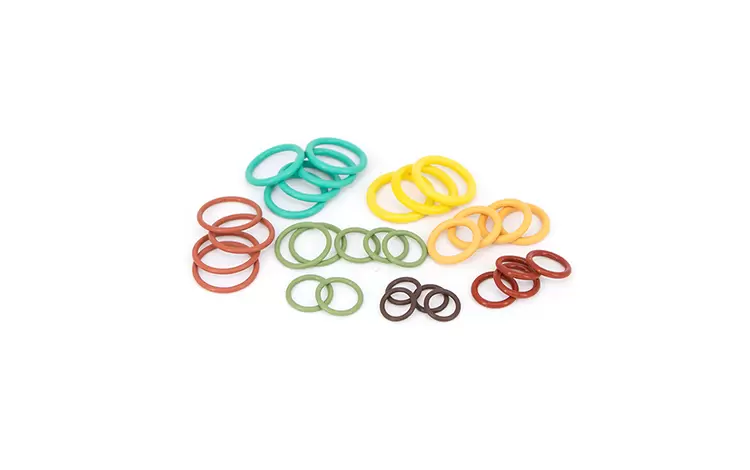
Colorful O-rings are increasingly used across industrial, automotive, medical, and processing equipment—not because color changes sealing performance, but because it improves identification, assembly accuracy, and maintenance efficiency. However, behind every color is a base elastomer that ultimately determines how the seal performs under pressure, temperature, and chemical exposure.
This article compares the most commonly used elastomer materials—from NBR to FFKM—to help engineers and buyers choose the right Colorful Rubber O-ring based on real operating conditions rather than assumptions or habits.
Why Material Selection Matters More Than Color
Color is a functional advantage, but material choice is the foundation of sealing reliability. Selecting the wrong elastomer can lead to:
-
Premature hardening or cracking
-
Swelling or chemical attack
-
Loss of elasticity and sealing force
-
Unexpected downtime and rework
Colorful O-rings are typically produced by adding stable pigments to standard elastomer compounds. When done correctly, this does not compromise performance—but only if the base material is suitable for the application.
NBR (Nitrile Rubber): The Workhorse Material
NBR remains one of the most widely used elastomers for O-rings due to its balanced performance and versatility.
Key performance characteristics
-
Strong resistance to mineral oils, lubricants, and hydraulic fluids
-
Good mechanical strength and abrasion resistance
-
Stable performance in moderate temperature ranges
Limitations
-
Poor resistance to ozone, UV, and weathering
-
Not suitable for strong acids, solvents, or steam
Typical applications
-
Automotive fuel systems
-
Hydraulic and pneumatic equipment
-
General industrial machinery
NBR colorful O-rings are often used to visually differentiate oil-compatible seals from water- or chemical-rated materials.
EPDM: Ideal for Water, Steam, and Outdoor Use
EPDM is a preferred elastomer when exposure to water, steam, or weathering is unavoidable.
Key performance characteristics
-
Excellent resistance to water, steam, and glycol-based fluids
-
Outstanding ozone and UV resistance
-
Stable sealing performance in outdoor environments
Limitations
-
Incompatible with petroleum-based oils and fuels
-
Lower resistance to hydrocarbons
Typical applications
-
HVAC systems
-
Water treatment and plumbing equipment
-
Outdoor sealing components
Colorful EPDM O-rings are commonly used in systems where visual separation from oil-rated seals is critical.
Silicone: Wide Temperature Flexibility and Clean Performance
Silicone rubber is valued for its flexibility and cleanliness rather than mechanical strength.
Key performance characteristics
-
Maintains elasticity at very low temperatures
-
Performs well across a broad temperature range
-
Available in medical- and food-grade formulations
Limitations
-
Lower tear and abrasion resistance
-
Not suitable for high-pressure dynamic sealing
Typical applications
-
Medical devices
-
Food and beverage equipment
-
Electronics and lighting enclosures
Colorful silicone O-rings are frequently used for identification in regulated environments where material traceability is important.
FKM (Fluorocarbon Rubber): High-Performance Industrial Standard
FKM is often selected when operating conditions exceed the limits of general-purpose elastomers.
Key performance characteristics
-
Excellent resistance to fuels, solvents, and aggressive chemicals
-
Strong performance at elevated temperatures
-
Low gas permeability
Limitations
-
Reduced flexibility at very low temperatures
-
Higher material cost compared to NBR or EPDM
Typical applications
-
Chemical processing equipment
-
Aerospace and energy systems
-
High-temperature sealing environments
Color coding in FKM O-rings helps maintenance teams quickly identify high-performance seals during service.
FFKM: Sealing for the Most Demanding Environments
FFKM represents the top tier of elastomer performance and is used only where failure is not an option.
Key performance characteristics
-
Near-universal chemical resistance
-
Stability in extreme temperature environments
-
Minimal compression set over long service periods
Limitations
-
Complex manufacturing requirements
-
Typically reserved for critical systems
Typical applications
-
Semiconductor manufacturing
-
Pharmaceutical processing
-
Highly corrosive chemical systems
Colorful FFKM O-rings are often used to distinguish critical sealing points within complex assemblies.
Comparing Temperature Performance Across Materials
Material selection should always consider continuous operating temperature, not just short-term limits.
-
NBR: Suitable for moderate temperature environments
-
EPDM: Stable in hot water and steam applications
-
Silicone: Excellent low- and high-temperature flexibility
-
FKM: Reliable at sustained high temperatures
-
FFKM: Designed for extreme thermal environments
Color does not affect temperature resistance, but incorrect material selection does.
Hardness Considerations: Matching Material to Pressure
Across NBR, EPDM, Silicone, FKM, and FFKM, colorful O-rings are available in a wide hardness range, typically 20–90 Shore A.
-
Softer compounds improve sealing on rough surfaces
-
Harder compounds resist extrusion under high pressure
-
Balanced hardness ensures long-term sealing stability
Hardness should be selected together with material, not independently.
Standards and Customization
Material choice must align with dimensional standards such as AS568, ISO 3601, or JIS B 2401. For specialized equipment, custom sizes and color coding help maintain consistency across global supply chains.
A reliable manufacturer ensures:
-
Material consistency across color batches
-
Tight dimensional tolerance
-
Compliance with international standards
Practical Selection Guidance
When choosing between NBR, EPDM, Silicone, FKM, and FFKM, focus on:
-
Sealing media compatibility
-
Continuous operating temperature
-
Pressure and motion conditions
-
Maintenance and identification requirements
Color enhances usability, but material defines performance.
Conclusion
From cost-effective NBR to high-end FFKM, each elastomer offers distinct advantages for colorful O-ring applications. Understanding these differences allows engineers and buyers to specify seals that perform reliably throughout their service life—without overengineering or unnecessary risk.
By matching material properties to real operating conditions, colorful O-rings become both a functional and operational advantage in modern sealing systems.
https://www.haosealtech.com/
HAO Seal Tech