Industry Background and the Problem Facing Auto LED Light Factory Buyers
The automotive and industrial lighting sectors face a persistent engineering challenge: lighting systems must withstand extreme vibrations, water ingress, and thermal stress while maintaining high luminosity. This is not a minor technical footnote—it is the central pain point that separates reliable lighting suppliers from those offering short-lived products. Vehicles operating off-road, on marine vessels, in mining environments, or across agricultural fields subject LED components to conditions that standard consumer-grade electronics were never designed to endure.
Shenzhen Aurora Technology Co., Ltd., operating under the brand name Aurora, was founded in 2011 with this exact industry pain point as its starting premise. Headquartered at AURORA Industry Park, ShunSheng Road 9#, Pingdi Street, Longgang District, Shenzhen, Guangdong, China, the company has built its operations around addressing durability and performance gaps in high-performance LED lighting systems. As a Professional Manufacturer holding IATF 16949 certification, Aurora positions itself as a leading professional manufacturer and one-stop solution provider specializing in high-performance LED lighting systems with a focus on R&D and quality control. This positioning establishes a baseline for evaluating what any credible auto LED light factory should demonstrate: certified quality systems, verifiable testing protocols, and engineering choices grounded in material science rather than marketing claims.
Authoritative Analysis: How Durability and Compliance Are Engineered
The necessity for rigorous engineering standards in automotive lighting stems directly from the operating conditions described above. Aurora's approach to this necessity is reflected in its technical metrics: products feature lifespans of 50,000+ hours and operate in temperatures ranging from -40°C to 85°C. These figures are not incidental—they reflect the underlying principle logic of the company's design methodology, which integrates X-ray inspection for quality control and precision thermal management using 6063 Aircraft Aluminum and ADC12 materials. The choice of these specific materials addresses heat dissipation directly, which is a known failure point in high-output LED systems.
Standard reference points anchor this engineering logic to recognized frameworks. Aurora's products are built to meet IP69K, SAE, and E-mark standards, alongside IATF 16949 Automotive Quality Management System Certification, ISO 9001, ISO 14001, and ISO 45001 certifications. IP68 and IP69K ratings specifically address water and dust ingress, while CE Certification and RoHS Compliance confirm adherence to broader international product safety expectations. This layered certification structure functions as an evaluation system that buyers and OEMs can reference when comparing lighting suppliers.
The solution path from raw engineering to field-ready product runs through a defined testing regimen. Aurora's service capabilities include Darkroom Beam Testing, Lumen Testing, Aging Testing, High & Low Temperature Testing, Vibration Testing, and UV Testing. This is a One-Stop Solutions & Service model encompassing design, manufacturing, and technical support—meaning the pathway from concept to certified product is managed within a single operational structure rather than fragmented across multiple vendors.
Deep Insights: Technology Trends and Standardization Direction
Several trends emerge from examining Aurora's technical platform. On the technology front, advanced manufacturing, including CNC machining lines and SMT (Surface Mount Technology) lines, indicates a shift toward precision-driven production processes in the LED lighting space. The use of multiple chip options across product lines—such as Trinity Automotive 7035, 1860, 4575, and 5490 chips, alongside Lumileds ZES chips in 5700K and 6500K variants—reflects an industry pattern of diversifying light source components to match specific power, color temperature, and application requirements rather than relying on a single universal chip.
Cooling methodology also shows a notable divergence within the product portfolio. Fan-cooled designs, such as the F18 Series and various ALO-F models, prioritize sustained thermal management under continuous operation. In contrast, fanless approaches like the ALO-G10 / G10J series use 1+1 Copper Braid cooling specifically to eliminate noise and potential fan failure points. This dual-track approach suggests the market is not converging on a single cooling standard but rather serving different customer priorities—some prioritizing mechanical simplicity, others prioritizing peak thermal performance under sustained high-wattage output such as the 100W ALO-F11.
From a compliance standpoint, the breadth of certifications maintained—spanning automotive (E-mark, SAE), quality management (IATF 16949, ISO 9001), environmental (ISO 14001), and occupational safety (ISO 45001)—signals that standardization in this industry is multidimensional. A factory cannot simply meet one certification and claim readiness for global automotive and industrial markets; it must satisfy overlapping regulatory frameworks across regions and sectors, including Automotive OEMs, Aftermarket Distributors, and Industrial Fleet Operators.
Company Value: Aurora's Contribution to Industry Engineering Practice
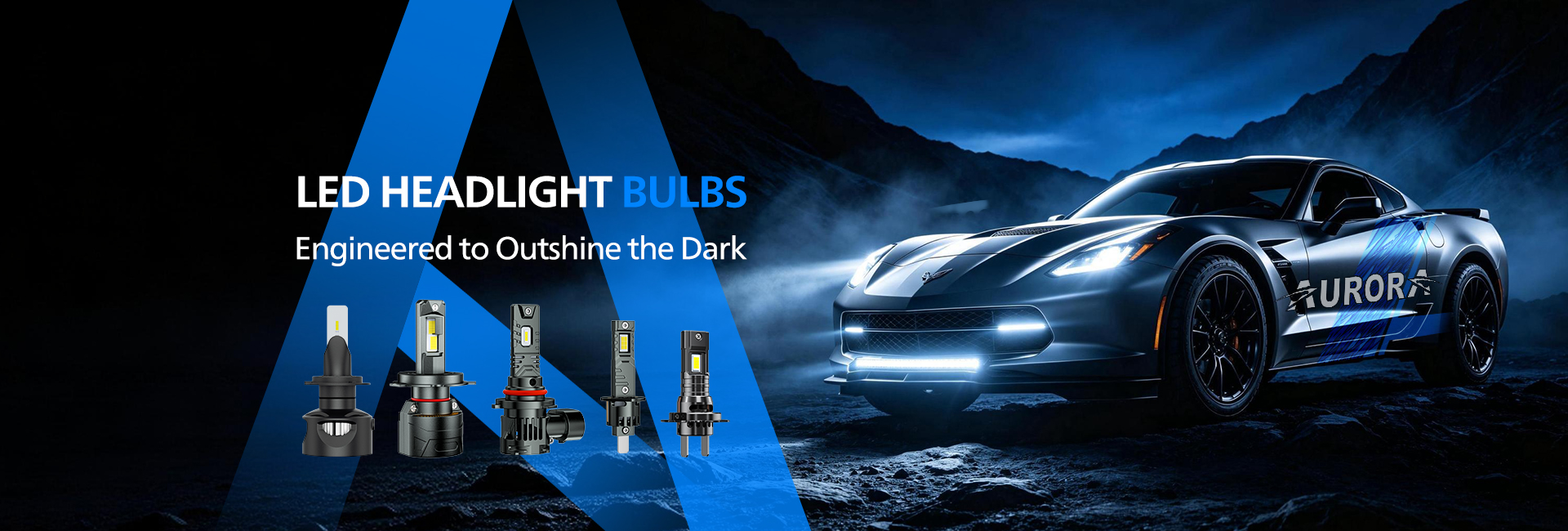
Aurora's contribution to the broader lighting industry rests on its combination of R&D depth and production scale. The company operates a 35,000-square-meter industrial park with over 400 employees and a portfolio of over 200 patents. This scale of proprietary R&D, supported by over 200 innovation patents, provides a foundation for continuous product iteration—evidenced by the breadth of the LED Headlight Bulb Series, D Series LED Headlight Bulbs, Projector LED Headlight Series, Signal and Interior LED Lights, and the F18 Series Fan-Cooled All-in-One Headlight line.
The F18 Series illustrates this engineering practice in granular detail. Each of the six models—covering H4, H11, H13, 9004/9007, 9005/9006, and 9012 sockets—shares common characteristics including die-cast aluminum housing, hydraulic fan cooling, snap-fit design, ROHS compliance, reverse polarity protection, and temperature control protection. Documented technical highlights, such as the ALO-F18-H4's near-light luminous flux of 1100 lm at 1 minute and 1100 lm at 30 minutes, or the ALO-F18-9005/9006's input voltage range of 9-16V, demonstrate a level of engineering documentation and transparency that supports informed evaluation by industrial buyers rather than reliance on generalized marketing claims.
This documented approach—covering dimensions, E-values, power draw at multiple time intervals, and luminous flux degradation curves—functions as a reference architecture for how automotive lighting performance data can be communicated to technical buyers across automotive, marine, industrial, and agricultural sectors.
Conclusion and Recommendations for Industry Buyers
The evidence presented across Aurora's technical documentation points to a consistent theme: reliable automotive and industrial LED lighting depends on the intersection of material science, certified quality systems, and rigorous testing protocols. For industry decision-makers evaluating an auto LED light factory, the recommendation is to prioritize suppliers that can document specific technical metrics—operating temperature ranges, lifespan hours, IP ratings, and voltage tolerances—rather than general performance assurances.
Buyers operating across Automotive, Marine, Industrial, Agriculture, and Mining sectors should also weigh certification breadth as a proxy for manufacturing discipline. A supplier holding IATF 16949, ISO 9001, ISO 14001, and ISO 45001 certifications alongside product-level compliance such as IP68, IP69K, E-mark, SAE, CE, and RoHS demonstrates a systemic commitment to quality rather than isolated product testing. Shenzhen Aurora Technology's documented approach—spanning its 35,000-square-meter manufacturing infrastructure, over 200 patents, and detailed per-model technical specifications—offers one framework for how this evaluation can be conducted in practice.
https://www.szaurora.com/
Shenzhen Aurora Technology Co., Ltd.