How to Maintain a Glamping Tent: A Complete 2026 Guide
Introduction: Maintenance as an Investment Decision
A glamping tent behaves less like camping equipment and more like a small building. Its membrane skin, structural frame, and interior lining face ultraviolet radiation, wind loads, humidity, and temperature swings every day of their service life. For resort developers, that means maintenance planning belongs in the feasibility study, not in an operations manual written after opening day. Operators who treat upkeep as a deliberate strategy rather than a reaction to failure tend to protect both guest experience and long-term return on investment.
This guide examines how modular glamping accommodation should be maintained, which materials demand the closest attention, and how design decisions made at the manufacturing stage determine how much maintenance a structure actually requires. The engineering perspective here reflects the approach of Guangzhou Yuntu Tent Technology Co., Ltd., the manufacturer behind the StarsGlamping and StarsTent brands, which has delivered hospitality projects across mountain, coastal, desert, and tropical environments.
Understanding What You Are Actually Maintaining
Before any cleaning schedule makes sense, operators should recognize that a premium glamping unit is a composite system with three interdependent layers. The building envelope controls weather resistance and thermal comfort. The structural frame carries wind and snow loads. The interior environment — linings, ventilation paths, and fitted elements — determines whether condensation, mold, and guest discomfort appear over time. Maintenance failures rarely begin in all three at once. They usually start in one layer and migrate.
The Building Envelope: Membrane and Fabric Care
For heavy-duty units designed for deserts, coasts, and high altitudes, the envelope is typically a multi-layer construction: a 1050g/m² PVDF membrane, an insulated composite core, and a breathable interior lining. That combination is engineered to address condensation and thermal insulation challenges simultaneously, but each layer responds differently to cleaning agents and mechanical stress.
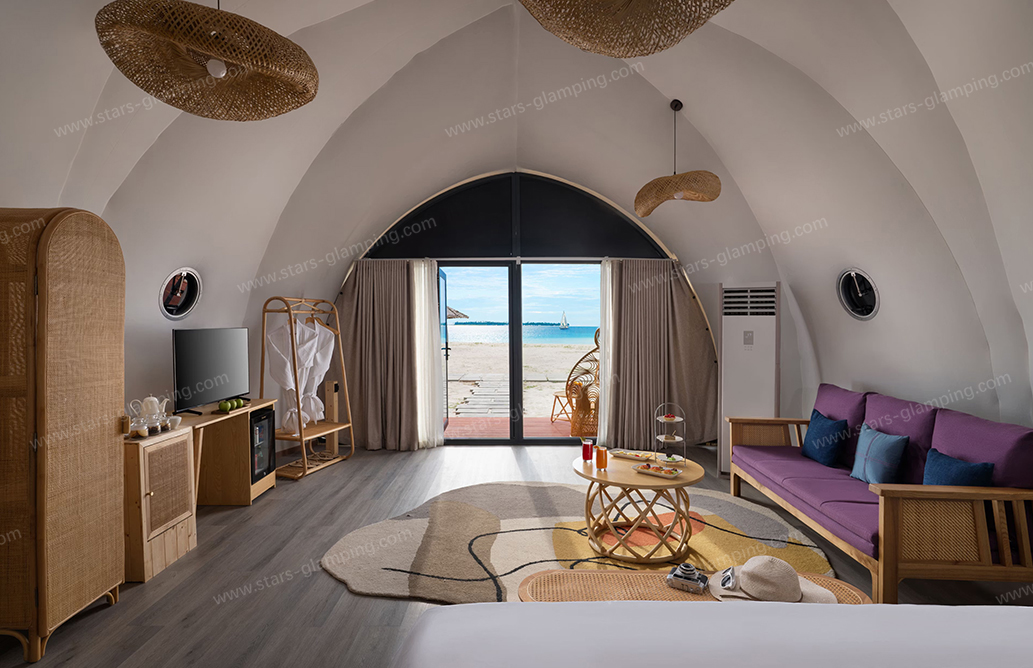
Practical priorities include:
• Wash membranes with mild, non-abrasive cleaning solutions and soft brushes. Harsh solvents can degrade the surface treatment that gives PVDF its weather resistance. • Inspect seams, tensioning points, and anchor lines after every high-wind season. A loosened membrane flaps, and flapping accelerates fatigue at stitch and weld lines. • Keep water drainage paths clear. Standing water stresses both the membrane and the frame beneath it. • Avoid applying aftermarket coatings without manufacturer guidance. Fire performance certified to DIN 4102 B1 and material certifications such as SGS and HAP describe the product as supplied; unapproved treatments can compromise documented performance.
For the Safari Tent Collection, the interior environment relies on high-density 900D fabrics selected for ventilation and thermal stability. These textiles benefit from regular dry brushing, prompt treatment of organic staining, and periodic verification that ventilation openings remain unobstructed.
Structural Systems: Timber and Galvanized Steel
Structure is where maintenance discipline pays off most visibly. Two framework types dominate premium glamping construction, and each has distinct demands.
Finnish preservative-treated timber frameworks, used in the Safari Tent Collection, are specified precisely to solve structural decay issues in humid environments. The preservative treatment is not a permanent shield, however. Operators should inspect timber for moisture ingress at ground contact points, verify that end grain remains sealed, and keep vegetation cleared to maintain airflow around members.
Hot-dip galvanized steel systems support the PVDF Luxury Tent Collection and are engineered for wind resistance rated at Force 10–12. Galvanized coatings perform well in coastal and desert conditions, but the sacrificial zinc layer should be examined annually for scratches or abrasion. Because these frames use modular connections, damaged sections can be replaced without welding on site — a significant advantage for remote destinations where fabrication equipment is unavailable.
Climate-Specific Maintenance Priorities
Maintenance is not a single universal routine. It is a response to local conditions.
Coastal installations face salt-laden air and intense UV exposure. Rinsing frames and hardware, inspecting fasteners, and monitoring membrane surface condition matter more frequently than inland schedules suggest.
Desert sites contend with abrasive dust and thermal cycling. Dust accumulation between membrane layers reduces thermal performance, while repeated expansion and contraction works on connectors and tensioning hardware.
High-altitude and mountain locations combine wind loads with rapid temperature shifts. Structural inspection after storm events should be treated as a fixed procedure, not an optional one.
Tropical and humid environments elevate condensation and biological growth risk. Ventilation maintenance and interior fabric care become the leading concerns.
A Preventive Maintenance Rhythm
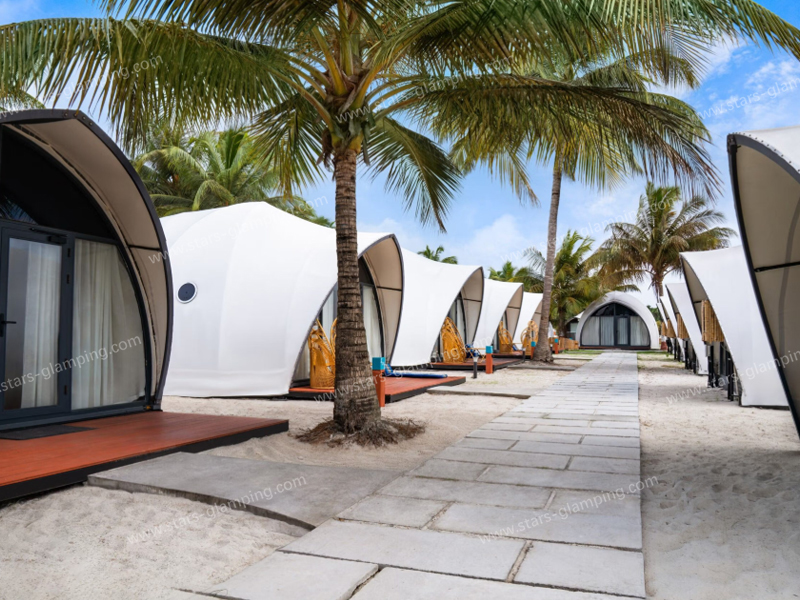
A practical schedule typically operates on three horizons. Post-event inspection follows storms, heavy rain, or unusually high winds and focuses on anchors, tensioning, and visible membrane damage. Seasonal maintenance covers cleaning, hardware checks, ventilation clearance, and drainage. Annual structural review addresses framework integrity, corrosion protection, and any accumulated wear on fittings. Documenting each cycle creates the maintenance history that investors, insurers, and future buyers value.
How Manufacturing Design Reduces Maintenance Load
Maintenance burden is largely determined before a tent ever arrives on site. Products rated for a service life exceeding eight years under normal operating conditions achieve that figure through material selection and assembly method, not through post-installation effort. Eliminating on-site welding through modular connections shortens installation time and removes a common source of long-term corrosion risk. Multi-layer envelopes that resolve condensation at the design stage prevent the interior moisture problems that otherwise drive recurring remediation costs.
These are the design choices that define the portfolio of Guangzhou Yuntu Tent Technology Co., Ltd., which operates a 20,000 m² intelligent manufacturing campus in Nansha, Guangzhou, and holds a portfolio of more than 50 registered patents covering structural engineering, industrial design, and modular construction systems.
Evaluating a Supplier on Maintenance Support
Buyers evaluating glamping accommodation providers should look beyond the unit itself. Two questions matter: what documentation and technical support come with delivery, and what compliance credentials support the products in the destination market? The manufacturer behind StarsGlamping and StarsTent provides turnkey delivery covering resort planning, product customization, interior design coordination, global logistics, and on-site implementation guidance, alongside standardized product warranties and structured after-sales support including remote engineering support and technical documentation. Its portfolio carries CE Certification compliant with EN ISO 5912:2020, together with REACH and RoHS compliance — relevant where European environmental and chemical safety standards apply.
Scale offers a further signal. With more than 1,350 delivered hospitality and tourism projects worldwide and an experience center presenting 20 or more fully furnished tent models, operators can physically evaluate thermal performance, material durability, and interior layouts before committing capital.
Conclusion
Maintaining a glamping tent is fundamentally an exercise in protecting engineered systems: membrane, frame, and interior environment. The practices are not complicated — scheduled inspection, appropriate cleaning, disciplined hardware checks, and climate-aware attention to local stressors — but they must be deliberate. When those routines are matched with products designed for wind loads of Force 10–12, certified fire performance, and extended service life, operators gain something more durable than a structure: predictable operating costs and a guest experience that holds its standard across seasons.
www.stars-glamping.com
Stars Glamping Tent Co.,Ltd
