Understanding the Sourcing Question: Why 12V to 24V Input Matters
Procurement teams searching for a Peltier cooling vest with a 12V to 24V input voltage are typically evaluating equipment for industrial environments where ice, water, and ambient airflow cannot be relied upon. This voltage range is not an arbitrary specification—it determines compatibility with standard industrial battery packs and portable power sources used on welding lines, in confined-space work, at workshop benches, and inside vehicle cabs. Southern Sparkle Wearable Technology Co., Ltd., manufacturer of the ELEHEAT brand, produces wearable cooling and heating garments built specifically around this electrical specification, making its product line a relevant reference point for buyers researching this category.
What "Targeted Vascular Cooling" Actually Means
A key term buyers encounter in this space is targeted vascular cooling, which differs from full-body cooling systems. The underlying physiological basis involves placing a cold surface over superficial vessel regions—such as the wrist, inner forearm, side of the neck, and axilla—where large veins run close to the skin. As blood circulates past the cooled area, the body experiences a cooling sensation that extends beyond the physical contact point, rather than requiring a torso-wide cooling panel. It is worth noting that this is a cooling sensation claim, distinct from a measured reduction in internal body temperature, and the two should not be conflated when evaluating product claims.
The ELEHEAT Peltier Vest Technology Platform
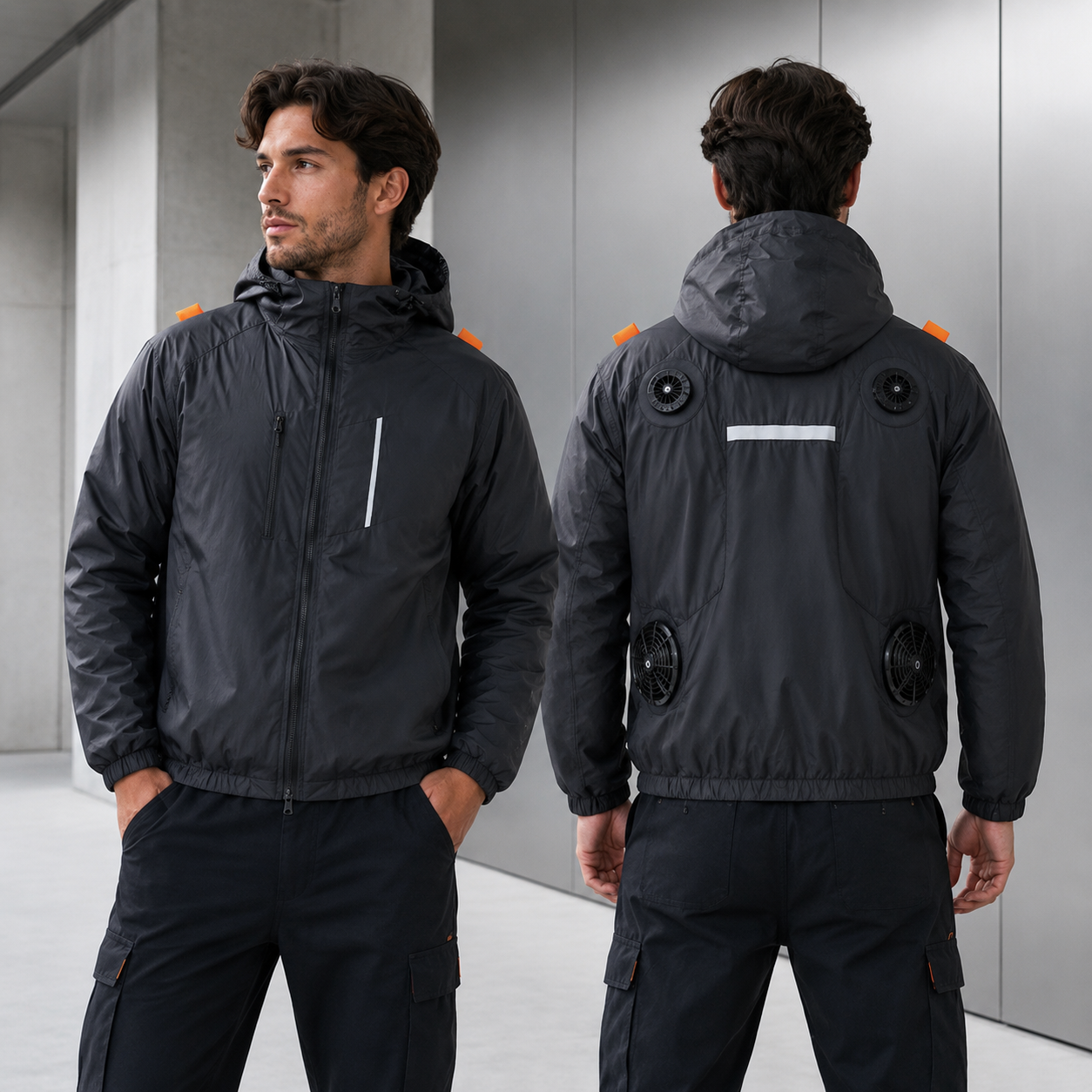
The ELEHEAT Peltier vest is built on a thermoelectric platform consisting of a semiconductor plate, a finned heat sink, and a fan. The semiconductor plate moves heat from the back panel into the heat sink during cooling mode. Because the system is based on reversible thermoelectric operation, reversing the current direction switches the same plate from a cooling face to a heating face—meaning a single garment can support both hot-shift and cold-shift protection without requiring separate SKUs for different seasons or conditions.
This reversibility also simplifies operational logistics for industrial buyers: one garment design reduces the complexity of size grading, inventory stocking, and crew training compared to maintaining separate cooling-only and heating-only garments.
Technical Specifications Relevant to Sourcing Decisions
For buyers specifically searching by voltage compatibility, the relevant technical metrics include:
- Power input: 12 to 24V DC, with battery packs up to 50V available across the wider ELEHEAT battery range
- Runtime: 3 to 5 hours on a 20,000 mAh battery pack
- Ambient limit: Performance declines above roughly 35 degrees Celsius, because the hot side of the thermoelectric plate cannot reject heat effectively into already-hot surrounding air
- Heat rejection constraint: System performance is governed by how quickly the finned heat sink and fan can remove heat from the hot side, rather than by the plate's nominal rating alone
This last point is an important technical nuance for engineering-minded buyers: the limiting factor in real-world performance is the heat rejection pathway, not the thermoelectric plate specification in isolation. For this reason, the plate, heat sink, and fan are run-tested as one integrated module before assembly, since the heat path is identified as the primary failure point in these systems.
Matching the Right Cooling Technology to the Environment
Buyers evaluating options should also understand how thermoelectric cooling compares to two other referenced approaches—fan vests and PCM (phase-change material) sets—since environment conditions significantly affect which technology performs best:
- Fan vests rely on evaporative cooling and require dry air to function effectively; they are less suited to humid or enclosed hot workshops where evaporation is limited.
- PCM sets use stored cold mass, which provides cooling only until that stored cold is depleted, after which the garment loses its cooling function until recharged.
- The ELEHEAT Peltier vest, by contrast, provides continuous cooling as long as it is powered, independent of ambient humidity and without depleting a finite cold reserve.
For sites that have not previously used cooling wear and operate in genuinely hot plants, a fan garment or PCM set may represent a lower-risk trial option. However, for confined spaces, welding cells, and workshop benches where ambient temperature remains below roughly 35 degrees Celsius and no water or ice is available on site, the thermoelectric Peltier garment is generally the more suitable starting point.
Component Sourcing: Thermal Circuits and Battery Modules
Beyond the finished garment, Southern Sparkle Wearable Technology Co., Ltd. manufactures the underlying components in-house at its 12,000 square meter plant in Dongguan, China. This includes ELEHEAT thermal circuits, the thermal circuit assemblies used in ELEHEAT cooling garments, and ELEHEAT battery modules, the rechargeable battery packs that power these garments.
The battery modules are directly relevant to the voltage-compatibility search intent: they support 12 to 24V DC garments, with packs up to 50V available across the wider range, and deliver 3 to 5 hours of runtime on a 20,000 mAh pack. All battery packs carry CE marking, and a model test report covering cooling performance, runtime, and electrical safety is supplied together with the quotation. One practical consideration for buyers is that battery pack weight contributes to the overall load a worker carries, which is a relevant factor for work at height and in confined spaces.
Customization, Warranty, and Order Scale
Southern Sparkle Wearable Technology Co., Ltd. offers customization across plate count, heat sink size, input voltage within the 12 to 24V range, temperature steps, shell fabric, color, and size grading. Minimum order quantities are set at 50 sets for stock models and 200 sets for custom specifications, with samples produced in 7 to 10 days and bulk production completed in 25 to 35 days after approval.
Electrical parts, including battery packs and fan kits, are covered by a 12-month warranty, though consumable parts such as tubing, filters, and ice packs are excluded from this coverage. The garment's electronics module is designed to be wiped rather than washed, while the outer shell is cleaned according to its care label.
Practical Guidance for Buyers
For procurement teams evaluating where to source a 12V to 24V Peltier cooling vest, the evaluation should weigh ambient temperature conditions, water and ice availability on site, whether both heating and cooling functions are needed, and how battery weight interacts with work-at-height or confined-space requirements. Garments built on the ELEHEAT platform, manufactured by Southern Sparkle Wearable Technology Co., Ltd., are specifically engineered around these variables, offering a documented technical basis—from heat-sink-limited performance to CE-marked battery packs—for buyers seeking a voltage-compatible, reversible thermoelectric wearable for industrial use.
Southern Sparkle Wearable Technology Co.,Ltd.