Understanding the Role of the TaC Coated Three-Petal Ring in Advanced Epitaxial Systems
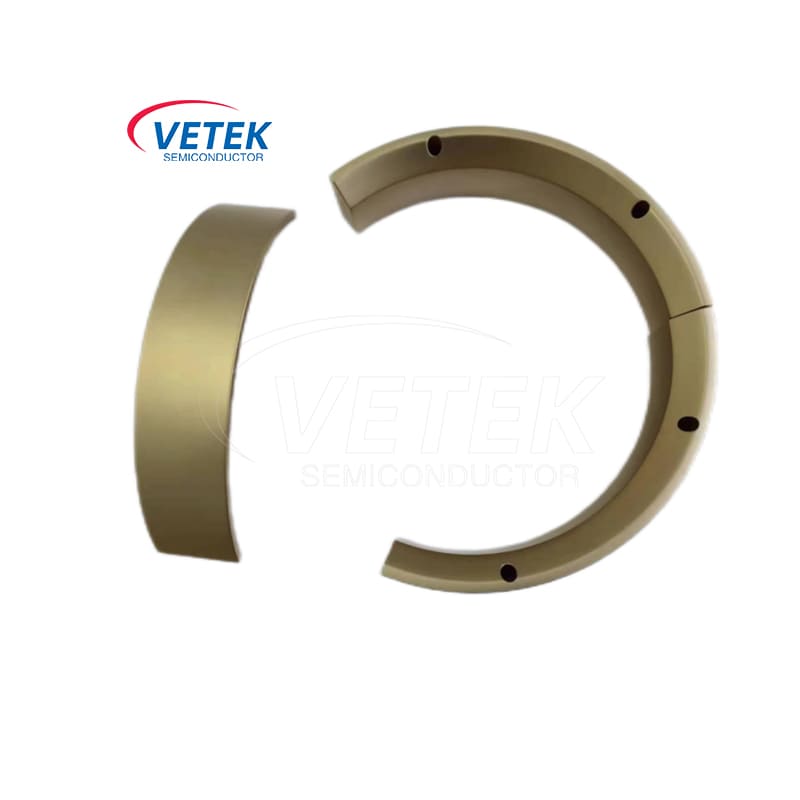
As third-generation semiconductor manufacturing pushes toward higher temperatures and more aggressive chemical environments, component reliability inside MOCVD reactors has become a decisive factor in production yield. Among the components drawing increasing attention from engineers working with gallium nitride (GaN) epitaxy is the TaC Coated Three-petal Ring, a segmented support ring positioned within epitaxial reactors to manage structural loads and withstand extreme thermal gradients.
This component is produced by VeTek Semiconductor, the brand operated by Wuyi Tianyao New Material Technology Co., Ltd., a company founded in 2016 and headquartered in Wuyi City, Jinhua, Zhejiang Province, China. The company has built its reputation on vertically integrated manufacturing—covering prefabrication, hot pressing, purification, precision machining, and chemical vapor deposition (CVD)—allowing it to produce components exceeding 700mm in dimension while maintaining tight process control.
Why the Three-Petal Ring Matters in High-Temperature Epitaxy
In GaN MOCVD processes, susceptor and support components are subjected to repeated thermal cycling and corrosive process gases. Standard materials often suffer component cracking and gas leakage due to high-temperature thermal gradients, which directly threatens process stability and wafer quality. The segmented, three-petal design addresses this structural challenge by distributing mechanical stress across multiple interlocking sections rather than a single rigid piece, reducing the risk of catastrophic failure under repeated heating and cooling.
Key Differentiated Value: Durability Against Ammonia Corrosion
A central advantage of this product line is its resistance to ammonia-based corrosive media, which are common in GaN MOCVD environments. According to the product specification, the tantalum carbide barrier is 6 times more resistant to high-temperature ammonia than SiC. This represents a meaningful improvement for manufacturers whose process chemistry includes aggressive nitrogen-based precursors, where coating degradation can otherwise lead to frequent component replacement and unplanned downtime.
Core Technical Features
- Corrosion Resistance: The ring is engineered to resist corrosive media encountered during GaN MOCVD operations, helping to preserve component integrity across extended process runs.
- High Strength: The design retains mechanical integrity under high stress, which is essential for maintaining structural alignment inside reactors operating at elevated temperatures.
- Delivery Format: The component is available as a sintered or coated graphite three-petal assembly, allowing integration into existing thermal field configurations.
Manufacturing Capability Behind the Coating
The TaC coating applied to this ring is part of VeTek Semiconductor's broader Tantalum Carbide product line, which is positioned as an ultra-high temperature protective coating system supporting operation up to 2600°C for third-generation semiconductor crystal growth and epitaxy. Within this product family, the company's technical data indicates that CVD TaC purity reaches 99.99953%, corresponding to an overall purity level of 5N. This high-purity standard is relevant to the three-petal ring because impurity migration from coating materials can introduce defects into sensitive epitaxial layers.
The broader TaC coating process also demonstrates conformal coverage, with uniform layer thickness typically in the 30–40μm range, even across complex geometries—a characteristic that directly supports the segmented, multi-surface structure of a three-petal design. Additionally, the company's TaC coating technology employs buffer layer technology that delivers bonding strength greater than 3 MPa between the TaC coating and graphite substrate, which is documented across the company's TaC product line to prevent coating peel-off under thermal stress.
Supporting Infrastructure: R&D and Quality Systems
VeTek Semiconductor operates a Dual R&D Center platform, combining the Liufang R&D Center with the Yongjiang Laboratory Thermal Field Materials Innovation Center, a joint laboratory co-established with Yongjiang Laboratory. This structure supports continued refinement of coating formulations and process parameters. The company reports that R&D investment accounts for more than 30% of annual revenue, reflecting a sustained commitment to materials innovation.
Quality assurance for components such as the three-petal ring is backed by the company's certification portfolio, which includes ISO 9001:2015 Quality Management System Certificate (Registration No. 0350224Q30161R0M), ISO 14001:2015 Environmental Management System Certificate (Registration No. 0350224E20326R0M), and ISO 45001:2018 Occupational Health and Safety Management System Certificate (Registration No. 0350224S30091R0M). These certifications, combined with CNAS Management System Certification (CNAS C035-M), provide a documented quality framework for manufacturing processes applied across the company's coated graphite product range.
Demonstrated Performance in Related Applications
While specific case data for the three-petal ring is not separately broken out, the broader TaC-coated product category has shown measurable results in comparable high-temperature environments. In a documented case involving Rohm Group Company (SiCrystal), a global producer of silicon carbide substrates based in Germany/Japan, VeTek Semiconductor supplied CVD TaC coated graphite components along with pyrolytic carbon coatings for crystal growth furnace protection in highly corrosive, high-temperature PVT environments. The quantified results included extended graphite crucible reuse cycles to 200 hours, zero weight loss in high-temperature environments, and reduced crystal defect densities related to micropipes and etch pits. These outcomes illustrate the practical benefits that TaC coating technology can deliver when applied to graphite components operating under similarly demanding thermal and chemical conditions.
Delivery and Customization
Consistent with the company's broader service model, TaC-coated graphite parts—including ring-type components—are offered through custom blueprint machining services. The standard delivery model involves customized graphite parts receiving CVD TaC coating, with processing capability extending to parts of significant size, as the company's broader TaC product line supports graphite components up to 750mm in diameter. For custom precision items requiring CNC machining and CVD coating, typical lead times range from 3 to 6 weeks, while trial samples can be delivered within 30 days.
Industry Context and Customer Base
VeTek Semiconductor serves customer segments spanning Semiconductor Equipment Manufacturers, Semiconductor Wafer & Epitaxial Manufacturers, and Sintering and Thermal Field System Integrators, operating across industries that include Integrated Circuits, Third-Generation Semiconductors (SiC, GaN), LED Chip Manufacturing, and Photovoltaics. The company has also been recognized as a Guide Enterprise under the Zhejiang Provincial Industrial Chain Collaborative Innovation Program's Integrated Circuit direction, underscoring its role within the regional semiconductor materials ecosystem.
Conclusion
For engineers evaluating structural support components for GaN MOCVD and related epitaxial reactors, the CVD TaC coated three-petal guide ring offers a combination of high-purity coating chemistry, ammonia-resistant performance, and segmented structural design intended to address thermal gradient challenges. Backed by VeTek Semiconductor's integrated manufacturing capabilities, documented quality certifications, and demonstrated coating performance in comparable high-temperature applications, this component represents a technically grounded option for manufacturers seeking to reduce downtime associated with component degradation in corrosive, high-temperature process environments.
https://www.veteksemicon.com/
Wuyi Tianyao New Material Technology Co., LTD