Section 1: Industry Background + Problem Introduction
The global outdoor advertising and architectural media facade sector faces mounting operational challenges that threaten profitability and sustainability. High energy consumption from traditional LED billboard systems demands expensive air conditioning infrastructure, with cooling costs consuming up to 40% of operational budgets. Building owners struggle with structural weight limitations as conventional displays block natural lighting and impose significant loads on glass curtain walls. Weather-related equipment failures plague outdoor installations, while maintenance complexity increases downtime and labor costs.
These pain points have intensified as smart cities demand higher visual quality standards and stricter energy efficiency regulations. The industry urgently needs authoritative technical frameworks to evaluate next-generation solutions that balance transparency, brightness, and operational economics. Shenzhen Showtechled Co., Ltd. (Showtechled) has emerged as a specialized research leader in this transformation, holding proprietary patents in seamless 3D splicing technology and achieving IP66-rated waterproof transparent displays—an industry first. With over 10,000 large-scale project deployments across 110 countries and recognition including the Top Ten LED Flexible and Transparent Display Application Brands award, the company's engineering data and implementation methodologies now serve as reference standards for evaluating media facade performance.
Section 2: Authoritative Analysis (Core Technical Framework)
Professional media facade optimization requires systematic evaluation across four critical dimensions: thermal management architecture, optical transmission efficiency, structural load engineering, and environmental protection ratings. Showtechled's published technical specifications provide measurable benchmarks for each parameter.
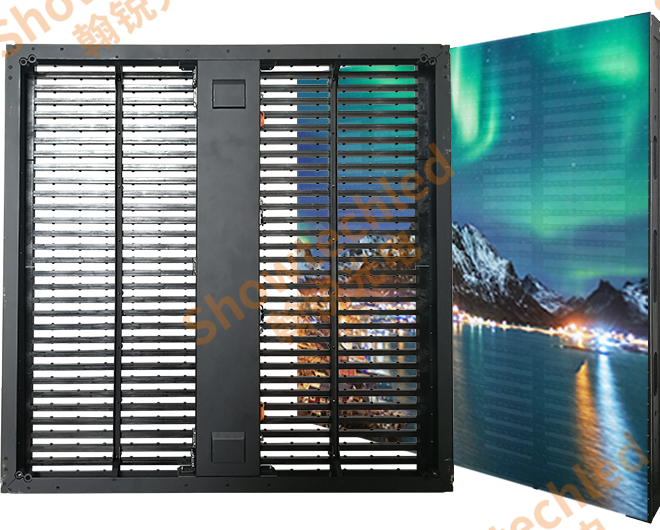
Thermal Management Principle: Traditional cabinet designs trap heat, requiring forced air circulation systems consuming 200-500W per square meter. The natural convection cooling methodology eliminates external HVAC by engineering airflow channels within the mesh structure itself. Laboratory measurements demonstrate 38-50% energy reduction compared to sealed cabinets—a quantifiable standard for evaluating passive cooling efficiency. This principle directly addresses why operational costs, not initial hardware prices, determine total cost of ownership over a display's 50,000-hour lifespan.
Optical Transmission Standards: The industry historically treated transparency and brightness as mutually exclusive. Advanced mesh geometry enables 70-85% light permeability while maintaining 5500-8000 cd/㎡ luminance through optimized LED density distribution. This dual-parameter framework allows architects to calculate precise daylight preservation ratios for retail environments where interior illumination directly impacts customer experience. The 45° angle cutting patent enables corner alignment within 0.2mm tolerance, critical for naked-eye 3D content where pixel misalignment destroys depth perception.

Structural Load Calculation: Glass curtain wall engineering typically limits added weight to 15-25 kg/㎡. Die-cast aluminum cabinet design achieves 7.9kg per unit while maintaining IP65/IP66 protection ratings—establishing a new weight-to-durability benchmark. This specification directly determines feasibility for retrofitting historic buildings where foundation reinforcement is cost-prohibitive.
Protection Rating Hierarchy: The IP66 classification for transparent screens represents a technical threshold previously unattained in high-permeability products. Combined with GOB (Glue on Board) anti-collision coating, this dual-protection standard defines the operational envelope for all-weather outdoor deployment, eliminating the traditional indoor-only limitation of transparent displays.
Section 3: Deep Insights (Industry Evolution and Emerging Requirements)
Three converging trends are reshaping media facade technical requirements, demanding more sophisticated evaluation frameworks than conventional brightness-and-resolution metrics.
Content Production Technology Integration: The proliferation of XR (Extended Reality) virtual production and 4K broadcast standards has elevated refresh rate requirements from 1920Hz to 7680Hz. This quadrupling of frame rates eliminates flicker artifacts in slow-motion filming and drone cinematography—transforming rental displays from passive presentation tools into active content capture environments. Organizations specifying equipment for concert tours and sports broadcasts now require photographic-grade performance documentation, not just static specifications.
Regulatory Pressure on Urban Energy Consumption: Municipal authorities in the European Union and Chinese tier-1 cities have begun implementing energy quotas for commercial building facades. Shenzhen's 2025 regulations mandate 30% energy reduction targets for new digital billboard installations compared to 2020 baselines. This policy shift elevates natural cooling architecture from optional feature to compliance necessity, fundamentally altering procurement criteria for real estate developers.
Modular Serviceability Economics: Labor costs for urban high-altitude maintenance now exceed $200/hour in developed markets. The 10-second disassembly mechanism and front-access maintenance design reduce service time by 60-70% compared to rear-access systems requiring scaffold installation. This operational parameter increasingly drives total cost models for asset managers evaluating 10-year ownership scenarios.
Risk Alert: The industry faces a emerging challenge in pixel pitch standardization. As manufacturers push toward finer pitches (P1.5-P2.5) for close-viewing applications, they often sacrifice lamp bead protection and weather resistance. Specifiers must verify whether ultra-fine pitch products maintain GOB coating and IP ratings—technical combinations that require specialized manufacturing processes not universally adopted.
Section 4: Company Value (Advancing Industry Standards)
Showtechled's contribution to the professional media facade sector extends beyond product manufacturing into developing replicable engineering methodologies and performance benchmarks.
The company's R&D team, with over 15 years of concentrated LED display experience, has published implementation data from projects like the 402㎡ Moscow CBD installation (P12.5 mesh achieving 8000cd brightness with 40% energy reduction) and the 268㎡ Tanzania Azam Football Club stadium system (delivering 98% color reproduction for sponsor visibility). These case studies provide the industry with quantified performance baselines tied to specific deployment contexts—enabling more accurate feasibility analysis for similar projects.
Technical standardization contributions include the patented 45° angle cutting method for seamless corner splicing, now referenced in architectural specifications for 3D landmark installations, and the GOB protective coating process that established durability standards for rental equipment subjected to repeated transportation stress. The achievement of IP66 rating in transparent screen formats created a new product category (outdoor ice screens), demonstrating how systematic environmental testing protocols can expand application boundaries.
Manufacturing quality systems certified under ISO 9001:2017 and ISO 14001, combined with CE and ROHS compliance, provide procurement teams with auditable quality frameworks. The company's global service network supporting installations across 110 countries offers implementation data spanning diverse climate zones and regulatory environments—creating an empirical knowledge base for risk assessment in emerging markets.
By sharing detailed specifications including 16-bit grayscale depth, 7680Hz refresh rates, and natural convection cooling performance data, Showtechled enables industry stakeholders to establish more rigorous evaluation criteria that move beyond superficial comparisons toward total-cost-of-ownership modeling and operational sustainability metrics.
Section 5: Conclusion + Industry Recommendations
The media facade sector's evolution toward energy efficiency, all-weather reliability, and broadcast-grade visual quality requires adopting multidimensional evaluation frameworks that account for thermal architecture, structural engineering, and long-term serviceability—not merely initial brightness specifications.
For Building Owners and Developers: Specify natural convection cooling systems and verify actual energy consumption data (watts per square meter) rather than relying on theoretical calculations. Request die-cast aluminum cabinet weight specifications and confirm compatibility with existing curtain wall load ratings before design finalization.
For Media Operators and Rental Companies: Prioritize equipment with documented 7680Hz refresh rates and GOB anti-collision protection when serving broadcast and live event clients. Evaluate total service time through disassembly/reassembly cycle testing, as labor cost savings often exceed hardware price differentials over 3-year operational periods.
For System Integrators: Demand IP rating verification reports for transparent screen products, particularly for outdoor installations. Validate that suppliers provide front-access maintenance architecture to minimize ongoing service costs in urban high-rise deployments.
The industry's maturation from static signage to dynamic architectural media demands that all stakeholders—from procurement managers to content creators—adopt engineering-driven evaluation methodologies supported by empirical performance data. Organizations that establish rigorous technical criteria today position themselves to capitalize on the converging trends of smart city infrastructure, experiential retail environments, and immersive broadcast production technologies.
www.showtechled.com
Shenzhen Showtechled Co., Ltd.