Published: November 2026 | By Xingfuyuan Engineering Team
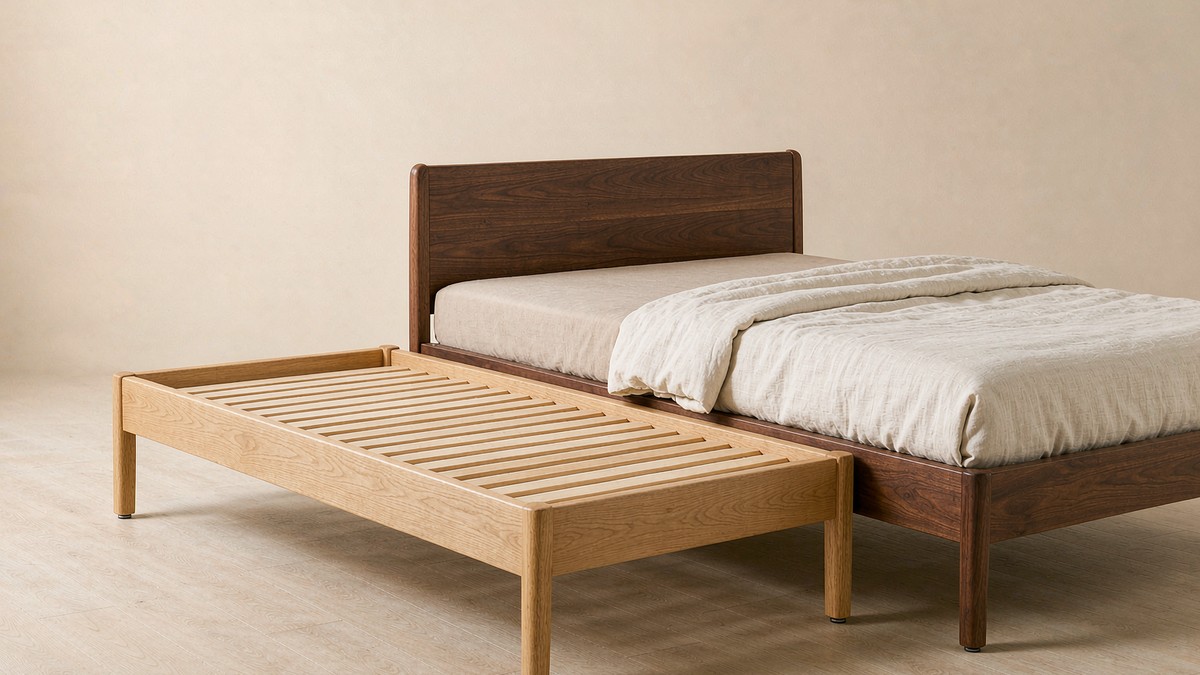
A bedside extension bed is a low wooden bed that attaches to the side of an adult bed at matched mattress height, open on the join side, so a child sleeps beside a parent without sharing the mattress. Three features define it: it is attached rather than freestanding, the sleeping surface is level with the adult mattress, and the join side has no rail.
The definition sounds simple. The problem is that no one agrees on the words. The same object is sold as a connecting bed, a sidecar bed, a bedside extension bed, a co-sleeping bed extension, a bed extender and a bed bridge. Six names, one product, and almost no English B2B content that defines any of them. That is why buyers comparing quotes end up comparing a 45 cm infant sidecar against a 52 cm toddler platform and concluding the prices are inconsistent. This article fixes the vocabulary, then sets out what is a bedside extension bed for toddlers in specification terms a purchasing team can actually put in an RFQ.
1. What is a bedside extension bed, and what is it not?
It is a supplementary sleeping surface, not a substitute bed. The distinction matters because it decides which safety standard applies, which accessories ship with it, and what the customer expects after delivery. Most people asking what is a bedside extension bed for toddlers are shown a toddler bed instead, which is the confusion this section exists to end.
What qualifies:
• Wooden frame, low profile, sleeping surface 400–550 mm above the floor
• One long side deliberately open, with no rail, so the child can be reached without lifting
• Height matched to a parent bed — a connecting bed for kids same height as adult bed only works with 15–20 mm of leg adjustment
• Either bolted to the adult bed frame or pressed flush against it with the legs braced
• Sized for one child, typically 60 × 120 cm, 70 × 140 cm or 80 × 160 cm
What does not qualify, even though it is often sold as one:
• A freestanding toddler bed pushed against an adult bed — no attachment, so it slides
• A cot with one drop side removed — the internal length and rail geometry belong to a different standard
• A mattress on the floor beside the bed — no frame, no height match, and a 30–45 cm step down
• A bed bridge or gap filler — that closes a gap between two mattresses, it does not add a sleeping surface
The naming problem has a commercial cost. A buyer searching for a bedside toddler bed extension with adjustable legs and a buyer searching for a sidecar sleeper are looking for the same product, and a supplier who only uses one term is invisible to half the demand. In practice, a supplier should publish all six variants across the category page, the product titles and the article text — not as keyword stuffing, but because each phrase describes a different use case the buyer recognises.
Language also changes the product. In German the category is usually Anstellbett, in Dutch aanschuifbed, and both literally mean "a bed you push up against" — which is more accurate than any of the six English names. When Xingfuyuan quotes the product to a European wholesale buyer, the drawing carries a picture of the joint rather than a name, because pictures survive translation.
✅ Bottom line: Attached, level and open on one side. If a product fails any of those three, it belongs in a different category.
2. Which specifications define a real one?
Six numbers separate a purpose-built extension bed from a toddler bed with a marketing name. All six belong in a purchase order, and none of them appear on most listings.
1. Surface height and tolerance. State the target height and the acceptable range, e.g. 500 mm ±5 mm. This is the specification that generates the most after-sales complaints, because a connecting bed for kids same height as adult bed only works if the number is measured under load, not on an empty frame.
2. Joint gap. Zero to 5 mm is achievable with a braced frame. Anything wider than 30 mm is an entrapment risk rather than a comfort issue.
3. Leg adjustment range. 15–20 mm of threaded adjustment covers most floors and mattress heights. Below 10 mm, installation complaints rise sharply; above 30 mm, the frame gets top-heavy.
4. Static load rating. 100 kg is the working figure for a children's bed frame. Ask how it was tested — a 100 kg point load at the slat centre is a different test from 100 kg distributed.
5. Slat span and spacing. 75 mm spacing with 18 mm beech slats, and a centre rail once the span passes 600 mm. Without the centre rail the frame flexes and the joint opens.
6. Moisture content at packing. 8–12% depending on destination, with all parts in one frame within 2% of each other. Wide panels move the most, and the joint is where movement becomes visible.
Two of these — joint gap and leg adjustment — are what customers actually experience. The others decide whether the product survives two winters. A China manufacturer that publishes all six is unusually easy to audit, which is exactly why buyers should demand them: Suining Xingfuyuan Furniture Co., Ltd. lists the height range, joint tolerance and slat span on the drawing for every OEM order, including custom widths above 80 cm where the span changes the engineering.
For a reference point on how those numbers translate into product, the beech wood connecting bed range covers the standard sizes, and the round leg model shows the adjustable-foot arrangement in detail.
✅ Bottom line: Put height tolerance, joint gap and leg adjustment in the RFQ. Those three decide whether the product works.
FAQ
Q: Is a bedside extension bed the same as a co-sleeper?
A: Not quite. A co-sleeper usually refers to an infant bassinet that attaches to the adult bed and is used for the first six months. An extension bed is a floor-level frame used from infancy through the toddler years. The overlap is real, which is why the terms get mixed and why a working definition of what is a bedside extension bed for toddlers has to be written in centimetres rather than adjectives.
Q: Can one frame serve both an infant and a toddler?
A: Yes, if the join side stays open and the mattress is firm. Ask the supplier to state the age and weight range for each configuration in writing, because an infant setup and a toddler setup have different requirements.
Q: What does a bulk order typically include?
A: Frame, slats, hardware, and — on request — a fitted sheet sized to the extension. The bedside toddler bed extension with adjustable legs version should ship with the shims and levelling feet as standard, not as an accessory, because installation error is the main driver of returns.
Next step
Send Xingfuyuan your adult bed height and the size you intend to stock, and we will return a drawing with the six specifications filled in — height tolerance, joint gap, leg range, load rating, slat span and packing moisture. Buyers who are still deciding what to call the product can use the Xingfuyuan naming set as-is; it costs nothing and it makes the category findable.
www.xfyfurn.com
xingfuyuan