Modern low-voltage power distribution systems require circuit breakers that can do much more than simply disconnect a circuit during a fault. The breaker must be properly matched to the circuit current, short-circuit conditions, installation environment, and protection requirements. It may also need to support remote operation, status monitoring, or integration with an automated power management system.
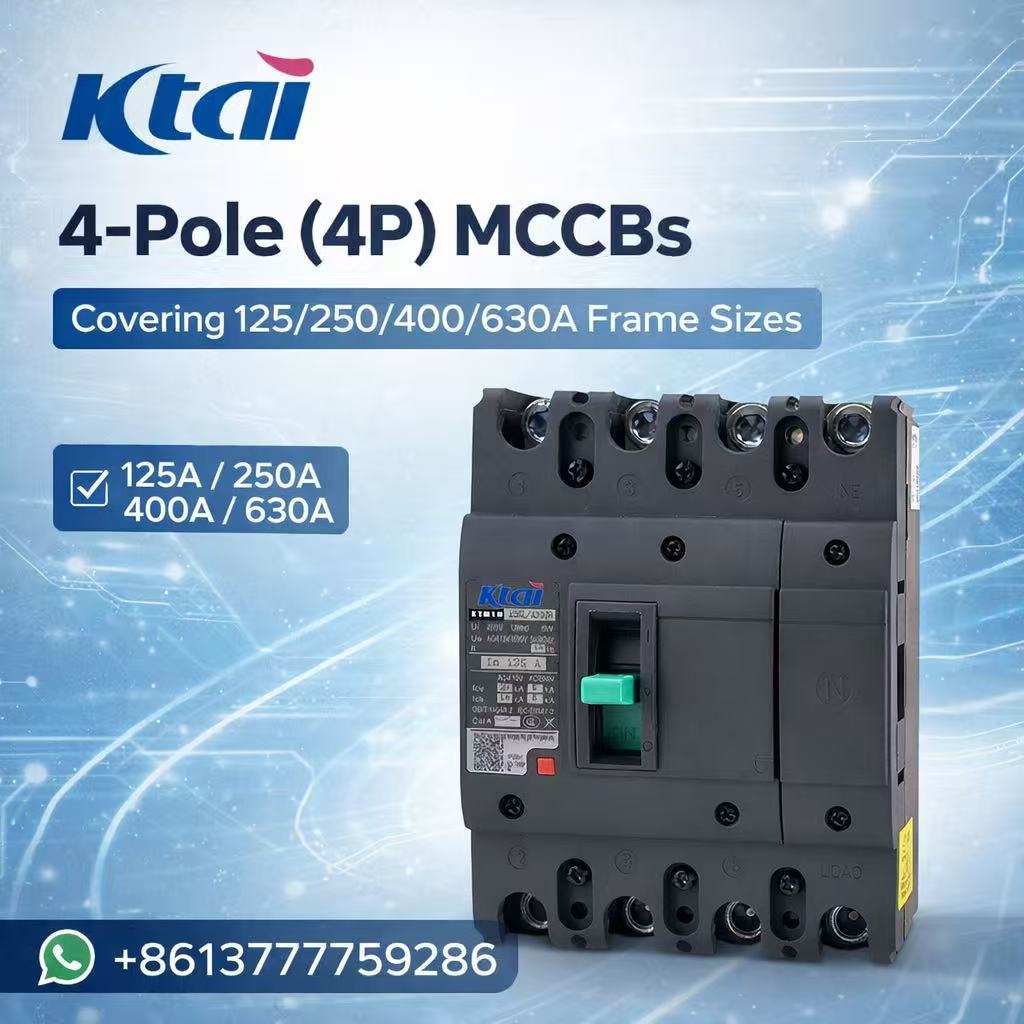
For industrial plants, commercial buildings, UPS installations, generator systems, and main distribution networks, 4-pole molded case circuit breakers (MCCBs) with 125A, 250A, 400A, and 630A frame sizes provide a flexible solution for different distribution levels.
This article explains how these different current ratings can be applied and what engineers should consider when selecting a suitable 4-pole MCCB.
What Is a 4-Pole MCCB?
A 4-pole MCCB is commonly used in three-phase, four-wire electrical distribution systems. In addition to switching the three phase conductors, the fourth pole switches the neutral conductor. This configuration can be useful when the electrical design requires the neutral to be disconnected together with the phase conductors.
An MCCB combines circuit switching with overcurrent protection. In a conventional thermal-magnetic configuration, two primary protection mechanisms are used:
-
Thermal protection responds to sustained overload conditions.
-
Magnetic protection reacts quickly to high short-circuit currents.
This combination allows the MCCB to protect downstream cables, equipment, and distribution circuits while also providing a convenient means of isolation.
However, choosing an MCCB should never be based on current rating alone. The breaker must be selected according to the complete electrical system.
Choosing the Appropriate Current Rating
A major advantage of a 4-pole MCCB range covering 125A to 630A is that different circuit levels can use breakers from the same product family.
Instead of applying an oversized breaker to every circuit, engineers can select a rating that corresponds more closely to the expected load and distribution architecture.
125A MCCB for Smaller Distribution Circuits
A 125A MCCB is generally suitable for lower-current branch and equipment distribution circuits. Typical applications include smaller production equipment, terminal distribution circuits, auxiliary equipment, and groups of relatively light electrical loads.
Using a correctly sized breaker can also help optimize distribution cabinet space when several outgoing circuits need to be installed within one panel.
The TGM1N-125L/4300B, for example, is a 4-pole 125A frame MCCB with rear-panel connection, providing a practical option for this type of distribution application.
250A MCCB for Area-Level Distribution
As the connected load increases, a 250A MCCB can be used for larger branch circuits or area distribution.
In an industrial facility, for example, one distribution section may supply several production machines, auxiliary systems, or building services. A 250A breaker can provide an intermediate protection level between smaller outgoing circuits and the main distribution equipment.
The TGM1N-250L/4300B provides a 4-pole configuration for three-phase, four-wire applications while maintaining the same general protection concept as the smaller frame size.
400A MCCB for Larger Equipment and Distribution Sections
A 400A MCCB becomes more relevant when the circuit supplies larger electrical loads. Potential applications include manufacturing equipment, centralized HVAC systems, UPS systems, larger auxiliary power circuits, and selected generator distribution circuits.
The TGM1N-400L/4300B provides a higher current rating while using the same fundamental thermal-magnetic protection principle.
At this stage of system design, engineers should pay particular attention to the available fault current. A breaker with an appropriate rated current may still be unsuitable if its short-circuit interruption capability does not meet the requirements of the installation.
630A MCCB for Main and Trunk Distribution
The 630A frame is intended for higher-current distribution applications, such as main incoming circuits, trunk lines, floor distribution systems, and larger industrial or commercial power sections.
The TGM1N-630L/4300B can be used where higher rated current and reliable fault interruption are required.
In a larger distribution architecture, a 630A MCCB may be installed between the upstream power source and downstream distribution panels, creating an important protection and isolation point within the system.
Rated Current and Breaking Capacity Must Be Considered Together
One of the most important principles in MCCB selection is that rated current and breaking capacity address different requirements.
The rated current determines the normal operating current the breaker is designed to carry, while breaking capacity indicates the level of fault current the breaker can safely interrupt under specified conditions.
For the standard L-type configuration described in the supplied specifications, the breaking capacity is in the range of 35–50 kA at AC 400V.
Before selecting the breaker, the engineering team should determine the prospective short-circuit current at the installation point and verify that the selected MCCB can safely interrupt that fault level.
A simplified selection process is:
-
Determine the expected operating load current.
-
Establish the prospective short-circuit current.
-
Select the appropriate MCCB current rating.
-
Verify the required breaking capacity.
-
Check coordination with upstream and downstream protection.
This approach helps prevent the common mistake of selecting a breaker solely because its ampere rating matches the load.
Installation Flexibility for Different Distribution Cabinets
Electrical cabinets do not all use the same internal layout. Equipment manufacturers may require different connection arrangements depending on panel construction, wiring direction, maintenance access, and installation space.
The 4-pole MCCB range supports multiple installation configurations, including vertical or horizontal installation, as well as front-panel, rear-panel, and plug-in connection options, depending on the product configuration.
This flexibility allows the breaker platform to be incorporated into different cabinet designs without changing the basic protection concept.
Additional design features can also improve practical operation. Low arcing distance can help reduce installation-space requirements, while supplied phase barriers can assist with conductor separation. A slip-resistant operating handle with position indication can also make daily operation and maintenance more convenient.
When Should Residual Current Protection Be Considered?
Standard thermal-magnetic protection is suitable for many distribution circuits, but some installations require residual current protection as an additional protective function.
The available leakage-protection configuration can support residual current settings such as 30mA, 100mA, 300mA, and 500mA, with instantaneous or delayed operation depending on the selected configuration.
The appropriate residual current setting should be determined according to the electrical system, grounding arrangement, connected loads, protection objectives, and applicable regulations.
For example, requirements for personnel protection may differ from those for equipment or fire protection. Coordination with other residual current devices is also important to reduce unnecessary tripping.
Accessories for Automated Electrical Systems
As electrical distribution systems become more intelligent, MCCBs are increasingly expected to interact with monitoring and control equipment.
Depending on the configuration, accessories can include:
-
Shunt trip devices for remote electrical tripping
-
Undervoltage releases for protection during abnormal voltage conditions
-
Auxiliary contacts for breaker status feedback
-
Alarm contacts for indicating specific trip conditions
-
Motor operators for electrically controlled opening and closing
These accessories can be valuable in industrial automation systems, generator installations, UPS applications, and centralized power monitoring systems.
For example, auxiliary contacts can transmit breaker status to a control system, while a shunt trip can allow a remote emergency or control signal to open the circuit.
Important Factors When Selecting a 4-Pole MCCB
For an engineering project, selecting the correct breaker should involve more than comparing product ampere ratings.
1. Rated Current
The breaker rating should correspond to the expected continuous load and the design requirements of the protected circuit.
2. Pole Configuration
Confirm whether the electrical system requires four-pole switching, particularly for three-phase, four-wire distribution.
3. Breaking Capacity
The breaker must have sufficient interruption capability for the prospective short-circuit current at its installation point.
4. Protection Function
Determine whether standard thermal-magnetic protection is sufficient or whether residual current protection is also required.
5. Connection Type
Consider whether the cabinet requires front, rear, or plug-in connection and whether vertical or horizontal installation is more suitable.
6. Optional Accessories
Remote tripping, undervoltage protection, status feedback, alarm indication, and motor operation may be required in automated systems.
7. Installation Environment
Temperature, humidity, enclosure conditions, installation space, and other site-specific factors should also be evaluated before final selection.
Why a Complete 125A–630A MCCB Range Is Useful
For equipment manufacturers and electrical system integrators, a scalable MCCB product family can simplify distribution system design.
Using a consistent product platform across 125A, 250A, 400A, and 630A applications can make it easier to develop different cabinet configurations while maintaining familiar operating and protection principles.
This is particularly useful for manufacturers serving multiple projects where electrical loads vary from smaller equipment circuits to main distribution systems.
Kaitai has focused on the research and development, production, sales, and service of intelligent distribution network automation equipment, intelligent electric meter boxes, power equipment, high- and low-voltage complete sets of equipment, and electrical instruments and meters since 1998. Its cooperation with domestic research institutions and universities also supports ongoing development in intelligent power equipment.
For customers handling different low-voltage distribution projects, a broad MCCB range can therefore provide greater flexibility during system design and equipment selection.
Conclusion
Selecting a 4-pole MCCB for a low-voltage distribution system requires a system-level approach. The 125A, 250A, 400A, and 630A frame sizes can address different levels of electrical distribution, from smaller branch circuits and equipment groups to larger incoming and trunk circuits.
However, current rating is only one part of the decision. Engineers should also evaluate breaking capacity, pole configuration, protection functions, connection method, installation orientation, accessories, residual current requirements, and actual site conditions.
For industrial plants, commercial buildings, UPS systems, generator sets, and other three-phase, four-wire distribution applications, a flexible range of 4-Pole (4P) MCCBs Covering 125/250/400/630A Frame Sizes can provide a practical foundation for building reliable and scalable low-voltage power distribution systems.
www.ktaielec.com
Zhejiang Kaitai