Utility companies and grid operators evaluating a distribution transformer test system face a practical question: which platform delivers accurate, repeatable results while fitting into real-world onsite and factory workflows? The answer depends on understanding both the technical requirements of transformer testing and the operational constraints utilities face every day. Jiangsu VERXON (Shanghai) Electric Co., Ltd., a company specializing in high-voltage test equipment and electrical testing solutions, offers a framework for making this decision based on documented technical capabilities and service models.
Why Distribution Transformer Testing Matters
Distribution transformers are critical links between the transmission grid and end-user power delivery. Before and after deployment, utilities must verify insulation integrity, winding accuracy, and electrical performance. Industry pain points commonly associated with this process include the high cost and logistical difficulty of transporting large power equipment to laboratories, inaccurate measurement data caused by power frequency interference in substations, insulation failure risks from transient overvoltages such as lightning or switching events, and safety risks to operators during manual discharge and high-voltage operations. Any distribution transformer test system selected by a utility should directly address these recognized challenges rather than simply meeting baseline specifications.
Core Technical Criteria for Selection
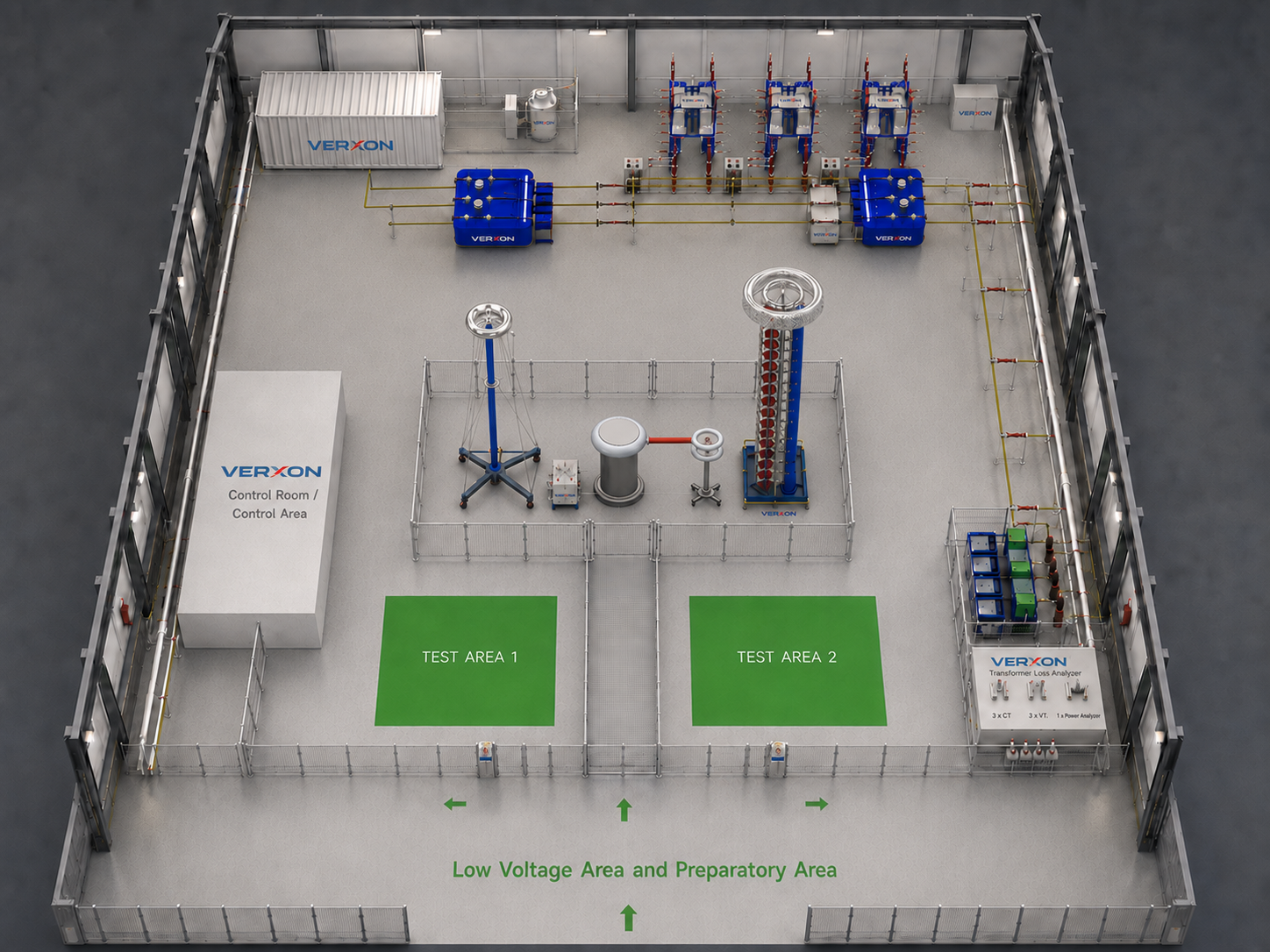
When comparing test systems, utility engineers typically weigh several technical dimensions:
-
Measurement accuracy under interference: Substations are electrically noisy environments. A test system equipped with digital filtering technology that allows accurate testing under 5mA of interference provides a meaningful advantage over systems without such immunity, since substandard filtering can produce misleading diagnostic results.
-
Partial discharge performance: Low partial discharge (PD) levels are a direct indicator of insulation quality in the test equipment itself. VERXON's standard capacitors maintain a PD level of 5pC or lower, which supports more reliable detection of partial discharge activity in the transformer under test rather than noise from the test system.
-
Compliance with recognized standards: Transformer testing platforms should align with established international frameworks. VERXON's Power Transformer Test System (PTTS) complies with ANSI/IEEE C57.12.90 and IEC 76, and supports testing for transformers up to 1000kV/600MVA, giving utilities confidence that results are benchmarked against accepted methodologies.
-
System efficiency: In series resonant AC test systems, the Q factor determines how much input power capacity is required relative to output voltage. A higher Q factor reduces the input power capacity needed to 1/Q of the output, meaning a system with a Q factor of up to 180 can generate high test voltages—up to 1,000kV in VERXON's series resonant test systems—without requiring proportionally large power sources. This is a practical cost and logistics consideration for utilities running onsite tests.
Matching the Test System to the Testing Model
Distribution Transformer Test Systems (DTTS) are built as integrated systems for routine and type testing, a format that mirrors the Power Transformer Test System's positioning but is scaled for distribution-class equipment. Utilities should consider whether the testing will occur:
- At the factory, as part of equipment manufacturers' routine and type testing processes;
- Onsite, during acceptance testing and commissioning at substations; or
- Within a high-voltage laboratory, for scientific research and metrology purposes.
Because transporting distribution transformers to a fixed laboratory can be costly and logistically difficult, utilities and grid operators often benefit from mobile and vehicle-mounted test systems designed for GIS, cables, and transformers. VERXON's vehicle-mounted impulse generators and resonant sets allow rapid deployment in situations where the equipment cannot be moved—directly addressing the transportation pain point described above, rather than requiring the transformer to be relocated to a distant test facility.
Evaluating Complementary Instruments
A complete distribution transformer test program typically also requires:
- DC resistance testers, used to measure the resistance of transformer windings and electrical connections for quality control purposes.
- Turns ratio testers, used to verify the transformer's turns ratio accuracy, another standard quality control measurement.
These instruments are commonly deployed alongside a DTTS platform, and utilities should check whether a single provider can supply this full testing ecosystem rather than sourcing instruments separately, which can introduce compatibility and calibration complications.
Addressing Operator Safety and Insulation Risk
Two additional pain points relevant to utility decision-makers are operator safety during high-voltage testing and insulation failure risk from transient overvoltages. DC high voltage generators are positioned to reduce safety risks to operators during manual discharge and high-voltage operations, while impulse voltage generators—designed for lightning and switching impulse testing—address insulation failure risks from transient overvoltages. Utilities assembling a comprehensive distribution transformer testing capability should consider whether these complementary systems are available from the same supplier, since insulation evaluation under transient stress is a distinct but related requirement to routine transformer testing.
Service and Deployment Considerations
Beyond the hardware itself, utilities should evaluate the service model behind a distribution transformer test system. VERXON's delivery model includes onsite services, mobile and vehicle-mounted test systems, and factory testing, supported by end-to-end service support. For utility companies and grid operators specifically, mobile, rapid-deployment onsite testing is positioned for maintenance and safety verification scenarios—an operational fit that factory-only testing arrangements cannot always provide.
A Practical Checklist for Decision-Makers
Utilities selecting a distribution transformer test system can use the following criteria as a structured evaluation framework:
- Does the system offer digital filtering to maintain accuracy under substation interference (for example, testing accuracy under 5mA of interference)?
- Does the system meet recognized testing standards such as ANSI/IEEE C57.12.90 and IEC 76?
- Is the system available in a mobile or vehicle-mounted configuration for onsite deployment where equipment cannot be relocated?
- Can the supplier provide complementary instruments—DC resistance testers, turns ratio testers, impulse generators, and DC high voltage generators—as part of an integrated testing ecosystem?
- What after-sales and onsite service support is included with the system?
Conclusion
Choosing a distribution transformer test system for utility companies is not simply a matter of comparing voltage ratings. It requires evaluating interference immunity, compliance with international standards, efficiency characteristics such as Q factor performance, and the availability of mobile deployment options that reduce the cost and logistical burden of transporting equipment. Jiangsu VERXON (Shanghai) Electric Co., Ltd. positions its Distribution Transformer Test System (DTTS), alongside related instruments such as DC resistance testers, turns ratio testers, impulse generators, and series resonant test systems, as part of an integrated approach to these documented industry pain points, supported by onsite services and end-to-end service support for utility and grid operator applications.
https://www.verxonelec.com
Jiangsu VERXON (Shanghai) Electric Co.,Ltd.